
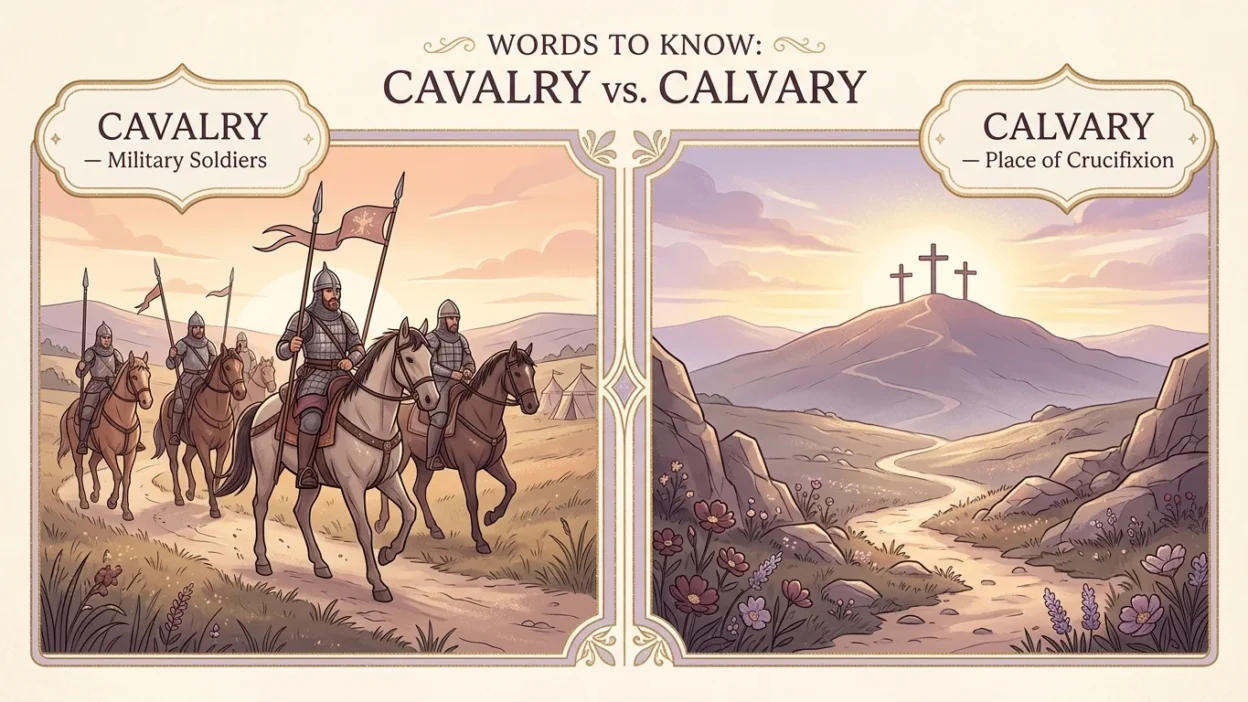
Have you ever written cavalry or calvary and wondered which word is correct? You’re not alone. These two words are easy to confuse because they look and sound very similar, but they have completely different meanings.
Cavalry refers to soldiers or military units historically associated with fighting on horseback, while calvary refers to the hill associated with the crucifixion of Jesus Christ. Understanding this small spelling difference can help you avoid an embarrassing mistake in everyday, religious, historical, and professional writing.
Quick Answer
The accepted English spellings are:
- Cavalry ✅ — soldiers or military units traditionally associated with horses.
- Calvary ✅ — the hill where Jesus was crucified; also used figuratively for a painful ordeal.
Both cavalry and calvary are real English words. The important difference is their meaning and spelling.
Quick Examples
- The cavalry arrived to support the soldiers.
- Christians traditionally identify Calvary as the place of Jesus’ crucifixion.
- The commander sent the cavalry across the field.
- The family described the difficult experience as their own calvary.
What Does Cavalry Mean?
Cavalry is a noun referring to soldiers or military units historically trained to fight while mounted on horseback.
Historically, cavalry played an important role in warfare because horses allowed soldiers to move quickly across battlefields.
For example:
- The cavalry charged across the battlefield.
- The general ordered the cavalry to advance.
- The army relied heavily on its cavalry.
- The cavalry arrived before the enemy could retreat.
Today, the word can still refer to military units called cavalry even when soldiers do not literally fight on horseback.
Cavalry in a Figurative Sense
In informal English, cavalry can also be used figuratively to describe people who arrive to provide help or support.
For example:
- Don’t worry—the cavalry is coming.
- We called in the cavalry to fix the problem.
- When the project became difficult, the technical team came in like the cavalry.
Here, the word suggests that reinforcements or rescuers are arriving.
What Does Calvary Mean?
Calvary is a proper noun traditionally referring to the hill outside Jerusalem where Jesus was crucified, according to Christian tradition.
The word is especially common in Christian religious writing.
Examples:
- The painting depicts Jesus on Calvary.
- The church discussed the significance of Calvary.
- The story describes Christ’s journey to Calvary.
Because Calvary is associated with the crucifixion, it is normally capitalized when referring specifically to the biblical place.
Calvary as a Figurative Word
Calvary can also be used figuratively to describe a period of intense suffering, hardship, or emotional pain.
For example:
- The illness became a long calvary for the family.
- She described the difficult years as her personal calvary.
- The survivors endured a terrible calvary.
In this figurative sense, the word does not necessarily refer directly to the biblical location. Instead, it evokes the idea of suffering.
Cavalry vs Calvary Comparison Table
| Feature | Cavalry | Calvary |
|---|---|---|
| Correct word? | ✅ Yes | ✅ Yes |
| Meaning | Mounted soldiers or military units | Place associated with Jesus’ crucifixion |
| Common context | Military, history, figurative support | Religion, Christianity, suffering |
| Part of speech | Noun | Proper noun or noun |
| Capitalization | Usually lowercase | Usually capitalized for the biblical place |
| Example | The cavalry advanced quickly. | Jesus was crucified at Calvary. |
Cavalry vs Calvary: The Main Difference
The easiest way to remember the difference is to focus on the meaning:
Cavalry = soldiers
Calvary = crucifixion
The extra a in cavalry helps distinguish it from calvary.
If you’re talking about military troops, horses, soldiers, or reinforcements, use cavalry.
If you’re talking about the Christian location associated with the crucifixion of Jesus, use Calvary.
Why Are Cavalry and Calvary Confused?
These words are commonly confused because their spellings differ by only one letter.
They are also pronounced very similarly in many varieties of English. In rapid speech, the difference can be difficult to notice.
This creates a common spelling problem: someone may know the correct word but still choose the wrong spelling when writing it.
The context usually makes the intended word clear.
For example:
- The cavalry arrived. → Military soldiers.
- He suffered a personal calvary. → A painful ordeal.
The meanings are completely different even though the words look and sound similar.
Common Mistakes People Make
Writers often make these mistakes:
- Writing calvary when referring to soldiers.
- Writing cavalry when referring to the biblical location.
- Confusing the words because of their similar pronunciation.
- Forgetting to capitalize Calvary when referring to the biblical place.
- Assuming the two words are different spellings of the same word.
Incorrect:
- ❌ The calvary arrived to help the troops.
Correct:
- ✅ The cavalry arrived to help the troops.
Incorrect:
- ❌ Jesus was crucified at cavalry.
Correct:
- ✅ Jesus was crucified at Calvary.
Simple Memory Trick
🐎 CAVALRY = CAVALRY has an “A” like “Army.”
✝️ CALVARY = CALVARY reminds you of Calvary and the crucifixion.
Another simple association is:
Cavalry → cavalry soldiers → military
Calvary → Christian tradition → crucifixion
When you remember the context, the spelling becomes much easier.
Cavalry in Historical Writing
The word cavalry is especially common when discussing military history.
For centuries, mounted soldiers were valued for their speed, mobility, and ability to maneuver across large areas.
Examples:
- The cavalry protected the army’s flank.
- The commander deployed the cavalry before dawn.
- Cavalry units were used for reconnaissance.
- The battle involved infantry, artillery, and cavalry.
Modern military organizations may still use the term cavalry even though horses are no longer their primary means of transportation.
Calvary in Religious Writing
Calvary appears frequently in Christian writing, sermons, hymns, books, and religious discussions.
It can refer specifically to the place associated with the crucifixion of Jesus.
Examples:
- The sermon focused on Christ’s sacrifice at Calvary.
- The church displayed an image of Calvary.
- The hymn refers to the cross at Calvary.
Because the word can also symbolize suffering and sacrifice, it sometimes appears in literary and figurative language.
Cavalry vs Calvary in Sentences
Examples with Cavalry
- The cavalry moved quickly across the battlefield.
- The commander called for cavalry reinforcements.
- The soldiers were protected by a nearby cavalry unit.
- The cavalry arrived just before sunset.
- The army used its cavalry for reconnaissance.
Examples with Calvary
- The church teaches about the sacrifice at Calvary.
- The painting shows Christ on Calvary.
- The story describes the journey toward Calvary.
- She described the experience as a personal calvary.
- The family endured a painful calvary together.
Cavalry, Calvary, and Cavalier
Another word that sometimes causes confusion is cavalier.
These words are related historically, but they do not mean the same thing.
- Cavalry = mounted soldiers or a military unit.
- Calvary = the biblical place associated with the crucifixion.
- Cavalier = historically, a mounted soldier or gentleman; today it can also describe someone who is dismissive or unconcerned.
For example:
- The cavalry entered the town.
- The church discussed Calvary.
- His cavalier attitude surprised everyone.
Pronunciation
Cavalry and Calvary are often pronounced very similarly, which is one reason people confuse them.
In many accents, both may sound approximately like KAL-vuh-ree, although pronunciation can vary by speaker and region.
Because pronunciation does not always clearly distinguish the words, remembering their meanings is more useful than relying on sound alone.
American vs British English
There is no major spelling difference between American and British English for these words.
Both varieties use:
- Cavalry for military units or mounted soldiers.
- Calvary for the biblical location and related figurative meanings.
The main challenge is not regional spelling. It is choosing the correct word according to context.
When Should You Use Cavalry?
Use cavalry when referring to:
- Mounted soldiers
- Military units
- Military history
- Horse-mounted troops
- Military reinforcements
- Figurative rescuers or helpers
Examples:
- The cavalry advanced toward the enemy.
- The cavalry was sent to reinforce the troops.
- Don’t worry—the cavalry is coming.
When Should You Use Calvary?
Use Calvary when referring to:
- The biblical location associated with Jesus’ crucifixion
- Christian religious writing
- The crucifixion of Jesus
- Figurative suffering or hardship
Examples:
- The story describes Jesus’ journey to Calvary.
- The church teaches about Christ’s sacrifice at Calvary.
- The difficult experience became a personal calvary.
Related Words and LSI Keywords
- cavalry meaning
- calvary meaning
- cavalry vs calvary
- cavalry definition
- calvary definition
- mounted soldiers
- military cavalry
- Christian symbolism
- crucifixion
- biblical Calvary
- commonly confused words
- English spelling
- spelling mistakes
- cavalry soldiers
- Calvary meaning
- cavalry pronunciation
- calvary pronunciation
- English vocabulary
- confusing English words
Tips for Remembering the Difference
Keep these simple points in mind:
- Cavalry relates to soldiers and military units.
- Calvary relates to the Christian crucifixion story.
- Cavalry contains an extra a.
- Calvary is usually capitalized when referring to the biblical place.
- Both words are correct, but they cannot normally be substituted for each other.
- When you hear the word spoken, use the surrounding context to determine which spelling is intended.
FAQs
Is cavalry or calvary correct?
Both are correct words, but they have different meanings. Cavalry refers to military units or mounted soldiers, while Calvary refers to the biblical place associated with Jesus’ crucifixion.
What is the difference between cavalry and Calvary?
Cavalry is a military term. Calvary is a religious term referring to the place associated with the crucifixion of Jesus.
Is Calvary always capitalized?
When Calvary refers specifically to the biblical place, it is normally capitalized. The word can also be used as a common noun in the figurative sense of a painful ordeal.
Does cavalry mean horses?
Historically, cavalry referred to soldiers who fought on horseback. Today, the term can refer more broadly to military units that retain the cavalry designation even when they do not use horses.
Is Calvary a place?
Yes. In Christian tradition, Calvary refers to the place associated with the crucifixion of Jesus, traditionally identified with Golgotha.
Are cavalry and Calvary homophones?
They are pronounced very similarly in many English accents and may function as homophones for many speakers. Exact pronunciation can vary by accent.
Can Calvary mean suffering?
Yes. Calvary can be used figuratively to describe a painful or difficult experience.
Why do people confuse cavalry and Calvary?
They are confused because their spellings differ by only one letter and their pronunciations are very similar. Their meanings, however, are distinct.
Is cavalry singular or plural?
Cavalry is generally treated as a collective noun referring to a military unit or body of soldiers. The exact grammar can vary depending on the variety of English and the sentence.
What is a cavalry soldier?
A cavalry soldier is a member of a cavalry unit. Historically, cavalry soldiers commonly fought while mounted on horses.
Summary
The difference between cavalry or calvary becomes simple once you connect each word with its meaning. Cavalry refers to soldiers or military units, especially those historically associated with horses. Calvary refers to the place traditionally associated with Jesus’ crucifixion and can also describe a painful ordeal figuratively.
Although these words look and sound similar, they should not be used interchangeably. Remember cavalry = military and Calvary = crucifixion, and you’ll have an easy way to choose the correct spelling whenever you write.

Rowan Blythecroft crafts atmospheric fiction filled with mystery and folklore.
Her stories often blur the line between reality and imagination.
She spends most of her days wandering forests and writing by candlelight.