Have you ever typed tittle when you actually meant title? You’re not alone. These two words look almost identical, and the extra t can easily slip into your writing. However, title and tittle are actually two different English words, so the correct choice depends on what you mean.
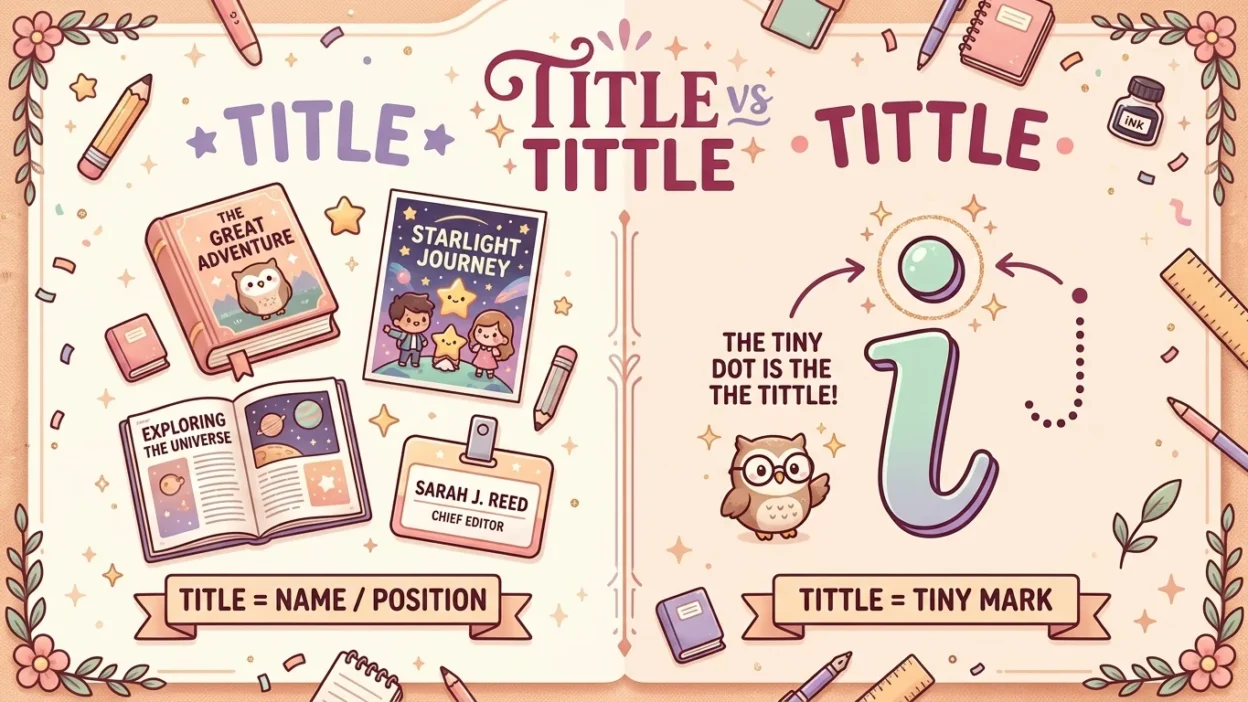
Title is the word you need when talking about the name of a book, article, movie, song, job position, or someone’s rank. Tittle is a real but much less common word that refers to a small mark or dot, especially the dot above a lowercase i or j.
In everyday writing, title is overwhelmingly the word most people are looking for.
Quick Answer
Here’s the simple difference:
- Title ✅ = the name of something, a position, rank, or heading.
- Tittle ✅ = a small mark or dot, especially the dot above i or j.
Examples:
- What is the title of this book? ✅
- She has the title of manager. ✅
- Don’t forget the tittle above the letter i. ✅
So if you’re talking about the name of a book, article, movie, or heading, use title, not tittle.
What Does Title Mean?
Title has several meanings, but one of its most common uses is to refer to the name given to a piece of writing, artwork, film, song, or other work.
Examples:
- The title of the book is Pride and Prejudice.
- What is the title of this article?
- I forgot the title of the movie.
- The song has an unusual title.
A title can also refer to a person’s position, rank, or honor.
Examples:
- Her title is Chief Executive Officer.
- He earned the title of champion.
- The job title is Marketing Manager.
- The king’s title was passed to his son.
It can also refer to legal ownership, especially of property or vehicles.
Example:
- The car’s title proves ownership.
What Does Tittle Mean?
Tittle is a real English word, but it is much less common than title.
A tittle is a small mark, dot, or stroke. The most familiar example is the dot above the lowercase letters i and j.
For example:
- The dot above the i is called a tittle.
- Make sure every i has its tittle.
- The handwritten letter had a tiny tittle.
The word can also be used more generally for a very small mark or detail.
Because tittle is uncommon, many people encounter it only in discussions about writing, typography, or language.
Title vs Tittle Comparison Table
| Word | Correct? | Meaning | Example |
|---|---|---|---|
| Title | ✅ Yes | Name, heading, rank, position, or ownership document | What is the title of the book? |
| Tittle | ✅ Yes | A small mark or dot, especially above i or j | The tittle is missing from the letter i. |
Unlike many spelling pairs, both words are real. They simply have completely different meanings.
Title in Sentences
Use title when referring to the name of something.
Examples:
- The book’s title is easy to remember.
- I changed the title of my article.
- What’s the title of that song?
- The movie has a strange title.
- Please write the title at the top of the page.
Use title for headings as well:
- The main title appears at the top.
- Add a descriptive title to the report.
- The article’s title contains the main keyword.
Title for Jobs and Positions
Title can also describe someone’s official job position.
Examples:
- Her job title is Content Manager.
- What is your official title?
- He recently received a new title at the company.
- The company created a new job title.
Common job titles include:
- Manager
- Director
- Editor
- Teacher
- Engineer
- Consultant
- Accountant
In each case, title is the correct spelling.
Title for Books, Movies, and Songs
One of the most common uses of title is the name of a creative work.
Examples:
- The title of the novel is Jane Eyre.
- I can’t remember the title of that movie.
- What’s the title of your favorite song?
- The author chose a powerful title for the book.
- The film’s title was changed before release.
Do not use tittle in these contexts.
Incorrect:
- ❌ What is the tittle of the book?
Correct:
- ✅ What is the title of the book?
Title in Articles and Websites
If you write blog posts, articles, or website content, title is the correct word.
Examples:
- Create an engaging article title.
- The title should describe the topic clearly.
- I changed the blog post title.
- The page title includes the target keyword.
- The article’s title attracted more readers.
For SEO writing, you will frequently see terms such as:
- SEO title
- Page title
- Article title
- Blog title
- Meta title
- Title tag
- Main title
All of these use title, not tittle.
Tittle in Writing and Typography
Although tittle is uncommon, it has a specific use in writing and typography.
The small dot above a lowercase i or j is called a tittle.
For example:
i
The small dot above the letter is its tittle.
Similarly:
j
The dot above the j is also a tittle.
This word can be useful when discussing:
- Typography
- Handwriting
- Calligraphy
- Letterforms
- Fonts
- Linguistics
- Writing systems
Example:
- The font has a distinctive tittle on the lowercase i.
Why Do People Confuse Title and Tittle?
The confusion is understandable because the two words differ by only one letter.
Compare:
Title
Tittle
The extra t in tittle makes it easy to accidentally use the wrong spelling.
The problem becomes especially common when typing quickly.
For example, someone may write:
- ❌ Article tittle
- ❌ Book tittle
- ❌ Job tittle
when they actually mean:
- ✅ Article title
- ✅ Book title
- ✅ Job title
The easiest solution is to remember their meanings rather than simply memorizing the spelling.
Common Mistakes People Make
Mistake 1: Writing Tittle for a Book Name
Incorrect:
- ❌ What is the tittle of this book?
Correct:
- ✅ What is the title of this book?
A book’s name is its title.
Mistake 2: Writing Tittle for an Article
Incorrect:
- ❌ I need a catchy article tittle.
Correct:
- ✅ I need a catchy article title.
Mistake 3: Writing Tittle for a Job Position
Incorrect:
- ❌ What is your job tittle?
Correct:
- ✅ What is your job title?
Mistake 4: Assuming Tittle Is Always Wrong
This is also incorrect.
Tittle is a real English word.
For example:
- The tittle above the lowercase i is clearly visible.
So the rule isn’t simply:
Title = correct, tittle = incorrect.
The real rule is:
Title = name, heading, rank, or position
Tittle = small mark or dot
Title vs Tittle in Examples
Compare these sentences:
Title
- The book’s title is memorable.
- What is the title of the movie?
- Her job title is editor.
- The article needs a better title.
- The king received an official title.
Tittle
- The tittle above the i is very small.
- The handwritten i has a noticeable tittle.
- The font has a decorative tittle.
- The tittle was accidentally omitted.
The context makes the difference clear.
Title vs Heading
A title and a heading can sometimes overlap in meaning, but they aren’t always identical.
A title commonly identifies an entire work.
Example:
- The title of the article is How to Improve Your Writing.
A heading usually identifies a section within a document.
Example:
- The article contains several headings.
You might therefore have:
Article title
followed by:
Introduction
Main Benefits
Common Mistakes
Those section names are headings.
Title vs Name
Title can also mean the name of a work.
Examples:
- The title of the movie
- The title of the book
- The title of the song
- The title of the article
However, for people and ordinary objects, name is usually more natural.
For example:
- My name is Sarah.
- The dog’s name is Max.
You wouldn’t normally call someone’s personal name their title unless you’re referring to a rank, honorific, or position.
Title as a Rank or Honor
Title can also refer to a rank, honor, or distinction.
Examples:
- She won the championship title.
- He defended his world title.
- The player earned the title of champion.
- She holds the title of professor.
This use is completely different from tittle.
Title as Legal Ownership
In legal and administrative contexts, title can refer to a document or legal right showing ownership of property.
Examples:
- The vehicle’s title was transferred to the new owner.
- The buyer received the property title.
- The company holds title to the land.
Again, tittle would be incorrect in these contexts.
Title in SEO Writing
If you’re writing online content, title is especially important.
You may encounter:
- SEO title
- Page title
- Article title
- Blog title
- Title tag
- Meta title
- Headline
For example:
- Write a compelling SEO title.
- Keep the page title relevant to the content.
- Include the main keyword naturally in the title.
Using tittle instead would be a spelling mistake in these contexts.
Is Tittle a Common Word?
No. Tittle is a legitimate English word, but it is relatively uncommon.
Most people use title much more frequently.
You are likely to encounter tittle when reading about:
- Typography
- Linguistics
- Calligraphy
- Fonts
- Handwriting
- Letter design
In ordinary conversation, title is far more common.
How to Remember Title vs Tittle
A useful way to remember the difference is to connect each word to its meaning.
TITLE → name
Think:
- Book title
- Movie title
- Article title
- Job title
TITTLE → tiny mark
Think of the tiny dot above:
i
The small dot is a tittle.
So:
Title = important name
Tittle = tiny mark
Easy Memory Trick
💡 Memory Trick
TITLE = a name or position
TITTLE = a tiny mark
Think:
Title → book, movie, article, job
Tittle → tiny dot on i or j
The extra T in tittle can remind you of a tiny mark.
Title or Tittle: Quick Examples
| Situation | Correct Word | Example |
|---|---|---|
| Name of a book | Title | The book’s title is interesting. |
| Name of a movie | Title | I forgot the movie’s title. |
| Name of an article | Title | The article needs a better title. |
| Job position | Title | Her job title is editor. |
| Championship | Title | He won the league title. |
| Dot above “i” | Tittle | The tittle is missing. |
| Dot above “j” | Tittle | The tittle is clearly visible. |
| Small mark | Tittle | The font has a decorative tittle. |
American vs British English
There is no significant spelling difference between American and British English for title and tittle.
Both varieties use:
- Title for a name, position, rank, or heading.
- Tittle for a small mark or dot, especially above i or j.
So whether you’re writing for an American or British audience, the same distinction applies.
Related Words and LSI Keywords
- title or tittle
- title vs tittle
- tittle meaning
- title meaning
- what is a tittle
- what is a title
- title spelling
- tittle spelling
- book title
- article title
- movie title
- job title
- title tag
- SEO title
- page title
- tittle above i
- tittle above j
- dot above i
- dot above j
- typography terms
- English spelling
- English grammar
- commonly confused words
- spelling mistakes
- correct English usage
- English language learning
- vocabulary guide
- writing correctly
Tips for Remembering the Difference
- Title is the usual word when talking about names or positions.
- A book has a title.
- A movie has a title.
- An article has a title.
- A person can have a job title.
- A champion can hold a title.
- A lowercase i has a tittle.
- A lowercase j can have a tittle.
- Tittle is a real word, but it is much less common.
- Think title = name and tittle = tiny mark.
- Don’t automatically assume tittle is a misspelling; check the context.
FAQs
Is title or tittle correct?
Both title and tittle are correct English words, but they have different meanings. Title refers to a name, heading, rank, position, or ownership document. Tittle refers to a small mark or dot, especially the dot above i or j.
What is the difference between title and tittle?
Title means the name of something or a position or rank. Tittle means a small mark or dot, especially above a lowercase i or j.
Is tittle a real word?
Yes. Tittle is a real English word. It refers to a small mark or dot, especially the dot above i and j.
What is a tittle?
A tittle is a small distinguishing mark or dot. The most familiar example is the dot above the lowercase letters i and j.
What is the title of a book?
The title is the name of the book.
For example:
- Pride and Prejudice is the title of Jane Austen’s novel.
Is “book tittle” correct?
No, if you’re referring to the name of a book.
The correct phrase is:
- book title
Is “article tittle” correct?
No. If you mean the name or heading of an article, use:
- article title
Is “job tittle” correct?
No, if you’re referring to someone’s professional position.
The correct phrase is:
- job title
What is the dot above the letter i called?
The dot above a lowercase i is called a tittle.
What is the dot above j called?
The dot above a lowercase j is also called a tittle.
Is tittle the same as title?
No. They are different words with different meanings.
Title = name, heading, rank, or position.
Tittle = small mark or dot.
Why do people write tittle instead of title?
The words look very similar, and people may accidentally add an extra t when typing. This is especially common when writing phrases such as book title, article title, or job title.
Is title used in American and British English?
Yes. Title is standard in both American and British English.
Is tittle used in American and British English?
Yes. Tittle is an English word in both varieties, although it is relatively uncommon.
Is “title” a noun?
Yes. Title is commonly used as a noun. It can refer to a name, heading, rank, position, championship, or legal ownership.
Can title be used as a verb?
Yes. Title can also be used as a verb meaning to give something a title.
Example:
- The author titled the book The Last Journey.
What is the easiest way to remember title vs tittle?
Remember:
Title = name or position
Tittle = tiny mark
If you’re talking about a book, movie, article, job, or championship, you almost certainly need title.
Summary
The difference between title or tittle becomes simple once you focus on meaning rather than spelling. Title is the common word used for the name of a book, movie, article, song, or other work. It can also refer to a job position, rank, championship, heading, or legal ownership. For most everyday writing, title is the word you’ll need.
Tittle, however, is not simply a misspelling of title. It is a real but uncommon word that refers to a small mark or dot, especially the dot above a lowercase i or j. So remember the easy distinction: title = name or position, tittle = tiny mark. Once you connect each spelling with its meaning, you’ll know exactly which word to use.

Rowan Blythecroft crafts atmospheric fiction filled with mystery and folklore.
Her stories often blur the line between reality and imagination.
She spends most of her days wandering forests and writing by candlelight.