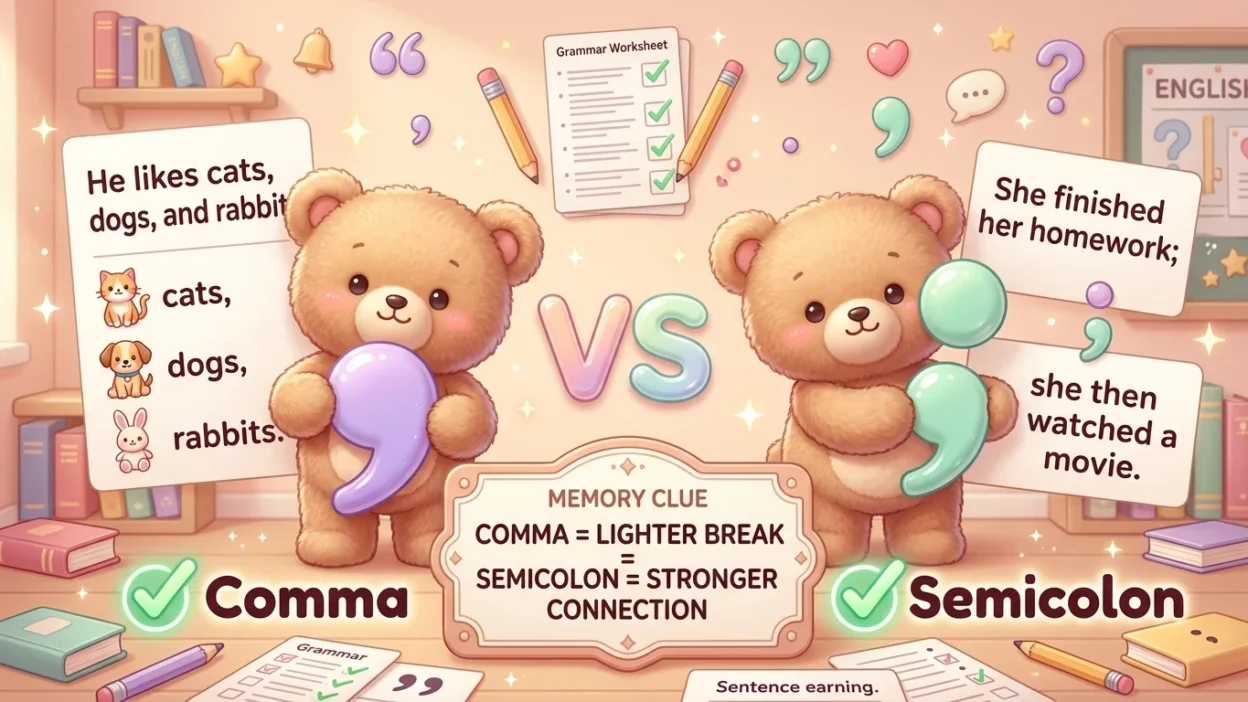
Have you ever wondered about the difference between a comma vs semicolon? Both punctuation marks help organize your writing, but they do different jobs. A comma (,) usually creates a short separation between words, phrases, or clauses, while a semicolon (;) creates a stronger connection between closely related complete thoughts.
Understanding comma vs semicolon can make your writing clearer, smoother, and easier to understand. In this complete guide, you’ll learn what each punctuation mark means, when to use it, common mistakes, examples, and simple ways to remember the difference.
Quick Answer
The basic difference is simple:
- Comma (,) = separates parts of a sentence or items in a list.
- Semicolon (;) = connects closely related independent clauses or separates complex list items.
Examples:
- I bought apples, oranges, and bananas. ✅
- I was tired; I went to bed. ✅
- I was tired, I went to bed. ❌
A quick way to remember it is:
Comma = shorter break
Semicolon = stronger connection
What Is a Comma?
A comma (,) is a punctuation mark that separates different parts of a sentence. Writers use commas to make sentences easier to read and to show relationships between words, phrases, and clauses.
Examples:
- After school, I went home.
- She bought apples, oranges, and bananas.
- Yes, I understand.
- My brother, who lives nearby, visited yesterday.
A comma usually creates a smaller pause than a semicolon.
What Is a Semicolon?
A semicolon (;) is a punctuation mark that creates a stronger separation than a comma but a closer connection than a period.
One of its most common uses involves connecting two closely related independent clauses.
Examples:
- I was hungry; I made a sandwich.
- She loves reading; her brother prefers movies.
- The weather was terrible; we stayed home.
Each side of the semicolon can stand as a complete sentence.
For example:
- I was hungry.
- I made a sandwich.
Because both thoughts are complete and closely related, a semicolon can connect them.
Comma vs Semicolon Comparison Table
| Feature | Comma (,) | Semicolon (;) |
|---|---|---|
| Main purpose | Separates parts of a sentence | Connects closely related complete thoughts |
| Strength | Lighter separation | Stronger separation |
| Simple lists | Yes | Usually no |
| Two independent clauses | Not by itself | Yes |
| Complex lists | Sometimes | Yes |
| Example | I bought apples, oranges, and pears. | I was tired; I went home. |
When Should You Use a Comma?
There are several common situations where you should use a comma.
Comma in a List
Use commas to separate three or more items in a simple list.
Examples:
- I bought bread, milk, eggs, and cheese.
- She likes reading, writing, painting, and dancing.
- We packed clothes, shoes, books, and snacks.
The commas make each item easier to identify.
Comma After an Introductory Phrase
Use a comma after many introductory words, phrases, and clauses.
Examples:
- After dinner, we watched a movie.
- In the morning, she went for a walk.
- Fortunately, nobody was injured.
- When the rain stopped, we went outside.
Comma With a Coordinating Conjunction
A comma can join two independent clauses when you use a coordinating conjunction such as and, but, or, so, yet, for, or nor.
Examples:
- I was tired, so I went home.
- She wanted to stay, but he wanted to leave.
- We could walk, or we could take the bus.
- He studied hard, yet he remained nervous.
These conjunctions help connect the two complete thoughts.
Comma With Nonessential Information
Commas can separate information that is not essential to the basic meaning of a sentence.
Example:
- My sister, who lives in London, is visiting us.
The phrase who lives in London adds information, but the sentence still works without it:
- My sister is visiting us.
When Should You Use a Semicolon?
A semicolon has fewer uses than a comma, but its main purposes are important.
Semicolon Between Independent Clauses
Use a semicolon to connect two closely related independent clauses.
Examples:
- I finished my work; I went home.
- She was tired; she continued studying.
- The restaurant was full; we went somewhere else.
Both sides contain complete thoughts.
Semicolon With Conjunctive Adverbs
You can use a semicolon before a conjunctive adverb when it connects two independent clauses.
Common conjunctive adverbs include:
- however
- therefore
- moreover
- nevertheless
- consequently
- instead
- meanwhile
Examples:
- I wanted to go; however, I was too tired.
- She studied hard; therefore, she passed the exam.
- The road was closed; consequently, we took another route.
- He was exhausted; nevertheless, he continued working.
Notice the pattern:
Independent clause; conjunctive adverb, independent clause.
Semicolon in Complex Lists
Semicolons can separate items in a list when those items already contain commas.
Example:
- We visited Lahore, Pakistan; London, England; and Paris, France.
The semicolons separate the major items, while the commas separate the city and country.
Without semicolons, the sentence could become confusing.
Comma Splice vs Semicolon
A comma splice happens when a writer joins two independent clauses using only a comma.
Incorrect:
- ❌ I was tired, I went to bed.
Comma vs Semicolon Examples
Here are some simple comparisons:
Example 1
- Comma: I bought apples, oranges, and bananas.
- Semicolon: I was hungry; I made a sandwich.
The comma separates items in a list. The semicolon connects two complete thoughts.
Example 2
- Comma: After work, I went home.
- Semicolon: I finished work; I went home.
The first comma follows an introductory phrase. The semicolon connects two independent clauses.
Example 3
- Comma: She was tired, but she continued working.
- Semicolon: She was tired; she continued working.
Both sentences connect related ideas, but the first uses a coordinating conjunction while the second uses a semicolon.
Can a Comma and Semicolon Be Used Together?
Yes, they can appear in the same sentence when they serve different purposes.
Example:
- I wanted to visit Paris, France; Rome, Italy; and Madrid, Spain.
Here, the commas separate the city and country, while the semicolons separate the larger list items.
Another example:
- I wanted to leave; however, the weather was getting worse.
The semicolon connects the independent clauses, while the comma follows however.
Comma vs Semicolon vs Colon
It is also helpful to understand the difference between these three punctuation marks.
Comma
A comma usually provides a lighter separation.
Example:
- I bought apples, oranges, and bananas.
Semicolon
A semicolon provides a stronger connection between closely related complete thoughts.
Example:
- I was hungry; I made lunch.
Colon
A colon usually introduces a list, explanation, example, or result.
Example:
- I bought three things: apples, oranges, and bananas.
A simple memory guide is:
Comma = separate
Semicolon = connect
Colon = introduce
Common Mistakes With Commas and Semicolons
Mistake 1: Using a Comma to Join Complete Sentences
Incorrect:
- ❌ She was tired, she went to bed.
Correct:
- ✅ She was tired; she went to bed.
- ✅ She was tired. She went to bed.
- ✅ She was tired, so she went to bed.
Mistake 2: Using a Semicolon in a Simple List
Incorrect:
- ❌ I bought apples; oranges; and bananas.
Correct:
- ✅ I bought apples, oranges, and bananas.
Use commas for ordinary lists.
Mistake 3: Using a Semicolon Before a Dependent Clause
Incorrect:
- ❌ I went home; because I was tired.
Correct:
- ✅ I went home because I was tired.
A dependent clause cannot normally stand alone as a complete sentence.
Mistake 4: Forgetting the Comma After “However”
Incorrect:
- ❌ I wanted to leave; however I stayed.
Correct:
- ✅ I wanted to leave; however, I stayed.
When however functions as a conjunctive adverb between independent clauses, a semicolon normally comes before it and a comma follows it.
What Is an Independent Clause?
An independent clause contains a subject and a verb and expresses a complete thought.
Examples:
- She smiled.
- I went home.
- They finished the project.
- The movie was excellent.
You can connect two closely related independent clauses with a semicolon.
Example:
- She smiled; I felt relieved.
Both sides can stand alone:
- She smiled.
- I felt relieved.
What Is a Dependent Clause?
A dependent clause contains a subject and verb but does not express a complete thought by itself.
Examples:
- because I was tired
- when the rain stopped
- although she was nervous
- if you have time
You normally should not use a semicolon to separate a dependent clause from the independent clause it belongs to.
Incorrect:
- ❌ I went home; because I was tired.
Correct:
- ✅ I went home because I was tired.
Simple Memory Trick
💡 Memory Trick
COMMA (,) = SHORTER BREAK
Think of a comma as a small pause inside a sentence.
SEMICOLON (;) = STRONGER CONNECTION
Think of a semicolon as a bridge between two closely related complete thoughts.
Remember:
Comma = separate
Semicolon = connect
If both sides can stand as complete sentences, a semicolon may be appropriate.
How to Choose Between a Comma and Semicolon
When you’re unsure, look at the structure of your sentence.
Step 1: Are You Separating Simple Items?
Use a comma.
Example:
- I bought apples, bananas, and grapes.
Step 2: Are You Connecting Two Complete Thoughts?
A semicolon may work.
Example:
- I was tired; I went home.
Step 3: Are You Using “And,” “But,” or “So”?
If you have two independent clauses connected by a coordinating conjunction, use a comma before the conjunction.
Example:
- I was tired, so I went home.
Step 4: Are Your List Items Already Complicated?
Use semicolons to separate the larger items.
Example:
- We visited Lahore, Pakistan; Dubai, UAE; and Istanbul, Turkey.
Comma vs Semicolon in Formal Writing
Both punctuation marks are important in formal writing.
Commas can help organize longer sentences and prevent confusion.
Example:
- After reviewing the report, the manager approved the proposal.
Semicolons can help connect related ideas without making the writing feel choppy.
Example:
- The report was detailed; the recommendations were practical.
However, you should not use semicolons simply because they look more formal. Use them when the sentence structure requires or benefits from them.
American vs British English
The basic rules for commas and semicolons are very similar in American and British English.
Both varieties use commas to separate sentence elements and list items. Both also use semicolons to connect related independent clauses and organize complex lists.
Some style preferences can differ, particularly regarding the Oxford comma.
For example:
- I bought apples, oranges, and bananas.
Some style guides prefer the final comma, while others may omit it. However, the fundamental rules for using semicolons remain largely consistent.
When Should You Use a Comma?
Use a comma when:
- Separating items in a simple list.
- Following an introductory phrase or clause.
- Setting off nonessential information.
- Separating certain coordinate adjectives.
- Connecting independent clauses with coordinating conjunctions.
- Improving clarity within a sentence.
Examples:
- After lunch, we went outside.
- I bought milk, bread, and eggs.
- She was tired, but she continued working.
- My brother, who lives nearby, called me.
When Should You Use a Semicolon?
Use a semicolon when:
- Connecting two closely related independent clauses.
- Connecting independent clauses with conjunctive adverbs.
- Separating complex items in a list.
Examples:
- I was tired; I went home.
- She wanted to leave; however, she stayed.
- We visited Lahore, Pakistan; London, England; and Paris, France.
Related Words and LSI Keywords
- comma vs semicolon
- comma or semicolon
- semicolon vs comma
- comma meaning
- semicolon meaning
- comma rules
- semicolon rules
- when to use a comma
- when to use a semicolon
- comma examples
- semicolon examples
- comma splice
- independent clause
- dependent clause
- punctuation rules
- punctuation marks
- Oxford comma
- semicolon grammar
- comma grammar
- English punctuation
- English grammar
- common punctuation mistakes
- commonly confused punctuation
- writing correctly
- correct punctuation
- grammar guide
- English learning
Tips for Remembering the Difference
- Comma (,) = lighter separation.
- Semicolon (;) = stronger connection.
- Use commas for simple lists.
- Use semicolons to connect closely related independent clauses.
- Don’t use a comma alone to join two independent clauses.
- Use a comma before a coordinating conjunction when joining two independent clauses.
- Use semicolons to separate complex list items that already contain commas.
- Use a semicolon before a conjunctive adverb such as however or therefore when it connects independent clauses.
- Remember: comma = separate; semicolon = connect.
Frequently Asked Questions
What is the difference between a comma and a semicolon?
A comma creates a lighter separation between parts of a sentence, while a semicolon creates a stronger connection between closely related independent clauses or separates complex list items.
When should I use a comma?
Use a comma for simple lists, introductory phrases, nonessential information, and independent clauses connected by coordinating conjunctions.
When should I use a semicolon?
Use a semicolon to connect two closely related independent clauses or to separate complex list items that already contain commas.
Can a comma join two complete sentences?
Not by itself. Using a comma alone between two independent clauses creates a comma splice.
Incorrect:
- ❌ I was tired, I went home.
Correct:
- ✅ I was tired; I went home.
- ✅ I was tired. I went home.
- ✅ I was tired, so I went home.
Can a semicolon join two independent clauses?
Yes. A semicolon can connect two closely related independent clauses.
Example:
- I finished my work; I went home.
Is a semicolon stronger than a comma?
Yes. A semicolon creates a stronger separation than a comma while still showing a close relationship between the ideas.
Can I use a semicolon instead of a comma?
Not always. A semicolon has specific grammatical uses and should not replace every comma.
Should I use a comma or semicolon before “however”?
When however connects two independent clauses, use a semicolon before however and a comma after it.
Example:
- I wanted to go; however, I was too tired.
Can a semicolon separate items in a list?
Yes. Semicolons work especially well when the individual list items already contain commas.
Example:
- We visited Lahore, Pakistan; London, England; and Paris, France.
What is a comma splice?
A comma splice occurs when a comma incorrectly joins two independent clauses without a coordinating conjunction.
Example:
- ❌ I was hungry, I made dinner.
Can you use a semicolon before “and”?
Usually, no. When and directly connects two independent clauses, a comma is normally used.
Example:
- ✅ I was tired, and I went home.
Do you put a comma after a semicolon?
Usually, no. However, when a conjunctive adverb follows the semicolon, a comma generally follows the adverb.
Example:
- I was tired; however, I continued working.
What is the Oxford comma?
The Oxford comma, also called the serial comma, is the comma placed before the final and or or in a list of three or more items.
Example:
- I bought apples, oranges, and bananas.
Are comma and semicolon rules the same in American and British English?
The basic rules are very similar in both varieties of English, although some style preferences can differ.
How do I remember comma vs semicolon?
Remember comma = lighter separation and semicolon = stronger connection. Use a comma for simple lists and sentence elements, while a semicolon can connect two closely related complete thoughts.
Summary
The difference between comma vs semicolon becomes much easier when you understand the strength of each punctuation mark. A comma (,) usually creates a lighter separation between words, phrases, clauses, or list items. A semicolon (;) creates a stronger connection and can join two closely related independent clauses or separate complex list items.
Think of a comma as a short break and a semicolon as a bridge between related complete thoughts. For example, you can write, “I bought apples, oranges, and bananas,” but you can write, “I was tired; I went home.” Once you understand what each punctuation mark does, choosing between a comma and semicolon becomes much easier.

Cedric Halewood is known for his intricate historical narratives.
His work reflects a deep fascination with lost civilizations.
He lives near the coast, where he finds inspiration in the sea.