
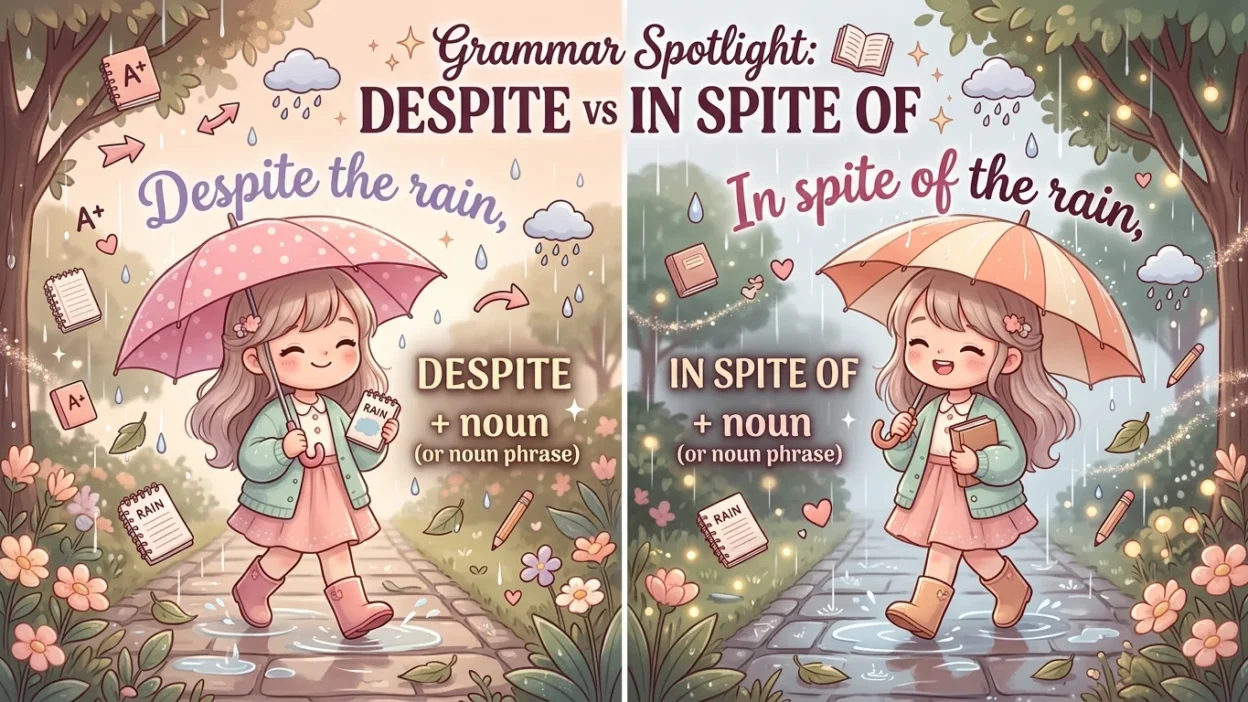
Have you ever wondered whether you should use despite or in spite in a sentence? You’re not alone. These two expressions often confuse English learners because they have almost exactly the same meaning and are used in very similar situations.
The good news is that despite and in spite of are both correct. They are used to introduce a contrast, showing that something happened even though there was a reason it might not have happened. The main difference is grammatical: despite is written as one word, while in spite is written as three words and normally requires of.
In this guide, you’ll learn the difference between despite and in spite of, how to use each correctly, common mistakes, sentence examples, and an easy way to remember the rule.
Quick Answer
Both despite and in spite of are correct.
- Despite ✅ = followed by a noun, pronoun, or -ing form.
- In spite of ✅ = followed by a noun, pronoun, or -ing form.
- In spite ❌ = normally incomplete when used in this structure.
Examples:
- Despite the rain, we went outside.
- In spite of the rain, we went outside.
- Despite being tired, she continued working.
- In spite of being tired, she continued working.
The two expressions have essentially the same meaning.
What Does Despite Mean?
Despite is a preposition used to show contrast.
It means that something happened even though there was an opposing condition or difficulty.
For example:
- Despite the rain, we went for a walk.
- Despite being tired, he continued working.
- Despite the difficulty, she finished the project.
In each sentence, the second idea happened even though the first idea might have prevented it.
Think of despite as meaning:
“Even though this was true, that still happened.”
What Does In Spite Of Mean?
In spite of has the same basic meaning as despite.
Examples:
- In spite of the rain, we went for a walk.
- In spite of being tired, he continued working.
- In spite of the difficulty, she finished the project.
You can generally replace despite with in spite of without changing the meaning.
For example:
- Despite the rain, we went outside.
- In spite of the rain, we went outside.
Both sentences are correct.
Despite vs In Spite Of Comparison Table
| Expression | Correct? | Meaning | Example |
|---|---|---|---|
| Despite | ✅ Yes | Shows contrast | Despite the rain, we left. |
| In spite of | ✅ Yes | Shows contrast | In spite of the rain, we left. |
| In spite | ❌ Usually incomplete | Normally needs of | ❌ In spite the rain |
The most important thing to remember is:
Despite + noun
In spite of + noun
Despite vs In Spite Of: Main Difference
The main difference is grammatical rather than semantic.
Despite is a single-word preposition.
In spite of is a three-word prepositional expression.
Both can be followed by:
- A noun
- A pronoun
- A gerund or -ing form
Examples:
Despite the traffic, we arrived on time.
In spite of the traffic, we arrived on time.
The meaning remains the same.
Despite With Nouns
Use despite before a noun or noun phrase.
Examples:
- Despite the rain, they played outside.
- Despite the traffic, we arrived early.
- Despite his illness, he went to work.
- Despite the high price, people bought the product.
- Despite the difficulty, she succeeded.
The structure is:
Despite + noun/noun phrase
For example:
Despite the weather
Despite the problem
Despite the delay
In Spite Of With Nouns
Use in spite of before a noun or noun phrase.
Examples:
- In spite of the rain, they played outside.
- In spite of the traffic, we arrived early.
- In spite of his illness, he went to work.
- In spite of the high price, people bought the product.
- In spite of the difficulty, she succeeded.
The structure is:
In spite of + noun/noun phrase
Despite With -Ing
You can use despite before a gerund, which is a verb ending in -ing that functions as a noun.
Examples:
- Despite feeling tired, she kept working.
- Despite having little money, they traveled.
- Despite knowing the risks, he continued.
- Despite working hard, she didn’t get the promotion.
- Despite being nervous, he gave the speech.
The structure is:
Despite + -ing
In Spite Of With -Ing
You can also use in spite of before an -ing form.
Examples:
- In spite of feeling tired, she kept working.
- In spite of having little money, they traveled.
- In spite of knowing the risks, he continued.
- In spite of working hard, she didn’t get the promotion.
- In spite of being nervous, he gave the speech.
Again, the meaning is essentially identical to the version with despite.
Despite vs Although
One important difference to understand is that despite and although are not grammatically interchangeable.
Despite is normally followed by a noun, pronoun, or -ing form.
Although is followed by a clause containing a subject and verb.
Compare:
- Despite the rain, we went outside.
- Although it was raining, we went outside.
Both express contrast, but their grammatical structures are different.
Another example:
- Despite being tired, she continued.
- Although she was tired, she continued.
Do not write:
- ❌ Despite she was tired, she continued.
Instead, write:
- ✅ Despite being tired, she continued.
- ✅ Despite the fact that she was tired, she continued.
- ✅ Although she was tired, she continued.
Despite the Fact That
Sometimes you need to introduce a complete clause after despite.
In that situation, use:
despite the fact that + subject + verb
Examples:
- Despite the fact that it was raining, we went outside.
- Despite the fact that she was tired, she continued working.
- Despite the fact that he was inexperienced, he got the job.
This structure allows despite to introduce a full clause.
In Spite Of the Fact That
The same structure works with in spite of.
Use:
in spite of the fact that + subject + verb
Examples:
- In spite of the fact that it was raining, we went outside.
- In spite of the fact that she was tired, she continued working.
- In spite of the fact that he was inexperienced, he got the job.
These sentences mean the same as the versions using despite the fact that.
Common Mistakes People Make
Mistake 1: Forgetting “Of”
Incorrect:
- ❌ In spite the rain, we went outside.
Correct:
- ✅ In spite of the rain, we went outside.
The standard expression is in spite of.
Mistake 2: Adding “Of” After Despite
Incorrect:
- ❌ Despite of the rain, we went outside.
Correct:
- ✅ Despite the rain, we went outside.
Unlike in spite of, despite does not normally take of.
Remember:
Despite the rain
In spite of the rain
Mistake 3: Using a Full Clause Directly After Despite
Incorrect:
- ❌ Despite she was tired, she continued working.
Correct:
- ✅ Despite being tired, she continued working.
- ✅ Despite the fact that she was tired, she continued working.
Mistake 4: Using “Despite Of”
A very common mistake is combining the two expressions.
Incorrect:
- ❌ Despite of the weather, we went out.
Correct:
- ✅ Despite the weather, we went out.
- ✅ In spite of the weather, we went out.
Never combine despite and of in this way.
Despite vs In Spite Of in Sentences
Here are pairs showing that both expressions can often be used interchangeably.
Example 1
- Despite the cold, we went swimming.
- In spite of the cold, we went swimming.
Example 2
- Despite being nervous, she gave a speech.
- In spite of being nervous, she gave a speech.
Example 3
- Despite the traffic, he arrived on time.
- In spite of the traffic, he arrived on time.
Example 4
- Despite his lack of experience, he succeeded.
- In spite of his lack of experience, he succeeded.
Example 5
- Despite the difficulties, they finished the project.
- In spite of the difficulties, they finished the project.
The meaning remains essentially the same in each pair.
Which Is More Formal: Despite or In Spite Of?
Both are standard and acceptable in formal English.
However, despite is often preferred in concise or formal writing because it is shorter.
For example:
- Despite the challenges, the company grew.
This can sound slightly more concise than:
- In spite of the challenges, the company grew.
Both are completely correct.
You can use either expression in:
- Academic writing
- Business writing
- Essays
- Articles
- Emails
- Everyday conversation
Despite vs In Spite Of in Academic Writing
Both expressions are suitable for academic writing.
Examples:
- Despite the limitations, the study produced useful results.
- In spite of the limitations, the study produced useful results.
Because academic writing often values conciseness, despite may be especially convenient.
However, there is no grammatical problem with using in spite of.
Despite vs In Spite Of in Professional Writing
Both are also appropriate in professional communication.
Examples:
- Despite the delay, the project was completed.
- In spite of the delay, the project was completed.
- Despite the increased costs, sales continued to grow.
- In spite of the increased costs, sales continued to grow.
Choose whichever sounds more natural in the context.
Despite vs In Spite Of With Pronouns
Both expressions can be followed by pronouns.
Examples:
- Despite him, we finished the work.
- In spite of him, we finished the work.
- Despite this, we continued.
- In spite of this, we continued.
- Despite everything, she remained positive.
- In spite of everything, she remained positive.
The pronoun should fit the grammatical structure of the sentence.
Despite vs In Spite Of With Possessives
Both can also be followed by possessive noun phrases.
Examples:
- Despite John’s efforts, the project failed.
- In spite of John’s efforts, the project failed.
- Despite her hard work, she didn’t win.
- In spite of her hard work, she didn’t win.
Again, the meaning is essentially the same.
Despite vs In Spite Of at the Beginning of a Sentence
Both expressions can begin a sentence.
Examples:
- Despite the rain, we went hiking.
- In spite of the rain, we went hiking.
- Despite being tired, he continued.
- In spite of being tired, he continued.
A comma is commonly used when the introductory phrase comes at the beginning.
Despite vs In Spite Of at the End of a Sentence
These expressions can also appear later in a sentence.
Examples:
- We went hiking despite the rain.
- We went hiking in spite of the rain.
- She continued working despite being tired.
- She continued working in spite of being tired.
The meaning remains unchanged.
Despite vs In Spite Of With “The”
Both expressions can be followed by the.
Examples:
- Despite the problem, we continued.
- In spite of the problem, we continued.
- Despite the high cost, they purchased it.
- In spite of the high cost, they purchased it.
The difference is simply that in spite requires of.
Despite or In Spite Of: Which Should You Choose?
There is no major difference in meaning, so the choice often comes down to style and personal preference.
Choose despite when you want:
- A shorter expression
- Concise writing
- A slightly more compact sentence
Choose in spite of when you prefer:
- A familiar three-word expression
- A slightly more conversational style
- Variety in your writing
Both are correct.
Easy Memory Trick
💡 Memory Trick
Think of the rule as:
DESPITE = no OF
IN SPITE = needs OF
So:
Despite the rain ✅
In spite of the rain ✅
Despite of the rain ❌
In spite the rain ❌
If you remember “in spite needs of,” you’ll avoid the most common mistake.
Despite vs In Spite Of: Quick Examples
| Meaning | Despite | In Spite Of |
|---|---|---|
| Rain didn’t stop us | Despite the rain | In spite of the rain |
| Tired but continued | Despite being tired | In spite of being tired |
| Traffic didn’t delay us | Despite the traffic | In spite of the traffic |
| Difficult situation but succeeded | Despite the difficulty | In spite of the difficulty |
| Lack of experience but succeeded | Despite his inexperience | In spite of his inexperience |
Both columns are grammatically correct.
American vs British English
There is no significant difference between American and British English in the basic use of despite and in spite of.
Both varieties use:
- Despite the rain
- In spite of the rain
- Despite being tired
- In spite of being tired
Both expressions are standard English.
Related Words and LSI Keywords
- despite or in spite
- despite vs in spite of
- in spite of meaning
- despite meaning
- despite and in spite of difference
- despite grammar
- in spite of grammar
- despite examples
- in spite of examples
- despite the fact that
- in spite of the fact that
- despite being
- in spite of being
- despite or although
- contrast words
- English prepositions
- English grammar
- grammar rules
- common grammar mistakes
- commonly confused words
- formal English
- academic writing
- professional writing
- English language learning
- correct English usage
- grammar guide
Tips for Remembering the Difference
- Despite and in spite of have essentially the same meaning.
- Despite is written as one word.
- In spite of is written as three words.
- Always remember the of after in spite.
- Do not write despite of.
- Do not normally write in spite without of in this structure.
- Use a noun, pronoun, or -ing form after both expressions.
- Use despite the fact that before a full clause.
- Use in spite of the fact that before a full clause.
- Think: Despite = no OF; In spite = OF.
FAQs
Is despite or in spite of correct?
Both despite and in spite of are correct. They have essentially the same meaning and are used to express contrast.
What is the difference between despite and in spite of?
There is very little difference in meaning. Despite is a single word, while in spite of is a three-word expression.
Is “in spite” correct without “of”?
When used to mean “despite,” the standard expression is in spite of. Therefore, you should normally include of.
Is “despite of” correct?
No. In standard English, use despite without of.
Correct:
- Despite the rain
Not:
- ❌ Despite of the rain
Can I use despite and in spite of interchangeably?
Yes, in most situations. For example:
- Despite the rain, we went out.
- In spite of the rain, we went out.
Both sentences have the same basic meaning.
What comes after despite?
You can normally use a noun, pronoun, or -ing form after despite.
Examples:
- Despite the rain
- Despite this
- Despite being tired
You can also use despite the fact that + clause.
What comes after in spite of?
You can use a noun, pronoun, or -ing form after in spite of.
Examples:
- In spite of the rain
- In spite of this
- In spite of being tired
Can I say “despite being tired”?
Yes. Despite being tired is completely correct.
Example:
- Despite being tired, she continued working.
Can I say “in spite of being tired”?
Yes. This is also correct.
Example:
- In spite of being tired, she continued working.
Which is more formal, despite or in spite of?
Both are acceptable in formal English. Despite is often preferred when concise writing is desired because it is shorter.
Is despite a preposition?
Yes. Despite functions as a preposition and is commonly followed by a noun, pronoun, or gerund.
Is in spite of a preposition?
In spite of functions as a prepositional expression and is followed by a noun, pronoun, or gerund.
Can despite be followed by a full sentence?
Not directly in the usual construction.
Incorrect:
- ❌ Despite she was tired, she continued.
Correct:
- ✅ Despite being tired, she continued.
- ✅ Despite the fact that she was tired, she continued.
Can I use despite with a verb?
You can use despite + -ing, but not normally despite + base verb.
Correct:
- Despite working hard, he failed.
Incorrect:
- ❌ Despite work hard, he failed.
Can I use in spite of with a verb?
Use in spite of + -ing, not normally in spite of + base verb.
Correct:
- In spite of working hard, he failed.
Incorrect:
- ❌ In spite of work hard, he failed.
Are despite and although the same?
They both express contrast, but their grammar is different.
- Despite the rain, we went out.
- Although it was raining, we went out.
Despite is normally followed by a noun, pronoun, or -ing form, while although introduces a clause.
What is easier to use: despite or in spite of?
Both are easy once you remember the structure. Despite is shorter, while in spite of has the additional word of.
Is despite used in American and British English?
Yes. Despite is standard in both American and British English.
Is in spite of used in American and British English?
Yes. In spite of is also standard in both varieties of English.
Summary
The difference between despite or in spite is surprisingly simple. Both expressions are correct and have essentially the same meaning: they introduce a contrast and show that something happened even though there was an opposing condition. The biggest grammatical difference is that despite is used without of, while the standard expression is in spite of.
For example, you can say “Despite the rain, we went outside” or “In spite of the rain, we went outside.” You can also use both before an -ing form, such as “Despite being tired” and “In spite of being tired.” Just remember the key rule: despite does not need of, but in spite does. Once you remember that small difference, choosing between these expressions becomes much easier.

Rowan Blythecroft crafts atmospheric fiction filled with mystery and folklore.
Her stories often blur the line between reality and imagination.
She spends most of her days wandering forests and writing by candlelight.