
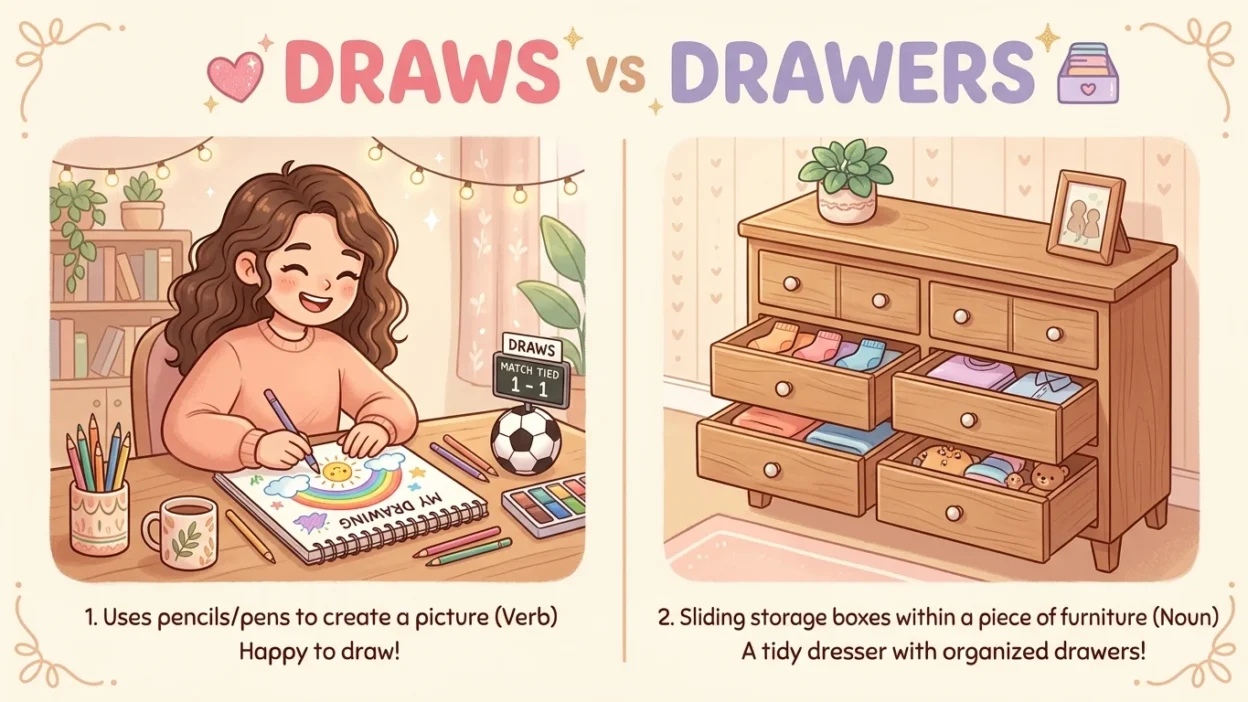
Have you ever confused draws vs drawers while speaking or writing English? These words look and sound similar, but they have very different meanings. Draws can be a form of the verb “draw” or refer to ties in competitions, while drawers usually refers to compartments in furniture or a type of clothing.
Understanding the difference between draws and drawers can help you avoid common spelling and vocabulary mistakes. In this complete guide, you’ll learn their meanings, differences, examples, common mistakes, pronunciation, American and British English usage, FAQs, and an easy memory trick.
Quick Answer
The basic difference is simple:
- Draws ✅ = forms of the verb draw, or ties in a competition.
- Drawers ✅ = storage compartments or a type of underwear/clothing.
Examples:
- She draws beautiful pictures. ✅
- The desk has three drawers. ✅
- The match ended in two draws. ✅
- He packed several pairs of drawers. ✅
Remember:
Draws = drawing or ties
Drawers = storage compartments or clothing
What Does Draws Mean?
Draws is the third-person singular form of the verb draw.
For example:
- She draws every evening.
- He draws cartoons for a magazine.
- My daughter draws pictures at school.
- The artist draws portraits.
In these sentences, draws means creates a picture, design, or image using a pen, pencil, or another tool.
Draws as a Verb
Draws can have several meanings depending on the context.
It can mean:
- Creates a picture.
- Pulls something toward itself.
- Takes something out.
- Attracts attention.
- Moves or pulls something.
- Selects something randomly.
Examples:
- She draws pictures of animals.
- The magnet draws the metal toward it.
- He draws the curtains every morning.
- The advertisement draws attention.
- She draws money from her account.
What Does Draws Mean in Sports?
Draws can also be the plural form of the noun draw.
In sports and competitions, a draw means a game or match ends without a winner.
Examples:
- The team has three draws this season.
- The two teams recorded two draws.
- Their match ended in a draw.
- The tournament included several draws.
In this context, draws has nothing to do with pictures or furniture.
It means ties or undecided results.
What Does Drawers Mean?
Drawers is the plural form of drawer.
A drawer is a sliding compartment in a piece of furniture, such as a desk, cabinet, dresser, or chest.
Examples:
- The desk has four drawers.
- I keep my documents in the top drawer.
- She opened the kitchen drawers.
- The bedroom cabinet has six drawers.
- Put the keys in one of the drawers.
When you see drawers in this context, think about storage compartments.
Drawers as Clothing
In some varieties of English, especially British English and some traditional usage, drawers can also refer to underwear.
For example:
- He bought a new pair of drawers.
- The old-fashioned character wore long drawers.
- The shop sells men’s drawers.
This meaning may sound old-fashioned or less common to some American English speakers.
In modern American English, people are more likely to use terms such as underwear, briefs, or boxers, depending on the garment.
Draws vs Drawers Comparison Table
| Word | Meaning | Common Use | Example |
|---|---|---|---|
| Draws | Creates pictures or performs another action related to “draw” | Art, pulling, attracting, selecting | She draws pictures. |
| Draws | Ties in competitions | Sports | The team has two draws. |
| Drawers | Sliding storage compartments | Furniture | The desk has three drawers. |
| Drawers | Underwear in some varieties of English | Clothing | He bought new drawers. |
The easiest distinction is:
Draws = action or sports ties
Drawers = storage or clothing
Draws in Sentences
Here are some examples of draws used correctly:
- She draws portraits beautifully.
- He draws cartoons for children.
- My son draws pictures every day.
- The artist draws with a pencil.
- The advertisement draws attention.
- The magnet draws the metal toward it.
- The team has three draws this season.
The exact meaning depends on the sentence.
For example:
She draws pictures.
Here, draws means creates pictures.
The team has three draws.
Here, draws means three tied matches.
Drawers in Sentences
Here are some examples of drawers:
- I keep my clothes in the drawers.
- The desk has two large drawers.
- She opened the kitchen drawers.
- Put the documents in the top drawer.
- The cabinet has several drawers.
- I found my keys inside one of the drawers.
In these examples, drawers refers to sliding compartments used for storage.
Draws vs Drawers: The Main Difference
The main difference is their meaning and grammatical form.
Draws
Draws can be:
- A verb meaning creates, pulls, attracts, or performs another action related to draw.
- A noun meaning tied results in competitions.
Examples:
- She draws flowers.
- The team has two draws.
Drawers
Drawers is the plural form of drawer.
It usually refers to:
- Sliding storage compartments.
- Underwear in some varieties of English.
Examples:
- The cabinet has five drawers.
- He bought a pair of drawers.
Therefore:
Draws = actions or tied games
Drawers = compartments or clothing
Why Are Draws and Drawers Confused?
These words are easy to confuse because they begin with exactly the same letters:
DRAW
The difference comes from the ending:
- Draws
- Drawers
The word drawers adds -ers, making it longer and changing its meaning completely.
Another reason for confusion is pronunciation.
Depending on the speaker’s accent, draws and drawers may sound very similar.
For example, some speakers pronounce the words with only a subtle difference in the ending.
Because of this, understanding the context can be more useful than relying only on pronunciation.
Common Mistakes People Make
Mistake 1: Using Drawers for Drawing
Incorrect:
- ❌ She drawers beautiful pictures.
Correct:
- ✅ She draws beautiful pictures.
The verb form is draws, not drawers.
Mistake 2: Using Draws for Furniture
Incorrect:
- ❌ The desk has three draws.
Correct:
- ✅ The desk has three drawers.
A storage compartment is a drawer, and the plural is drawers.
Mistake 3: Confusing Draws With Drawers in Sports
Correct:
- The team had two draws this season.
Here, draws means tied matches.
You would not use drawers in this context.
Mistake 4: Adding “-er” to Draws
Some learners see the word draw and assume that drawers is simply another form of the verb.
However:
Draws = verb or plural noun
Drawers = plural noun
They do not have the same grammatical function.
Simple Memory Trick
💡 Memory Trick
Spelling Box
✏️ DRAWS = DRAWING
If someone draws, they may be creating a picture.
🗄️ DRAWERS = STORAGE
If you can open it and put things inside, it’s a drawer.
🏆 DRAWS = TIES
In sports, a draw means neither team wins.
Remember:
Draws = draws pictures or ties
Drawers = storage compartments
Think: Draws = do; Drawers = furniture.
Draws vs Drawers Pronunciation
Pronunciation can make these words confusing.
Draws
Draws is pronounced approximately:
drawz
Example:
- She draws every day.
Drawers
Drawers may be pronounced approximately:
draw-erz
However, pronunciation varies considerably between accents.
In some varieties of English, particularly certain American and British accents, drawers can sound very close to draws.
Because of this, spelling and context are important.
If you’re talking about art or a tied game, use draws.
If you’re talking about furniture, use drawers.
Draw vs Drawer
Understanding the singular forms makes the difference easier.
Draw
Draw is a verb with many meanings.
Examples:
- I can draw a picture.
- Please draw the curtains.
- The game may draw.
Drawer
A drawer is a storage compartment.
Example:
- Put the papers in the drawer.
The plural forms are:
Draw → Draws
Drawer → Drawers
This simple pattern can help you avoid confusion.
Draws vs Drawers in American English
In American English, draws commonly appears as a form of the verb draw and as a noun meaning tied games.
Examples:
- She draws cartoons.
- The game ends in a draw.
Drawers usually refers to sliding storage compartments.
The clothing meaning exists but is much less common in modern American English.
Americans are more likely to say:
- Underwear
- Boxers
- Briefs
when referring to men’s undergarments.
Draws vs Drawers in British English
British English uses draws in the same basic ways:
- She draws pictures.
- The match ended in a draw.
Drawers commonly refers to storage compartments.
The word drawers can also refer to underwear, although this usage may sound traditional or old-fashioned depending on the context.
For example:
- He wore a pair of long drawers.
Therefore, the clothing meaning is more familiar in British English than in modern American English.
Drawers vs Draws in Furniture
When talking about furniture, always use drawers.
Examples:
- The bedroom has a dresser with six drawers.
- I put my socks in the drawers.
- The kitchen drawers are full.
- The desk drawers are locked.
A useful rule is:
Furniture → drawers
Never write:
- ❌ The cabinet has three draws.
Write:
- ✅ The cabinet has three drawers.
Draws in Sports and Games
When a sports match ends with both sides having the same result, you can use draw or draws.
Examples:
- The match ended in a draw.
- The team recorded five draws this season.
- They have more draws than wins.
- The two teams played out a draw.
In American sports, the term tie is often more common than draw, while draw is especially common in football/soccer and British English.
The plural is still:
Draws
Not:
Drawers
When Should You Use Draws?
Use draws when:
- Someone creates pictures.
- Someone pulls something.
- Something attracts attention.
- Someone takes money from an account.
- A competition ends without a winner.
- You need the third-person singular form of draw.
Examples:
- She draws beautifully.
- The advertisement draws attention.
- He draws money from the bank.
- The team has three draws.
When Should You Use Drawers?
Use drawers when referring to:
- Furniture compartments.
- Desk storage.
- Kitchen storage.
- Bedroom storage.
- Clothing or underwear in certain varieties of English.
Examples:
- The desk has four drawers.
- My clothes are in the drawers.
- Put the documents in the top drawers.
- He wore long drawers.
Draws vs Drawers Examples
Correct Uses of Draws
- She draws pictures every day. ✅
- He draws cartoons professionally. ✅
- The team has two draws this season. ✅
- The advertisement draws attention. ✅
Correct Uses of Drawers
- The desk has three drawers. ✅
- I keep my socks in the drawers. ✅
- She opened the kitchen drawers. ✅
- The cabinet has several drawers. ✅
Incorrect Uses
- ❌ She drawers pictures.
- ❌ The desk has three draws.
- ❌ The team recorded two drawers.
- ❌ Put the papers in the draws.
Correct them as follows:
- ✅ She draws pictures.
- ✅ The desk has three drawers.
- ✅ The team recorded two draws.
- ✅ Put the papers in the drawers.
Draws vs Drawers Grammar
The easiest grammatical distinction is:
Draws can function as:
- A third-person singular verb.
- A plural noun meaning tied games.
Drawers is:
- A plural noun.
Examples:
She draws.
Here, draws is a verb.
The game ended in draws.
Here, draws is a plural noun.
The desk has drawers.
Here, drawers is a plural noun referring to furniture compartments.
This grammatical difference makes the words much easier to identify.
Related Words and LSI Keywords
- draws vs drawers
- drawers vs draws
- draws meaning
- drawers meaning
- draw meaning
- drawer meaning
- draw vs drawer
- draws definition
- drawers definition
- when to use draws
- when to use drawers
- draws examples
- drawers examples
- drawer vs drawers
- draw pronunciation
- drawers pronunciation
- draws pronunciation
- sports draw meaning
- drawer meaning in English
- British English drawers
- American English drawers
- commonly confused words
- English spelling
- English grammar
- confusing English words
- vocabulary mistakes
- correct English usage
- English language learning
- grammar guide
Tips for Remembering the Difference
- Draws = creates pictures.
- Draws = tied games.
- Drawers = storage compartments.
- Think draw → draws for the verb.
- Think drawer → drawers for furniture.
- If you can open it and store something inside, use drawers.
- If someone is creating a picture, use draws.
- In sports, a tied match is a draw.
- Don’t write drawers when you mean the verb draws.
- Don’t write draws when you mean furniture compartments.
- Remember that drawers can also mean underwear in some varieties of English.
Frequently Asked Questions
What is the difference between draws and drawers?
Draws can mean creates pictures, performs an action related to “draw,” or refers to tied games. Drawers usually means storage compartments in furniture.
Is it draws or drawers for furniture?
Use drawers for furniture.
Example:
- The desk has three drawers.
Is it draws or drawers for drawing pictures?
Use draws.
Example:
- She draws beautiful pictures.
What does draws mean?
Draws can be the third-person singular form of draw, as in “She draws pictures.” It can also mean tied games, as in “The team has three draws.”
What does drawers mean?
Drawers is the plural of drawer, meaning sliding storage compartments. In some varieties of English, it can also mean underwear.
Is “The desk has three draws” correct?
No. The correct sentence is:
- The desk has three drawers.
Is “She drawers pictures” correct?
No. The correct sentence is:
- She draws pictures.
What is the plural of drawer?
The plural of drawer is drawers.
Example:
- The cabinet has four drawers.
What is the difference between draw and drawer?
Draw is usually a verb meaning to create a picture, pull something, attract, or perform other actions. Drawer is a noun referring to a sliding storage compartment.
Can draws mean a tie in sports?
Yes. A draw is a match that ends without a winner, and draws is the plural form.
Example:
- The team has five draws this season.
Do Americans say drawers for underwear?
The word drawers can refer to underwear, but this usage is uncommon in modern American English. Americans usually use terms such as underwear, boxers, or briefs.
Do British people use drawers for underwear?
Yes. Drawers can refer to underwear in British English, particularly in traditional or older usage. The meaning depends on context.
Are draws and drawers pronounced the same?
They can sound very similar in some accents, although drawers generally has an additional syllable or ending sound. Pronunciation varies by region.
How do I remember draws vs drawers?
Remember draws = drawing or ties, while drawers = storage compartments. If you’re creating a picture or talking about a tied game, use draws. If you’re talking about furniture storage, use drawers.
Is drawers singular or plural?
Drawers is plural. The singular form is drawer.
Example:
- One drawer
- Two drawers
Summary
The difference between draws vs drawers becomes easy when you focus on the meaning and context. Draws can be the third-person singular form of draw, as in “She draws pictures,” or it can mean tied games, as in “The team has two draws.” Drawers, on the other hand, is the plural of drawer and usually refers to sliding storage compartments in furniture.
Remember the simple rule: draws = drawing or ties, while drawers = storage compartments. In some varieties of English, drawers can also mean underwear. Once you connect each spelling with its meaning, you’ll have no trouble choosing the correct word.

Rowan Blythecroft crafts atmospheric fiction filled with mystery and folklore.
Her stories often blur the line between reality and imagination.
She spends most of her days wandering forests and writing by candlelight.