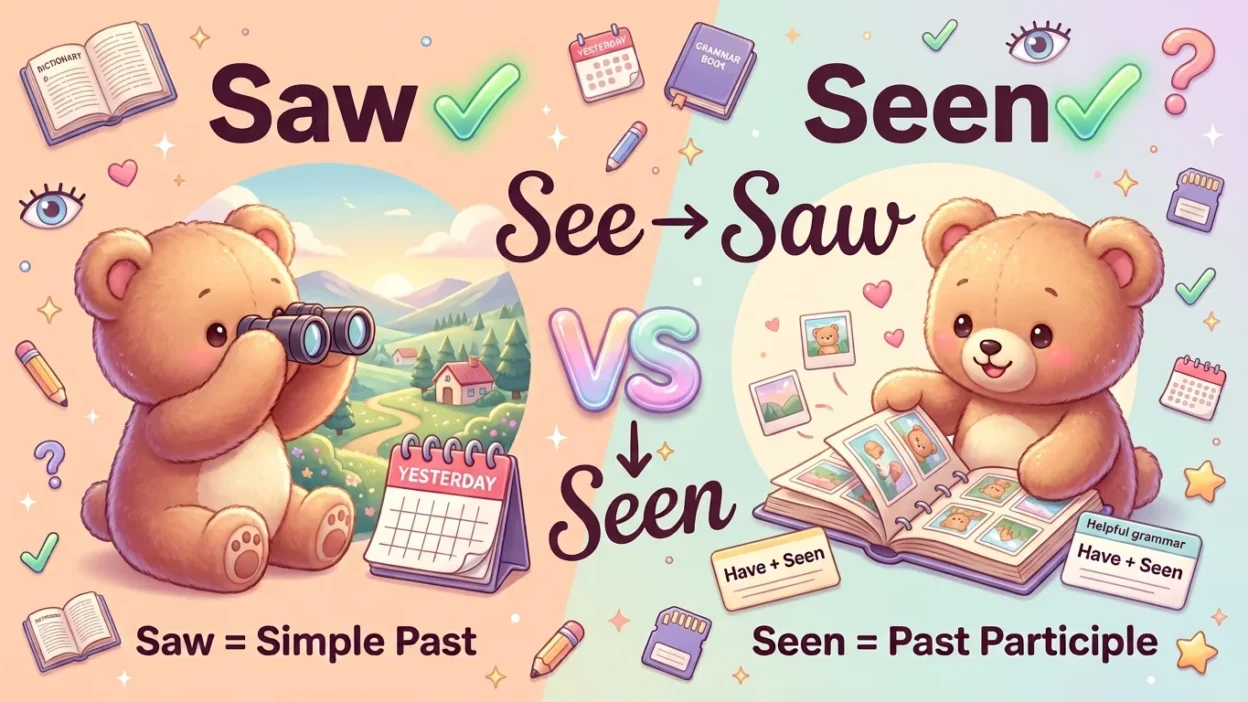
Have you ever wondered about saw vs seen and which one you should use in a sentence? Both words come from the verb see, but they have different grammatical uses. Saw is the simple past tense of see, while seen is the past participle and normally needs a helping verb such as have, has, or had.
Understanding saw vs seen can help you avoid common English grammar mistakes. In this complete guide, you’ll learn their meanings, differences, sentence examples, verb forms, common mistakes, pronunciation, usage rules, American and British English usage, FAQs, and an easy memory trick.
Quick Answer
The basic difference is simple:
- Saw ✅ = simple past tense of see.
- Seen ✅ = past participle of see, usually used with have, has, or had.
Examples:
- I saw her yesterday. ✅
- I have seen her before. ✅
Remember:
Saw = past action
Seen = usually needs a helping verb
The verb forms are:
See → Saw → Seen
What Does Saw Mean?
Saw is the simple past tense of the irregular verb see.
Use saw when you are talking about something that happened and finished in the past.
Examples:
- I saw John yesterday.
- She saw a beautiful sunset.
- We saw a movie last night.
- He saw his teacher at the store.
- They saw a strange bird in the garden.
The important point is that saw can stand on its own as the main verb.
For example:
- I saw him yesterday. ✅
You do not need have or had before saw.
What Does Seen Mean?
Seen is the past participle of see.
Unlike saw, seen normally needs a helping verb.
Common combinations include:
- have seen
- has seen
- had seen
- have been seen
- was seen
- were seen
Examples:
- I have seen that movie.
- She has seen this before.
- They had seen the warning.
- He was seen near the building.
- We have seen many changes.
You generally cannot use seen by itself as the simple past tense.
Incorrect:
- ❌ I seen him yesterday.
Correct:
- ✅ I saw him yesterday.
- ✅ I have seen him before.
Saw vs Seen Comparison Table
| Word | Grammar Form | Main Use | Example |
|---|---|---|---|
| Saw | Simple past | A completed past action | I saw her yesterday. |
| Seen | Past participle | Perfect tenses and passive constructions | I have seen her before. |
The easiest rule is:
Saw = simple past
Seen = past participle
See, Saw, and Seen
These three forms belong to the same irregular verb.
| Verb Form | Word | Example |
|---|---|---|
| Present | See | I see my friend every day. |
| Simple Past | Saw | I saw my friend yesterday. |
| Past Participle | Seen | I have seen my friend before. |
This pattern is important because see does not follow the regular -ed pattern.
You do not say:
- ❌ See → Seed → Seed
Instead:
- See → Saw → Seen
Saw in Sentences
Here are some examples of saw used correctly:
- I saw a rainbow yesterday.
- She saw her brother at the airport.
- We saw a great performance last night.
- He saw the accident from his window.
- They saw the teacher after class.
- I saw that movie last weekend.
- She saw him at the restaurant.
In each example, saw describes an action that happened in the past.
Words such as yesterday, last night, last week, earlier, and two days ago often appear with saw.
Seen in Sentences
Here are some examples of seen:
- I have seen that movie before.
- She has seen the message.
- We have seen this problem before.
- He had seen the warning earlier.
- They have seen many changes.
- The bird was seen near the lake.
- She was seen leaving the building.
Notice that seen usually appears with another verb.
For example:
I have seen
She has seen
They had seen
He was seen
Saw vs Seen: The Main Difference
The biggest difference is grammatical.
Saw
Saw is the simple past tense.
Example:
- I saw him yesterday.
This tells us that the action happened in the past.
Seen
Seen is the past participle.
Example:
- I have seen him before.
The word have helps form the present perfect tense.
Therefore:
I saw him yesterday.
I have seen him before.
Both sentences are correct, but they use different verb forms.
Why Are Saw and Seen Confused?
The main reason is that see is an irregular verb.
Many English verbs form their past tense and past participle in the same way:
- Walk → walked → walked
- Talk → talked → talked
- Play → played → played
However, see changes differently:
- See → saw → seen
Because saw and seen both describe past events, English learners sometimes use them incorrectly.
A common mistake is:
- ❌ I seen him yesterday.
The correct sentence is:
- ✅ I saw him yesterday.
Another common mistake is:
- ❌ I have saw that movie.
The correct sentence is:
- ✅ I have seen that movie.
Common Mistakes People Make
Mistake 1: Using Seen as Simple Past
Incorrect:
- ❌ I seen her yesterday.
Correct:
- ✅ I saw her yesterday.
Because the sentence describes a completed past action, use saw.
Mistake 2: Using Saw After Have
Incorrect:
- ❌ I have saw that movie.
Correct:
- ✅ I have seen that movie.
After have, has, or had, use the past participle seen.
Mistake 3: Using Seen Without a Helping Verb
Incorrect:
- ❌ I seen him at the store.
Correct:
- ✅ I saw him at the store.
Seen normally needs a helping verb in standard English.
Mistake 4: Confusing “I Saw” and “I Have Seen”
These sentences have different meanings.
I saw the movie yesterday.
This refers to a specific completed event in the past.
I have seen the movie.
This tells us that the experience has happened at some point before now.
Simple Memory Trick
💡 Memory Trick
Spelling Box
👀 SAW = SIMPLE PAST
Think: I saw it yesterday.
👁️ SEEN = NEEDS A HELPER
Think: I have seen it before.
Remember:
See → Saw → Seen
Saw can stand alone.
Seen usually needs a helping verb.
If you can add yesterday, last night, or another finished past-time expression, saw is often the right choice.
If you have have, has, or had, use seen.
Saw vs Seen With Have, Has, and Had
One of the easiest ways to understand seen is to look at helping verbs.
Have Seen
Use have seen with I, you, we, and they.
Examples:
- I have seen that movie.
- We have seen this before.
- They have seen the results.
Has Seen
Use has seen with he, she, and it.
Examples:
- She has seen the doctor.
- He has seen this movie.
- The manager has seen the report.
Had Seen
Use had seen when describing something that happened before another past event.
Examples:
- I had seen him before the meeting.
- She had seen the message before she called.
- They had seen the problem earlier.
In all these examples, seen works as the past participle.
Saw vs Seen With Time Expressions
Time expressions can help you choose the correct form.
Saw
Use saw with completed past-time expressions.
Examples:
- I saw her yesterday.
- We saw him last week.
- She saw the movie last night.
- They saw the accident two hours ago.
- I saw him on Monday.
Seen
Use seen with perfect constructions when the exact past time is not the main focus.
Examples:
- I have seen that movie before.
- She has seen him recently.
- We have seen this problem many times.
- They had seen the warning already.
A useful distinction is:
Specific finished past time → saw
Experience or connection to the present → have/has seen
Saw vs Seen in Questions
The same grammar rule applies to questions.
Questions With Saw
- Did you see him yesterday?
- Did she see the movie?
- Did they see the accident?
Notice something important:
After did, use the base form see, not saw.
Incorrect:
- ❌ Did you saw him?
Correct:
- ✅ Did you see him?
Questions With Seen
Use seen after helping verbs such as have or has.
Examples:
- Have you seen this movie?
- Has she seen the message?
- Have they seen the new building?
- Had he seen the report before?
This is a very common grammar pattern.
Saw vs Seen in Negative Sentences
Saw
Use didn’t see for simple past negative sentences.
Examples:
- I didn’t see him yesterday.
- She didn’t see the accident.
- We didn’t see the movie.
Notice that after didn’t, use see, not saw.
Incorrect:
- ❌ I didn’t saw him.
Correct:
- ✅ I didn’t see him.
Seen
Use haven’t seen, hasn’t seen, or hadn’t seen in perfect constructions.
Examples:
- I haven’t seen him recently.
- She hasn’t seen the message.
- They hadn’t seen the warning.
“I Saw” vs “I Have Seen”
These two sentences are especially important.
I Saw
I saw refers to a completed event in the past.
Example:
- I saw John yesterday.
The sentence tells us when the event happened.
I Have Seen
I have seen describes an experience or past event connected to the present.
Example:
- I have seen John before.
The exact time is not important.
Compare:
- I saw that movie last Friday.
- I have seen that movie before.
The first gives a specific past time.
The second focuses on experience.
“I Saw Him” vs “I Have Seen Him”
Compare these examples:
I saw him at the mall yesterday.
This describes a specific event.
I have seen him at the mall before.
This means you have the experience of seeing him there at some point in the past.
The difference is not simply about whether the action happened in the past. Both happened in the past.
The difference comes from the verb tense and context.
Saw vs Seen in Passive Voice
Seen can also appear in passive constructions.
Examples:
- He was seen near the station.
- She was seen entering the building.
- The car was seen on the highway.
- They were seen together.
- The bird was seen in the garden.
Here, seen follows forms of be, such as:
- was seen
- were seen
- is seen
- are seen
- has been seen
This is another reason why seen does not always appear with have, has, or had.
“Have Saw” vs “Have Seen”
This is a very common mistake.
Incorrect:
- ❌ I have saw that movie.
- ❌ She has saw the message.
- ❌ They had saw the accident.
Correct:
- ✅ I have seen that movie.
- ✅ She has seen the message.
- ✅ They had seen the accident.
The rule is simple:
Have/has/had + seen
Not:
Have/has/had + saw
Saw vs Seen in American and British English
The basic grammar rules are the same in American and British English.
Both varieties use:
- See = present
- Saw = simple past
- Seen = past participle
Examples:
- I saw him yesterday.
- I have seen him before.
There is no major spelling difference between American and British English for these verb forms.
Saw vs Seen Pronunciation
Saw and seen have noticeably different pronunciations.
Saw
Pronounced approximately:
saw
It has a long vowel sound.
Example:
- I saw him yesterday.
Seen
Pronounced approximately:
seen
It rhymes with words such as:
- green
- clean
- screen
Example:
- I have seen that movie.
Because their sounds are different, pronunciation can also help you distinguish them.
When Should You Use Saw?
Use saw when:
- You are describing a completed action in the past.
- The sentence uses a specific past time.
- You are using the simple past tense.
- No helping verb requires the past participle.
Examples:
- I saw her yesterday.
- We saw a movie last night.
- He saw the accident.
- They saw the results earlier.
Remember:
See → Saw
When Should You Use Seen?
Use seen when:
- It follows have, has, or had.
- You are forming a perfect tense.
- It appears in a passive construction with be.
- You are describing an experience without focusing on a specific finished time.
Examples:
- I have seen this before.
- She has seen the movie.
- They had seen the warning.
- He was seen near the station.
Remember:
See → Saw → Seen
Saw vs Seen Examples
Correct Uses of Saw
- I saw him yesterday. ✅
- She saw a bird. ✅
- We saw the movie last night. ✅
- They saw the accident. ✅
Correct Uses of Seen
- I have seen him before. ✅
- She has seen the movie. ✅
- We had seen the warning. ✅
- He was seen near the station. ✅
Incorrect Uses
- ❌ I seen him yesterday.
- ❌ I have saw him before.
- ❌ She has saw the movie.
- ❌ They seen the accident last night.
Correct them as follows:
- ✅ I saw him yesterday.
- ✅ I have seen him before.
- ✅ She has seen the movie.
- ✅ They saw the accident last night.
Related Words and LSI Keywords
- saw vs seen
- seen vs saw
- saw meaning
- seen meaning
- see saw seen
- past tense of see
- past participle of see
- saw or seen
- when to use saw
- when to use seen
- I saw vs I have seen
- have seen vs saw
- saw examples
- seen examples
- see verb forms
- irregular verbs
- English grammar
- English verb forms
- commonly confused words
- grammar mistakes
- confusing English words
- English vocabulary
- correct English usage
- past tense grammar
- present perfect tense
- English language learning
- grammar guide
Tips for Remembering the Difference
- Saw is the simple past tense of see.
- Seen is the past participle of see.
- Remember See → Saw → Seen.
- Use saw for a completed past action.
- Use seen after have, has, or had.
- Seen can also appear in passive constructions such as was seen.
- Don’t say I seen him in standard English.
- Don’t say I have saw him.
- Say I saw him for simple past.
- Say I have seen him for present perfect.
- After did, use see, not saw.
- After didn’t, use see, not saw.
Frequently Asked Questions
What is the difference between saw and seen?
Saw is the simple past tense of see, while seen is the past participle. Seen usually needs a helping verb such as have, has, had, or was.
Is it “I saw” or “I seen”?
Use I saw when talking about a simple past action.
Correct:
- I saw him yesterday.
I seen is not standard English when used alone.
Is “I have saw” correct?
No. The correct form is:
- I have seen.
Example:
- I have seen that movie before.
Is “I have seen” correct?
Yes. I have seen is grammatically correct.
Example:
- I have seen that movie before.
What is the past tense of see?
The simple past tense of see is saw.
Example:
- I saw her yesterday.
What is the past participle of see?
The past participle of see is seen.
Example:
- I have seen her before.
Can seen be used by itself?
In standard English, seen normally requires a helping verb or another grammatical structure.
Incorrect:
- ❌ I seen him yesterday.
Correct:
- ✅ I saw him yesterday.
- ✅ I have seen him before.
Why do we say “I saw” but “I have seen”?
Because saw is the simple past form, while seen is the past participle used with auxiliary verbs in perfect constructions.
Is “Did you saw him?” correct?
No.
The correct sentence is:
- Did you see him?
After did, use the base form see.
Is “I didn’t saw him” correct?
No.
The correct sentence is:
- I didn’t see him.
After didn’t, use see, not saw.
Is “Have you saw it?” correct?
No.
The correct sentence is:
- Have you seen it?
Use the past participle seen after have.
Is “He was seen” correct?
Yes.
Seen is correct because it is being used as a past participle in a passive construction.
Example:
- He was seen near the station.
Is “I saw that movie” correct?
Yes.
If you’re talking about a completed event in the past, I saw that movie is correct.
Is “I have seen that movie” correct?
Yes.
I have seen that movie means you have the experience of watching it at some point before now.
What is an easy way to remember saw vs seen?
Remember the three forms:
See → Saw → Seen
Think:
Saw = simple past
Seen = needs a helper
For example:
- I saw him yesterday.
- I have seen him before.
Are saw and seen used differently in American and British English?
Yes, but the basic rules are the same in both varieties. Saw is the simple past, while seen is the past participle.
Summary
The difference between saw vs seen becomes easy when you remember the three forms of the verb see: see → saw → seen. Saw is the simple past tense and can stand alone as the main verb, as in “I saw her yesterday.” Seen is the past participle and normally works with a helping verb, as in “I have seen her before.”
The easiest memory rule is saw = simple past and seen = usually needs a helper. Also remember that after did, you use see, not saw, and after have, has, or had, you use seen. Once you understand these patterns, choosing between saw and seen becomes much easier.
Meta Description: Learn saw vs seen with clear meanings, verb forms, examples, grammar rules, common mistakes, FAQs, and an easy memory trick.

Rowan Blythecroft crafts atmospheric fiction filled with mystery and folklore.
Her stories often blur the line between reality and imagination.
She spends most of her days wandering forests and writing by candlelight.