Have you ever wondered about continually vs continuously and whether these two words mean the same thing? They are very similar, and people often use them interchangeably. However, there is a useful difference. Continually usually means something happens repeatedly, with breaks between occurrences, while continuously means something happens without stopping or interruption.
Understanding continually vs continuously can help you choose the right word in everyday conversations, professional writing, essays, and formal English. In this complete guide, you’ll learn their meanings, differences, examples, common mistakes, pronunciation, usage rules, and an easy memory trick.
Quick Answer
The basic difference is simple:
- Continually ✅ = happening repeatedly, often with breaks.
- Continuously ✅ = happening constantly without interruption.
Examples:
- She continually checks her phone during the day. ✅
- The machine ran continuously for six hours. ✅
A simple way to remember the difference is:
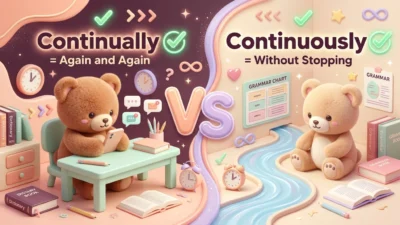
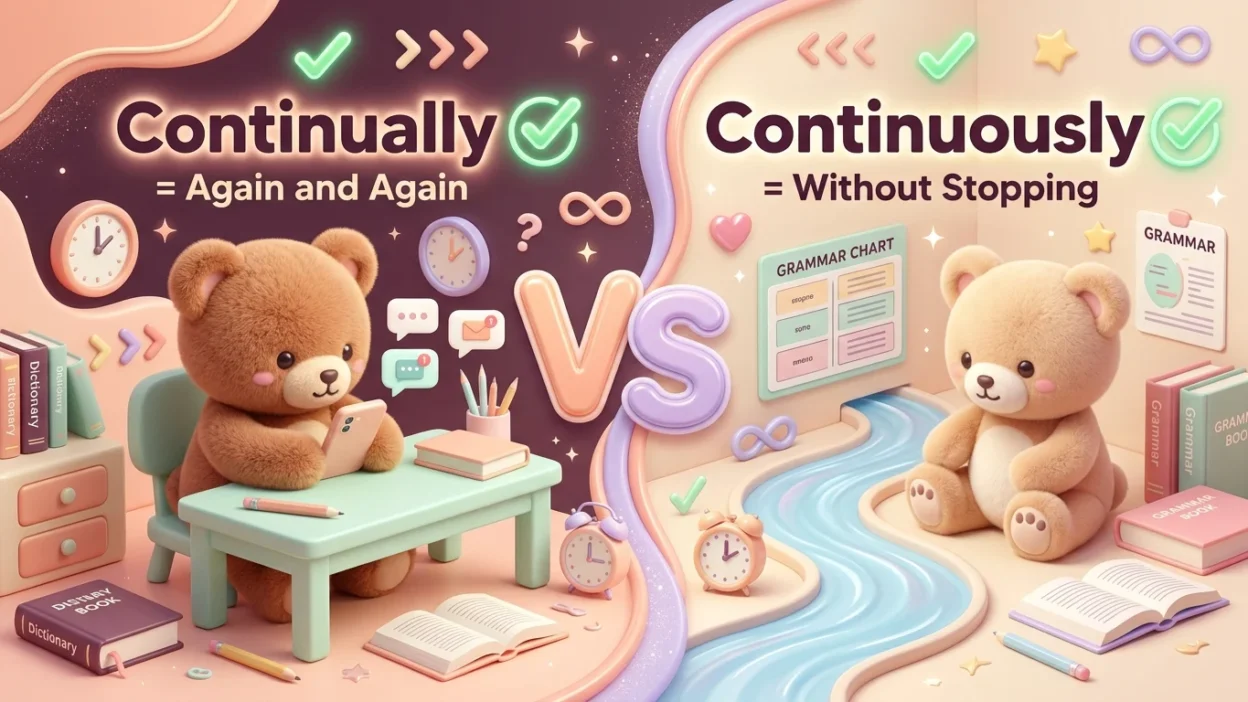
Continually = again and again
Continuously = without stopping
Although these words sometimes overlap in everyday English, this distinction makes your meaning clearer.
What Does Continually Mean?
Continually is an adverb that means something happens repeatedly or frequently, usually with periods when it stops before happening again.
For example:
- He continually forgets his keys.
- She continually asks the same question.
- The children continually interrupted the teacher.
- My phone continually receives notifications.
- They continually argued about the same issue.
In each example, the action happens repeatedly rather than necessarily happening every second without a break.
Think of continually as:
Something happens → stops → happens again → stops → happens again.
What Does Continuously Mean?
Continuously means something happens without interruption or stopping.
Examples:
- The rain fell continuously throughout the night.
- The machine operated continuously for twelve hours.
- The river flows continuously toward the sea.
- The lights remained continuously on.
- The recording played continuously.
The focus is on an ongoing action with no meaningful break.
Think of continuously as:
Something starts → keeps going → keeps going → does not stop.
Continually vs Continuously Comparison Table
| Word | Meaning | Main Idea | Example |
|---|---|---|---|
| Continually | Repeatedly or frequently | Again and again | She continually checks her email. |
| Continuously | Without interruption | Nonstop | The machine ran continuously for eight hours. |
The easiest distinction is:
Continually = repeated
Continuously = uninterrupted
Continually in Sentences
Here are some examples of continually used correctly:
- He continually changes his plans.
- She continually forgets where she puts her phone.
- The customer continually complained about the service.
- My neighbor continually plays loud music.
- The students continually asked questions.
- The company continually improves its products.
These actions happen more than once. They may stop between occurrences and then happen again.
For example, someone who continually forgets something does not forget it every second. Instead, they forget it repeatedly over time.
Continuously in Sentences
Here are some examples of continuously:
- The fan ran continuously all night.
- The water flowed continuously through the pipe.
- The video played continuously for three hours.
- The machine operated continuously during the test.
- The road was monitored continuously.
- The music played continuously without a break.
In these examples, the action continues without interruption.
Continually vs Continuously: The Main Difference
The key difference involves breaks.
Continually
Something happens repeatedly, but it can stop between occurrences.
Example:
- She continually calls me.
This means she calls me again and again. She is not necessarily calling every moment without stopping.
Continuously
Something continues without stopping.
Example:
- She talked continuously for two hours.
This suggests that she kept talking without a meaningful interruption.
Therefore:
Continually = repeated actions
Continuously = uninterrupted actions
Why Are Continually and Continuously Confused?
These words are easy to confuse because they come from the same root word, continue.
Both words describe something that happens over time, and their meanings overlap in many everyday situations.
For example:
- The company continually improves its services.
- The company continuously improves its services.
Both sentences can be understood, but they can suggest slightly different ideas.
Continually emphasizes repeated improvement.
Continuously emphasizes an ongoing process without interruption.
Because everyday English does not always enforce a strict distinction, native speakers sometimes use these words interchangeably.
Continually vs Continuously Examples
Example 1: Phone Calls
- She continually calls me. ✅
- She continuously calls me. ✅
The first suggests repeated calls.
The second can suggest that the calls are occurring without interruption, although that interpretation may sound unusual depending on the context.
Example 2: Rain
- It rained continually throughout the week.
- It rained continuously for six hours.
The first can suggest repeated or persistent rain over a period.
The second strongly emphasizes that the rain did not stop during those six hours.
Example 3: Complaints
- He continually complains about his job. ✅
This means he complains again and again.
Using continuously would suggest that he complains without stopping, which is a much stronger idea.
Example 4: Machine
- The machine ran continuously for 24 hours. ✅
This means the machine kept running without interruption.
Continually could suggest that the machine repeatedly starts and stops instead.
Common Mistakes People Make
Mistake 1: Assuming They Are Exactly the Same
Although the words overlap, they can communicate different ideas.
Compare:
- She continually interrupted me.
- She continuously interrupted me.
The first means she interrupted repeatedly.
The second can suggest almost nonstop interruption.
Mistake 2: Using Continuously for Repeated Actions
If an action happens again and again with breaks, continually is usually clearer.
Less precise:
- He continuously forgets his password.
Better:
- He continually forgets his password.
The second sentence clearly communicates repeated behavior.
Mistake 3: Using Continually for a Nonstop Action
When something genuinely does not stop, continuously is often the better choice.
Less precise:
- The machine ran continually for ten hours.
Clearer:
- The machine ran continuously for ten hours.
The second sentence emphasizes uninterrupted operation.
Mistake 4: Thinking “Continually” Means Constantly
Continually usually suggests repeated occurrence, while constantly can suggest something happens very frequently or seemingly all the time.
For example:
- She continually checks her messages.
This suggests repeated checking.
Simple Memory Trick
💡 Memory Trick
Spelling Box
🔄 CONTINUALLY = AGAIN AND AGAIN
Think of an action that happens repeatedly, with breaks between occurrences.
♾️ CONTINUOUSLY = WITHOUT STOPPING
Think of a straight, uninterrupted flow that keeps going.
Remember:
Continually = repeated
Continuously = nonstop
If it stops and starts again, think continually.
If it keeps going without stopping, think continuously.
Continually vs Constantly
Continually and constantly are closely related, but they are not always identical.
Continually often emphasizes repeated actions:
- He continually changes his mind.
Constantly can emphasize something happening very frequently or seeming to happen all the time:
- He constantly complains.
Both can describe repeated behavior, but continually is especially useful when you want to emphasize recurrence rather than uninterrupted continuation.
Continually vs Continuously vs Constantly
These three words can be confusing.
| Word | Meaning | Example |
|---|---|---|
| Continually | Repeatedly, with possible breaks | She continually checks her phone. |
| Continuously | Without interruption | The machine runs continuously. |
| Constantly | Very frequently or seemingly all the time | He constantly talks about work. |
A simple guide:
Continually → repeatedly
Continuously → nonstop
Constantly → very frequently
Continually in Formal Writing
Continually works well in academic, professional, and everyday writing when you describe repeated actions or changes.
Examples:
- The organization continually evaluates its policies.
- Employees are continually encouraged to improve their skills.
- The company continually updates its software.
- Researchers continually develop new methods.
These sentences describe recurring actions rather than one uninterrupted action.
Continuously in Formal Writing
Continuously is useful when you need to emphasize an uninterrupted process.
Examples:
- The equipment was monitored continuously.
- The system operated continuously throughout the experiment.
- Temperature levels were measured continuously.
- The device recorded data continuously for 48 hours.
This word is particularly useful in technical, scientific, and professional writing when uninterrupted activity matters.
Continually vs Continuously in Everyday English
In casual conversation, people often use these words loosely.
For example:
- “It continually rains here.”
- “It continuously rains here.”
A listener can usually understand the intended meaning.
However, careful writing benefits from choosing the word that matches the situation.
Use continually when something happens repeatedly.
Use continuously when something happens without interruption.
This small distinction can make your writing more precise.
American vs British English
There is no major spelling difference between American and British English for continually and continuously.
Both varieties use:
- Continually
- Continuously
The distinction between repeated and uninterrupted action is also recognized in both forms of English, although everyday usage can vary.
Therefore, whether you’re writing for American or British readers, you can use the same spelling and general meaning.
When Should You Use Continually?
Use continually when something:
- Happens repeatedly.
- Occurs again and again.
- Keeps recurring over time.
- Happens frequently with possible breaks.
- Describes repeated behavior or actions.
Examples:
- He continually forgets his keys.
- She continually changes her mind.
- The company continually improves its services.
- They continually discussed the problem.
When Should You Use Continuously?
Use continuously when something:
- Happens without interruption.
- Continues without stopping.
- Flows without a break.
- Operates nonstop.
- Remains active throughout a period.
Examples:
- The machine operated continuously.
- The river flows continuously.
- The rain fell continuously for six hours.
- The camera recorded the event continuously.
Continually vs Continuously Pronunciation
The pronunciation of the two words is similar because both come from continue.
Continually
Pronounced approximately:
kuhn-TIN-yoo-uh-lee
Continuously
Pronounced approximately:
kuhn-TIN-yoo-uhs-lee
The extra -ous- sound in continuously helps distinguish the words when spoken.
However, pronunciation alone may not always make the difference obvious. Understanding the context is more important.
Continually vs Continuously in a Sentence
Consider this example:
She continually checks the door.
This means she checks it repeatedly.
Now compare:
She continuously watches the door.
This suggests she watches the door without stopping.
The first focuses on repeated actions.
The second focuses on uninterrupted attention.
Another example:
The workers continually repaired the machine.
They repaired it repeatedly over time.
The workers continuously monitored the machine.
They monitored it without interruption.
How to Choose Between Continually and Continuously
When you’re unsure, ask yourself one simple question:
Does the action stop and happen again?
If yes, choose continually.
Example:
- He continually checks his email.
If the action continues without stopping, choose continuously.
Example:
- The system continuously monitors the temperature.
This quick test can help you choose the more precise word.
Related Words and LSI Keywords
- continually vs continuously
- continuously vs continually
- continually meaning
- continuously meaning
- continual vs continuous
- continual meaning
- continuous meaning
- continually definition
- continuously definition
- when to use continually
- when to use continuously
- continually examples
- continuously examples
- continual vs continuous
- constantly vs continually
- constantly vs continuously
- English grammar
- English vocabulary
- commonly confused words
- confusing English words
- English usage
- grammar mistakes
- correct English
- professional writing
- English language learning
- adverbs
- grammar guide
Tips for Remembering the Difference
- Continually means repeatedly.
- Continuously means without interruption.
- Think continually = again and again.
- Think continuously = nonstop.
- Use continually for repeated behavior.
- Use continuously for an uninterrupted process.
- A person who continually complains does so repeatedly.
- A machine that runs continuously does not stop.
- Look for breaks in the action.
- If there are breaks, continually is usually the clearer choice.
- If there are no breaks, continuously is usually the clearer choice.
Frequently Asked Questions
What is the difference between continually and continuously?
Continually usually means repeatedly or again and again, while continuously means without interruption or stopping.
Is continually the same as continuously?
Not exactly. Their meanings overlap, but continually generally emphasizes repetition, while continuously emphasizes uninterrupted continuation.
Does continually mean repeatedly?
Yes. Continually commonly means something happens repeatedly or frequently, often with breaks between occurrences.
Does continuously mean without stopping?
Yes. Continuously means something continues without interruption.
Which is correct: continually or continuously?
Both are correct words. The correct choice depends on the meaning you want to express.
Use continually for repeated actions and continuously for uninterrupted actions.
Is it “continually changing” or “continuously changing”?
Both can be correct, but they suggest slightly different meanings.
- Continually changing = changing repeatedly over time.
- Continuously changing = changing without interruption.
The best choice depends on the context.
Is it “continually improving” or “continuously improving”?
Both are possible.
Continually improving emphasizes repeated improvement over time.
Continuously improving emphasizes an ongoing process of improvement without interruption.
In everyday and professional writing, continually improving is often a natural choice when describing repeated progress.
Is it continually or continuously raining?
Both can be used, depending on what you mean.
- Continually raining can emphasize recurring or persistent rain.
- Continuously raining strongly suggests that the rain does not stop.
If you want to emphasize that there was no break, continuously is clearer.
Is continually a positive or negative word?
Neither. Continually is neutral and can describe positive, negative, or neutral repeated actions.
Examples:
- She continually improves her skills.
- He continually makes the same mistake.
Can continually and continuously be used interchangeably?
Sometimes, especially in casual English, but they can create different meanings. Careful writers should choose continually for repetition and continuously for uninterrupted action.
What is the difference between continual and continuous?
Continual generally means happening repeatedly, often with breaks. Continuous means happening without interruption.
For example:
- Continual interruptions = interruptions that happen repeatedly.
- Continuous noise = noise that does not stop.
Is continuously stronger than continually?
In terms of uninterrupted duration, continuously gives a stronger sense that something does not stop. Continually focuses more on repeated occurrence.
What is an easy way to remember continually vs continuously?
Remember:
Continually = again and again
Continuously = without stopping
If something happens repeatedly with breaks, choose continually. If it keeps going without a break, choose continuously.
Are continually and continuously spelled the same in American and British English?
Yes. Both American and British English use continually and continuously with the same spellings.
Summary
The difference between continually vs continuously becomes easy when you focus on whether an action has breaks. Continually usually means something happens repeatedly or again and again, while continuously means something happens without interruption.
For example, someone who continually checks their phone checks it repeatedly throughout the day, while a machine that operates continuously keeps running without stopping. Although native speakers sometimes use these words interchangeably, choosing the more precise word makes your writing clearer. Simply remember: continually = repeated, while continuously = nonstop.

Alistair Fenwicke is a quiet observer of rural life and forgotten histories.
His novels explore memory, solitude, and the passing of time.
He writes from a small countryside cottage surrounded by fields.