
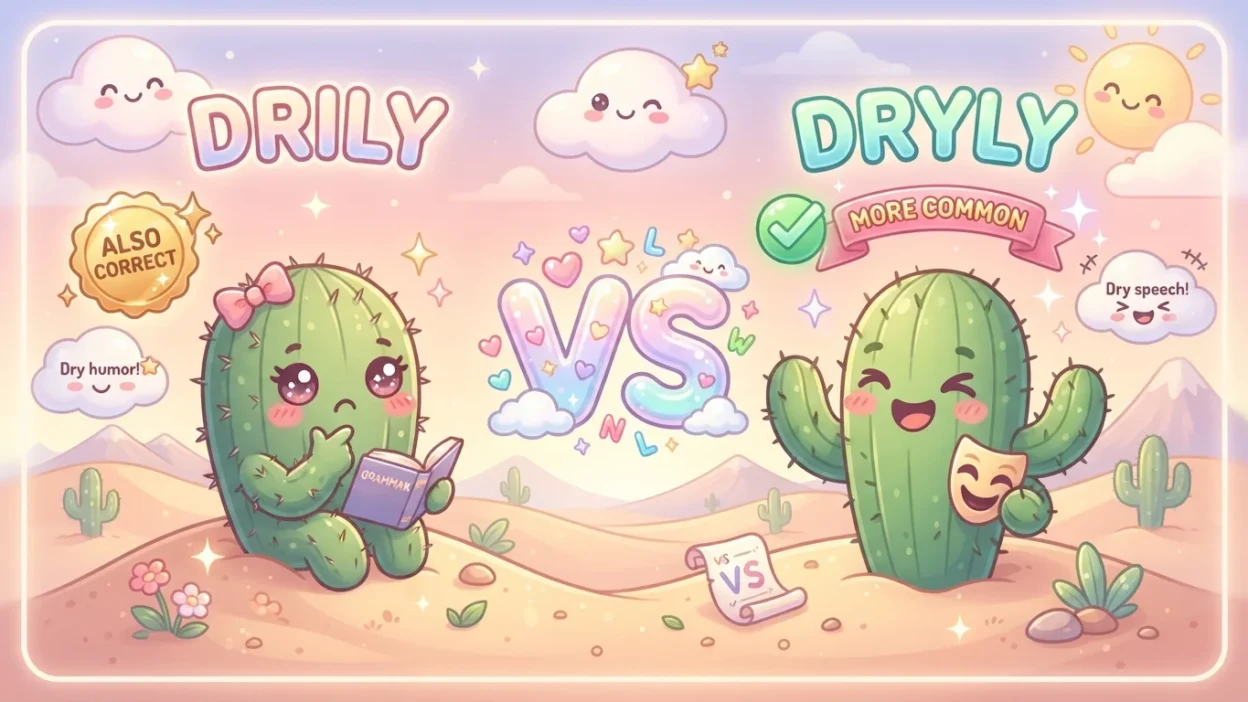
Have you ever wondered whether drily or dryly is the correct spelling? You’re not alone! These two spellings often confuse writers because both appear in dictionaries and published writing. The good news is that both are correct, but one is more common.
In this guide, you’ll learn the difference between drily vs dryly, their meanings, examples, usage, common mistakes, and an easy memory trick to help you choose the right spelling.
Quick Answer
- Dryly ✅ — Correct and more common.
- Drily ✅ — Also correct, but less common.
Both spellings mean “in a dry manner” or “with little emotion or humor.”
Examples:
- She dryly remarked that the meeting could have been an email.
- He drily observed that nothing had changed.
What Do Drily and Dryly Mean?
Both words are standard English adverbs with the same meaning. They differ only in spelling preference.
What Is Dryly?
Dryly is an adverb that means:
- In a dry manner.
- Without emotion or enthusiasm.
- With subtle or understated humor.
It is the more common spelling in modern English.
Examples:
- She dryly thanked him for the obvious advice.
- The professor dryly explained the mistake.
- He dryly joked about the long meeting.
- She smiled dryly before answering.
What Is Drily?
Drily has exactly the same meaning as dryly.
It is an alternative spelling that appears in both American and British English but is used less frequently.
Examples:
- He drily commented on the situation.
- She drily noted the irony.
- The reviewer drily criticized the film.
Drily vs Dryly Comparison Table
| Feature | Drily | Dryly |
|---|---|---|
| Correct English Word | ✅ Yes | ✅ Yes |
| Dictionary Entry | Yes | Yes |
| Meaning | In a dry or unemotional manner | In a dry or unemotional manner |
| Common Usage | Less Common | More Common |
| Used in Formal Writing | Yes | Yes |
Which Spelling Should You Use?
Since both spellings are correct, the best choice depends on consistency and style.
In most situations:
- Dryly is the preferred spelling because it is more widely used.
- Drily is perfectly acceptable but appears less often.
If you’re writing for a broad audience, dryly is usually the safest option.
Examples of Dryly in Sentences
- She dryly replied, “That was unexpected.”
- He dryly pointed out the obvious.
- The comedian dryly delivered the punchline.
- The teacher dryly corrected the mistake.
- She dryly smiled before leaving.
Examples of Drily in Sentences
- He drily remarked that the project was overdue.
- She drily answered the reporter’s question.
- The narrator drily described the scene.
Common Mistakes People Make
Many writers accidentally:
- Think only one spelling is correct.
- Assume drily is a misspelling.
- Switch between the two spellings in the same document.
- Choose one spelling without following the chosen style consistently.
Incorrect assumption:
- ❌ Drily is always wrong.
Correct:
- ✅ Both drily and dryly are correct.
Simple Memory Trick
💡 Memory Trick
- Dryly keeps the full word dry, making it easier to recognize.
- Think: “Keep DRY together in dryly.”
Rule: Both are correct, but dryly is the more common choice.
When Should You Use Dryly?
Use dryly when writing:
- Everyday English.
- Professional documents.
- Articles and blogs.
- Academic writing.
- Dialogue with subtle humor.
- General communication.
When Should You Use Drily?
Use drily when:
- Following a specific style guide.
- Matching an author’s preferred spelling.
- Maintaining consistency in a publication.
Both spellings are accepted, so consistency matters more than the choice itself.
American vs British English
There is no strict difference between American and British English.
Both varieties recognize:
- ✅ Dryly
- ✅ Drily
However, dryly is more common in both American and British English.
Related Words and LSI Keywords
- dryly meaning
- drily meaning
- dry humor
- dry wit
- understated humor
- adverb spelling
- English spelling rules
- commonly confused words
- grammar guide
- vocabulary tips
- language learning
- proofreading
- correct English usage
- word comparison
Tips for Remembering the Difference
- Both spellings are correct.
- Dryly is the more common choice.
- Stay consistent throughout your writing.
- Follow your publisher’s or style guide’s preference.
- Choose one spelling and use it throughout the document.
Frequently Asked Questions
Is drily a real word?
Yes. Drily is a correct English word.
Which is correct: drily or dryly?
Both are correct, but dryly is more commonly used.
Do drily and dryly have different meanings?
No. They have exactly the same meaning.
Is dryly preferred in American and British English?
Yes. Although both spellings are accepted, dryly is generally more common.
Can I use drily in formal writing?
Yes. Drily is fully acceptable in formal writing.
Should I use both spellings in the same article?
No. Choose one spelling and use it consistently.
Summary
The difference between drily vs dryly is mainly a matter of spelling preference rather than meaning. Both words are correct and mean “in a dry, unemotional, or subtly humorous way.” However, dryly is the more common spelling and is usually the better choice for most readers.
If you’re writing an article, report, or email, using dryly will feel more familiar to your audience while still being completely correct.

Rowan Blythecroft crafts atmospheric fiction filled with mystery and folklore.
Her stories often blur the line between reality and imagination.
She spends most of her days wandering forests and writing by candlelight.