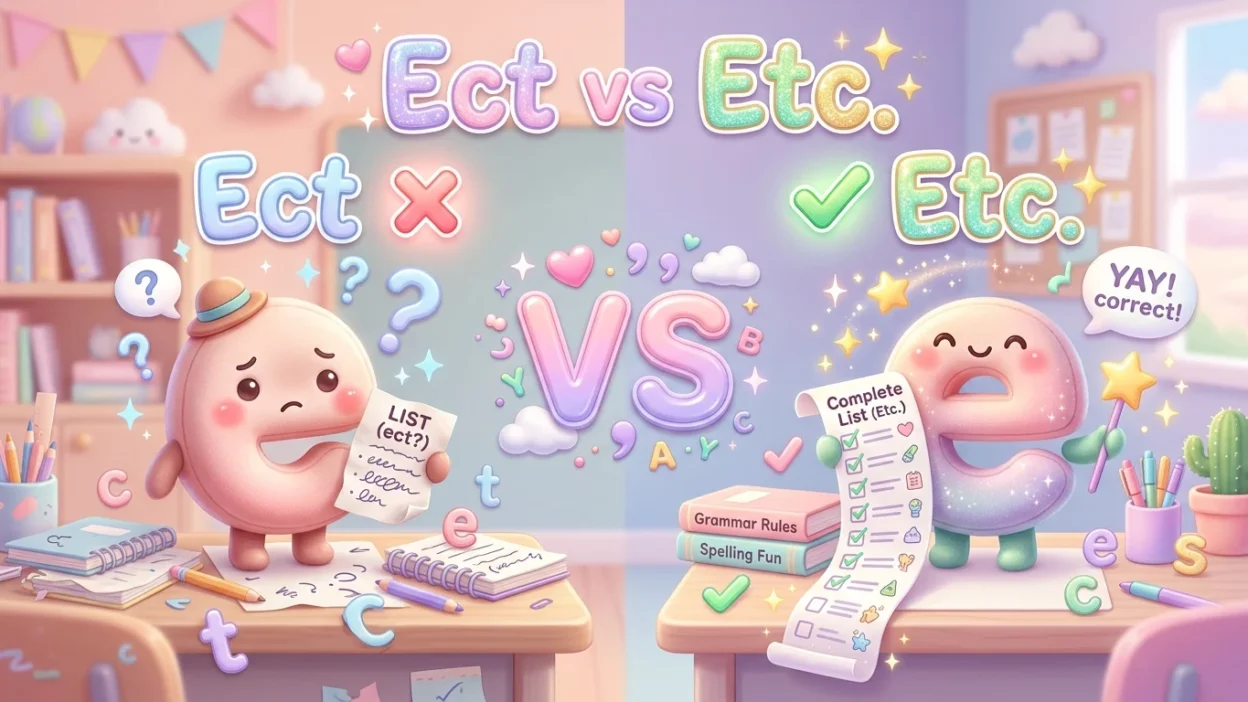
Have you ever wondered whether ect or etc is the correct abbreviation? You’re not alone! Many people write ect because the abbreviation etc. is usually pronounced like “et-see,” which can make the spelling confusing. However, only one form is correct in standard English.
In this guide, you’ll learn the difference between ect vs etc, what each form means, how to use etc. correctly, common mistakes, examples, and an easy memory trick to help you remember the right spelling.
Quick Answer
- Etc. ✅ — Correct abbreviation.
- Ect. ❌ — Incorrect spelling of etc.
Etc. is short for the Latin phrase et cetera, meaning “and other things” or “and so on.”
Example:
- Bring pens, notebooks, folders, etc.
What Do Ect and Etc Mean?
Although these forms look almost identical, only one is a standard abbreviation.
What Is Etc.?
Etc. is an abbreviation of the Latin phrase et cetera. It means and other things, and so on, or and the rest.
It is used when you list some examples but don’t want to mention every item.
Examples:
- We bought apples, oranges, bananas, etc.
- Bring your passport, tickets, identification, etc.
- She enjoys reading books about history, science, art, etc.
What Is Ect.?
Ect. is an incorrect spelling of etc.
The letters appear in the wrong order. The correct abbreviation is e-t-c, not e-c-t.
Incorrect:
- ❌ Books, pens, pencils, ect.
Correct:
- ✅ Books, pens, pencils, etc.
Ect vs Etc Comparison Table
| Feature | Ect | Etc. |
|---|---|---|
| Correct Abbreviation | ❌ No | ✅ Yes |
| Full Form | None | Et cetera |
| Meaning | None | And other things |
| Standard English | No | Yes |
| Common Usage | Incorrect | Very Common |
Why Is “Etc.” Correct?
The abbreviation etc. comes from the Latin phrase et cetera.
The words break down as:
- et = and
- cetera = the rest or other things
The abbreviation takes the first letters:
et cetera → etc.
That’s why the letters must appear in this order:
E → T → C
Not:
E → C → T
Therefore:
- Etc. ✅ — Correct.
- Ect. ❌ — Incorrect.
Examples of Etc. in Sentences
- We need paper, pens, folders, etc.
- The store sells shoes, bags, hats, etc.
- She packed clothes, toiletries, towels, etc.
- You can use fruits such as apples, pears, peaches, etc.
- The course covers grammar, vocabulary, pronunciation, etc.
- He enjoys sports like football, tennis, basketball, etc.
- Bring your laptop, charger, headphones, etc.
Common Mistakes People Make
Many people accidentally:
- Write ect instead of etc.
- Reverse the final two letters.
- Spell the abbreviation according to its pronunciation.
- Forget the period after etc in traditional writing.
- Use etc. after a list that is already complete.
Incorrect:
- ❌ I bought books, pens, and notebooks, ect.
Correct:
- ✅ I bought books, pens, and notebooks, etc.
Simple Memory Trick
💡 Memory Trick
Spelling Box
Remember the original phrase:
ET CETERA → ETC.
The abbreviation keeps the letters in the same order:
E → T → C
Rule: Think ETC = Et Cetera. Never switch the T and C.
How to Use Etc. Correctly
Use etc. when you provide examples and want to indicate that the list continues.
For example:
- You can bring snacks such as chips, cookies, fruit, etc.
However, don’t use etc. when the list needs to be complete or when the missing items are essential to understanding your meaning.
Avoid Redundancy
Don’t write:
- ❌ and etc.
Because et cetera already means “and other things.”
Use:
- ✅ apples, oranges, bananas, etc.
Instead of:
- ❌ apples, oranges, bananas, and etc.
Punctuation With Etc.
In traditional English writing, etc. includes a period because it is an abbreviation.
Example:
- We bought food, drinks, plates, etc.
If etc. appears at the end of a sentence, you normally don’t need to add another period.
Example:
- We bought food, drinks, plates, etc.
If the sentence requires another punctuation mark, that punctuation can follow the abbreviation.
When Should You Use Etc.?
Use etc. when:
- A list contains several examples.
- The remaining items are obvious.
- You don’t need to name every item.
- You want to mean “and so on.”
Examples:
- Clothes, shoes, accessories, etc.
- Books, magazines, newspapers, etc.
- Apples, pears, bananas, etc.
When Should You Use Ect.?
Never use ect. as the abbreviation for et cetera.
The correct form is always:
Etc. ✅
American vs British English
Etc. is used in both American and British English.
There is no difference in the spelling:
- Etc. ✅
- Ect. ❌
However, some formal writing styles may prefer replacing etc. with clearer wording, especially when precise communication matters.
Related Words and LSI Keywords
- etc meaning
- etc definition
- et cetera
- and so on
- and other things
- abbreviation
- Latin abbreviation
- list abbreviation
- punctuation
- English grammar
- spelling rules
- commonly misspelled words
- writing tips
- proofreading
- correct English usage
Tips for Remembering the Difference
- Remember et cetera → etc.
- Keep the letters in the order E-T-C.
- Don’t switch T and C.
- Ect. is incorrect.
- Remember that etc. means “and other things.”
Frequently Asked Questions
Is ect a correct abbreviation?
No. Ect. is a common misspelling of etc.
Which is correct: ect or etc?
Etc. is correct.
What does etc. stand for?
Etc. stands for the Latin phrase et cetera, meaning “and other things” or “and so on.”
Why do people spell etc. as ect?
The mistake often happens because etc. is commonly pronounced “et-see,” which can make people reverse the final letters when spelling it.
Should etc. have a period?
Traditionally, yes. Etc. is an abbreviation, so it is commonly written with a period.
Is etc. used in American and British English?
Yes. Etc. is standard in both American and British English.
Can I write “and etc.”?
No. It’s usually redundant because etc. already conveys the idea of “and other things.” Write items, etc. instead.
Summary
The difference between ect vs etc is very simple. Etc. is the correct abbreviation of the Latin phrase et cetera, which means “and other things” or “and so on.” Ect. is a common spelling mistake caused by reversing the final two letters.
Whenever you need to shorten et cetera, remember the original phrase: et cetera → etc. Keeping the letters in the order E-T-C will help you avoid this common mistake.

Alistair Fenwicke is a quiet observer of rural life and forgotten histories.
His novels explore memory, solitude, and the passing of time.
He writes from a small countryside cottage surrounded by fields.