Have you ever wondered whether goodmorning or good morning is the correct form? You’re not alone! Many people type goodmorning as a single word in emails, text messages, and social media posts. However, only one form is correct in standard English.
In this guide, you’ll learn the difference between goodmorning vs good morning, their meanings, examples, common mistakes, and an easy memory trick to help you remember the correct form.
Quick Answer
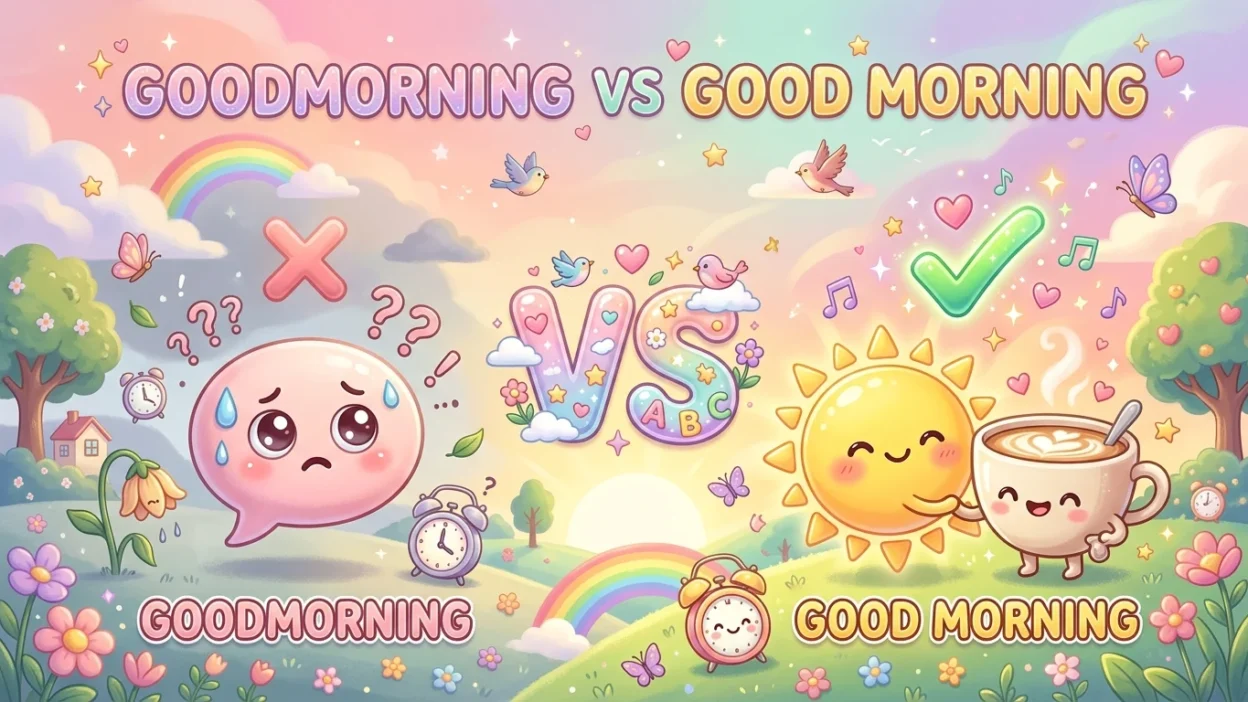
- Good morning ✅ — Correct form.
- Goodmorning ❌ — Incorrect spelling.
Use good morning as two separate words whenever you greet someone in the morning.
Examples:
- Good morning! How are you today?
- She smiled and said, “Good morning.”
What Do Goodmorning and Good Morning Mean?
Although these forms look similar, only one is accepted in standard English.
What Is Good Morning?
Good morning is the correct greeting used to wish someone well during the morning. It is always written as two separate words.
It can be used:
- As a greeting.
- At the beginning of an email.
- In conversations.
- In speeches and presentations.
Examples:
- Good morning, everyone!
- Good morning, Professor Smith.
- I walked into the office and said, “Good morning.”
- Good morning! I hope you have a wonderful day.
What Is Goodmorning?
Goodmorning is a misspelling of good morning.
It is not recognized as a standard English word and should not be used in formal or informal writing.
Goodmorning vs Good Morning Comparison Table
| Feature | Goodmorning | Good Morning |
|---|---|---|
| Correct English Form | ❌ No | ✅ Yes |
| Dictionary Entry | No | Yes (as a phrase) |
| Meaning | None | Morning greeting |
| Used in Formal Writing | No | Yes |
| Used in Everyday English | No | Very Common |
Why Is “Good Morning” Correct?
The correct form is:
G-O-O-D M-O-R-N-I-N-G
Good is an adjective, and morning is a noun. Together, they form the greeting good morning.
Unlike words such as goodbye, this greeting remains two separate words in standard English.
Therefore:
- Good morning ✅ — Correct.
- Goodmorning ❌ — Incorrect.
Examples of Good Morning in Sentences
- Good morning! It’s nice to see you.
- She wished everyone a good morning before the meeting.
- Good morning, class.
- He sent me a good morning message.
- We heard the presenter say, “Good morning, everyone.”
- I always start my emails with Good morning.
- Good morning! Have a productive day.
Common Mistakes People Make
Many writers accidentally:
- Write goodmorning as one word.
- Type the greeting too quickly.
- Forget that it is a two-word phrase.
- Miss the typo while proofreading.
Incorrect:
- ❌ Goodmorning everyone!
Correct:
- ✅ Good morning, everyone!
Simple Memory Trick
💡 Memory Trick
Greeting Rule Box
“Good” describes “morning,” so they stay as two separate words.
Think of:
- Good afternoon
- Good evening
- Good night
Rule: If it’s a greeting, always write good morning as two words.
When Should You Use Good Morning?
Use good morning when:
- Greeting someone.
- Starting an email.
- Beginning a speech.
- Saying hello before noon.
- Sending morning messages.
- Welcoming a group.
Examples:
- Good morning, everyone.
- Good morning, sir.
- Good morning, team.
- Good morning, friends.
- Good morning, class.
- Good morning, Mom.
When Should You Use Goodmorning?
Never.
Goodmorning is always a spelling mistake and should be corrected to good morning.
American vs British English
There is no difference between American and British English.
Both varieties use:
- ✅ Good morning
- ❌ Goodmorning
The greeting is written as two words in both forms of English.
Related Words and LSI Keywords
- good morning meaning
- morning greeting
- English greetings
- greeting phrases
- formal greetings
- email greetings
- hello
- morning wishes
- English spelling rules
- commonly confused words
- grammar guide
- vocabulary tips
- proofreading
- correct English usage
Tips for Remembering the Difference
- Good morning is always two words.
- Good describes morning.
- Think of good afternoon and good evening.
- Never combine the two words.
- Proofread greetings before sending emails or messages.
Frequently Asked Questions
Is goodmorning a real word?
No. Goodmorning is not recognized as a standard English word.
Which is correct: goodmorning or good morning?
Good morning is the correct form.
Why is good morning written as two words?
Because good is an adjective modifying the noun morning, forming a two-word greeting.
Is good morning used in American and British English?
Yes. Both varieties use the same two-word form.
Can I write goodmorning in formal emails?
No. Always write good morning as two separate words.
Is good morning capitalized?
Capitalize Good morning only when it begins a sentence, an email, or a greeting line. Otherwise, use lowercase unless required by your style guide.
Summary
The difference between goodmorning vs good morning is simple. Good morning is the correct English greeting and is always written as two separate words. Goodmorning is a common typing mistake and should never be used in standard English.
Whenever you greet someone before noon, remember to write good morning with a space between the two words.

Alistair Fenwicke is a quiet observer of rural life and forgotten histories.
His novels explore memory, solitude, and the passing of time.
He writes from a small countryside cottage surrounded by fields.