
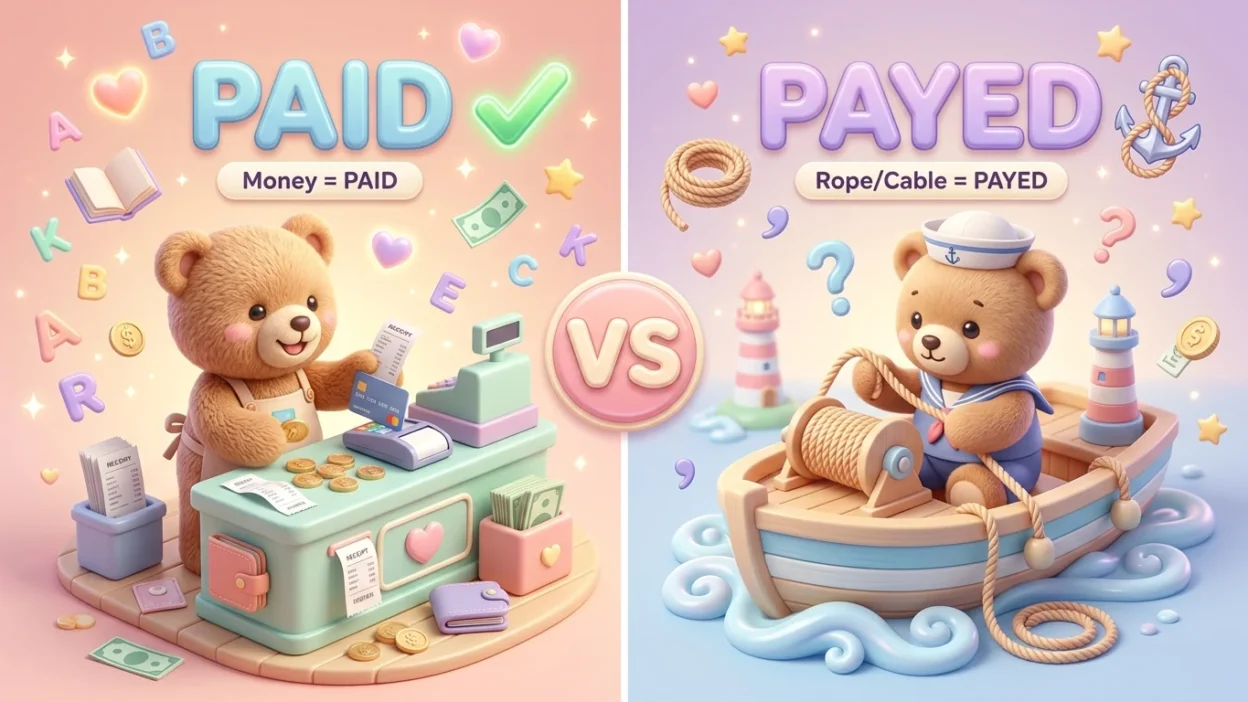
Have you ever wondered whether payed or paid is the correct spelling? You’re not alone. These two forms come from the verb pay, but they are not interchangeable in standard English. Paid is the correct past tense and past participle of pay when you mean giving money, settling a bill, or providing payment. Payed has a much more limited use and mainly appears in specialized nautical contexts.
In this guide, you’ll learn the difference between payed vs paid, including their meanings, correct usage, examples, common mistakes, grammar rules, and an easy memory trick. Once you understand where each form belongs, you’ll know exactly when to use paid and when the rare payed may be correct.
Quick Answer
- Paid ✅ — The standard past tense and past participle of pay when referring to money or payment.
- Payed ⚠️ — A rare specialized form used mainly in nautical contexts, such as paying out rope or cable.
Examples:
- I paid the bill yesterday. ✅
- She paid for the meal. ✅
- The sailor payed out the rope. ⚓
For everyday English involving money, paid is almost always the correct choice.
What Do Payed and Paid Mean?
What Does Paid Mean?
Paid is the past tense and past participle of pay.
It is used when someone gives money, settles a debt, receives compensation, or fulfills a financial obligation.
Examples:
- I paid the bill.
- She paid for the tickets.
- They paid their employees.
- He has paid the rent.
- We paid the full amount.
Paid can also be used outside direct financial situations.
For example:
- She paid attention.
- He paid a compliment.
- They paid the price for their mistake.
So, paid has several meanings beyond simply giving money.
What Does Payed Mean?
Payed is a rare and specialized form of pay.
It is mainly associated with nautical terminology, particularly when referring to paying out a rope, cable, or chain.
For example:
- The crew payed out the rope.
- The sailors payed out the cable slowly.
In everyday English, however, paid is the correct form.
Payed vs Paid Comparison Table
| Feature | Paid | Payed |
|---|---|---|
| Common English | ✅ Yes | ⚠️ Rare |
| Meaning | Gave money, settled, fulfilled | Specialized nautical use |
| Common Context | Bills, wages, purchases, debts | Rope, cable, nautical terminology |
| Example | I paid the bill. | The crew payed out the rope. |
| Memory Clue | Money = paid | Rope/cable = payed |
Why Are Payed and Paid Confused?
The confusion happens because pay looks like a regular verb that might form its past tense by adding -ed.
People may naturally think:
- Pay → payed ❌
But pay is an irregular verb in its standard financial sense.
The correct form is:
- Pay → paid ✅
Just as:
- Say → said
- Lay → laid
- Make → made
So when you mean money or payment, remember:
pay → paid
Examples of Paid in Sentences
- I paid the bill yesterday.
- She paid for her groceries.
- We paid the rent on time.
- He paid the driver.
- They paid their employees last Friday.
- I have already paid for the tickets.
- She paid attention during the meeting.
- He paid a high price for the mistake.
- We paid the full amount.
Examples of Payed in Sentences
Payed is uncommon and should not normally be used for ordinary payments.
A specialized example is:
- The sailors payed out the rope.
Another example:
- The crew payed out the cable carefully.
If you’re talking about a bill, salary, purchase, debt, rent, fee, or ordinary financial transaction, use paid.
Common Mistakes People Make
One of the most common mistakes is writing payed when talking about money.
Incorrect:
- ❌ I payed the bill yesterday.
Correct:
- ✅ I paid the bill yesterday.
Incorrect:
- ❌ She payed for the groceries.
Correct:
- ✅ She paid for the groceries.
Incorrect:
- ❌ We payed our employees.
Correct:
- ✅ We paid our employees.
The general rule is simple: money = paid.
Simple Memory Trick
💡 Memory Trick
Spelling Box
Remember:
PAY → PAID
When money is involved, use PAID.
Paid a bill
Paid rent
Paid money
Paid a salaryPAYED is mainly reserved for specialized nautical uses involving things such as rope or cable.
Rule: Money = PAID. Rope/Cable = PAYED.
Paid for Something
Use paid for when you give money in exchange for a product, service, or experience.
Examples:
- I paid for the meal.
- She paid for the tickets.
- We paid for the hotel.
- He paid for the repair.
- They paid for the groceries.
The correct form is always paid for in these ordinary contexts.
Not:
- ❌ payed for
Paid a Bill
When you settle a bill, use paid.
Examples:
- I paid the bill yesterday.
- She paid the electricity bill.
- We paid our phone bill.
- He paid the restaurant bill.
Again:
pay → paid
Paid Someone
When you give someone money, use paid.
Examples:
- The company paid its employees.
- She paid the contractor.
- We paid the driver.
- He paid the workers.
The same rule applies whether you’re talking about wages, services, or ordinary transactions.
Paid Attention
Paid is also used in the common expression pay attention.
Examples:
- Please pay attention.
- She paid attention in class.
- He wasn’t paying attention.
- They paid close attention to the instructions.
The past form is paid attention, not payed attention.
Incorrect:
- ❌ She payed attention.
Correct:
- ✅ She paid attention.
Paid the Price
The expression pay the price can be literal or figurative.
Examples:
- He paid the price for the damage.
- She paid the price for ignoring the warning.
- They paid a high price for the property.
The past form remains paid.
Payed Out in Nautical English
The unusual form payed is mainly found in specialized nautical terminology.
Pay out can mean to let out or release a rope, cable, or similar material gradually.
Examples:
- The crew payed out the rope.
- The sailors payed out the cable.
- The anchor line was payed out slowly.
This is a specialized use, so most English learners will rarely need payed.
For everyday writing, paid is overwhelmingly more common.
Payed vs Paid in Professional Writing
In business, workplace, academic, and everyday writing, use paid when discussing money.
Examples:
- The invoice was paid.
- Employees were paid on Friday.
- The customer paid the balance.
- The company has paid the supplier.
Using payed in these sentences would be considered incorrect.
Payed vs Paid in Email and Messages
When writing about payments, use paid.
Correct:
- I have paid the invoice.
- The order has been paid for.
- We paid the deposit yesterday.
- She already paid the fee.
Incorrect:
- ❌ I have payed the invoice.
- ❌ We payed the deposit yesterday.
Payed vs Paid in Different Tenses
Understanding the verb forms can make the distinction easier.
Present
- I pay the bill.
Past
- I paid the bill.
Present Perfect
- I have paid the bill.
Future
- I will pay the bill.
Present Continuous
- I am paying the bill.
Notice that payed does not appear in the ordinary financial forms.
Paid vs Payed: American vs British English
The distinction is essentially the same in American and British English.
Both varieties use:
- pay → paid for ordinary financial meanings.
Examples:
- I paid the bill.
- She paid for the service.
- They were paid on Friday.
The specialized nautical use of payed is uncommon in both varieties.
When Should You Use Paid?
Use paid when talking about:
- Money
- Bills
- Rent
- Salaries
- Wages
- Fees
- Purchases
- Debts
- Invoices
- Attention
- Compliments
- Prices
- Consequences
Examples:
- I paid the rent.
- She paid the invoice.
- He paid attention.
- They paid the price.
When Should You Use Payed?
Use payed only in rare specialized contexts, especially nautical terminology involving paying out rope, cable, or similar material.
Example:
- The crew payed out the rope.
For normal financial situations, don’t use payed.
Related Words and LSI Keywords
- payed meaning
- paid meaning
- payed vs paid
- paid definition
- payed definition
- pay past tense
- past tense of pay
- paid for
- paid bill
- paid salary
- paid rent
- paid attention
- payed out rope
- nautical terminology
- irregular verbs
- English grammar
- English spelling
- commonly confused words
- common spelling mistakes
- correct English usage
Tips for Remembering the Difference
- Pay → paid when money is involved.
- Paid is the normal past tense of pay.
- Paid for is correct.
- Paid attention is correct.
- Paid the bill is correct.
- Payed is rare and specialized.
- Think “Money = PAID.”
- Think “Rope or cable = PAYED” only in specialized nautical language.
Frequently Asked Questions
Is it payed or paid?
For ordinary English, paid is correct. Use paid when talking about money, bills, wages, purchases, or debts.
Is payed a word?
Yes, payed can occur as a specialized nautical form, particularly in expressions involving paying out rope or cable. However, it is not the standard past tense for ordinary financial meanings.
What is the past tense of pay?
The standard past tense of pay is paid.
Example: I paid the bill yesterday.
Is it paid for or payed for?
The correct phrase is paid for.
Example: She paid for the meal.
Is it paid attention or payed attention?
The correct phrase is paid attention.
Example: He paid attention during the lesson.
Is “I payed the bill” correct?
No. The correct sentence is “I paid the bill.”
What does payed mean?
Payed is a rare specialized form associated mainly with nautical usage, especially letting out rope or cable.
What does paid mean?
Paid is the past tense and past participle of pay. It commonly means giving money, settling a debt, or fulfilling a financial obligation.
Is “payed out” correct?
In specialized nautical terminology, payed out can be correct when referring to letting out rope or cable. In ordinary financial contexts, however, use paid.
What is an easy way to remember payed vs paid?
Remember MONEY = PAID. If you’re talking about a bill, purchase, salary, rent, or debt, use paid. Reserve payed for rare specialized nautical contexts.
Summary
The difference between payed vs paid is simple for everyday English: paid is the correct past tense and past participle of pay when talking about money, bills, purchases, wages, debts, or other ordinary meanings. For example, write “I paid the bill” and “She paid for the meal.”
Payed does exist, but it has a very limited specialized use, particularly in nautical language involving paying out rope or cable. For most writers and English learners, the key rule is easy: money = paid. Remember pay → paid, and you’ll avoid the most common mistake.

Cedric Halewood is known for his intricate historical narratives.
His work reflects a deep fascination with lost civilizations.
He lives near the coast, where he finds inspiration in the sea.