Have you ever written storys and wondered if it should actually be stories? You’re not alone! Plural nouns ending in -y often cause confusion, especially for English learners. Thankfully, this is one of the easiest spelling rules to remember.
In this guide, you’ll learn the difference between storys or stories, their meanings, examples, common mistakes, and simple memory tricks to help you use the correct spelling every time.
Quick Answer
Here’s the simple answer:
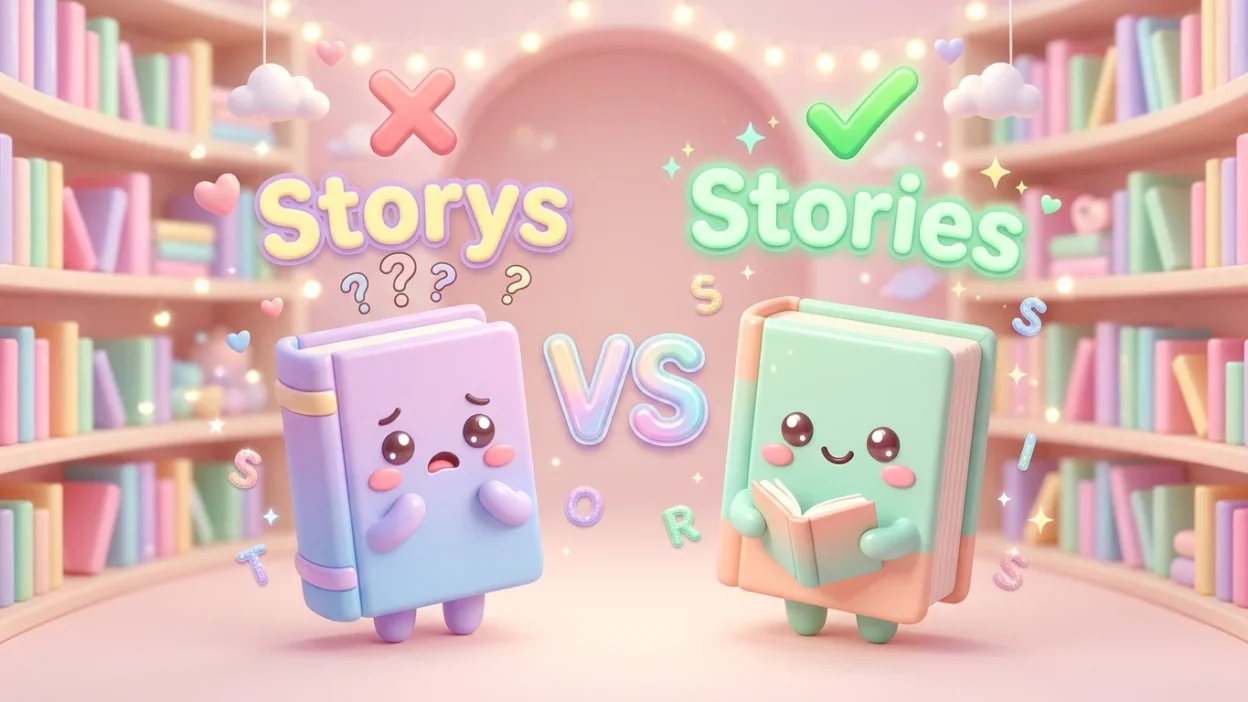
- Storys ❌ — Incorrect spelling.
- Stories ✅ — Correct spelling.
Whenever you’re referring to more than one story, always use stories.
Examples:
- I love reading bedtime stories.
- She shared several funny stories about her childhood.
What Do Storys and Stories Mean?
Although these words look similar, only one is accepted in standard English.
What Is Stories?
Stories is the plural form of the noun story.
A story can mean:
- A tale or narrative.
- An account of events.
- A level or floor in a building (mainly in American English).
Examples:
- The children listened to exciting stories.
- He wrote several short stories.
- The newspaper published inspiring stories.
- The building has three stories.
What Is Storys?
Storys is a misspelling of stories.
It is not recognized as a standard English word and should never be used in formal or informal writing.
Storys vs Stories Comparison Table
| Feature | Storys | Stories |
|---|---|---|
| Correct English Word | ❌ No | ✅ Yes |
| Dictionary Entry | No | Yes |
| Meaning | None | Plural of story |
| Used in Formal Writing | No | Yes |
| Used in Everyday English | No | Very Common |
Why Is “Stories” Correct?
English follows a simple plural rule:
If a noun ends in a consonant + y, change the y to ies.
Examples:
- Story → Stories
- City → Cities
- Baby → Babies
- Country → Countries
Therefore:
- Stories ✅ — Correct plural form.
- Storys ❌ — Incorrect spelling.
Examples of Stories in Sentences
- Grandma tells the best stories.
- We shared travel stories over dinner.
- The magazine featured success stories.
- Children enjoy imaginative stories.
- She has written dozens of mystery stories.
- The old man loved recounting war stories.
- Social media is filled with personal stories.
Common Mistakes People Make
Many writers accidentally:
- Add only s and write storys.
- Forget the y → ies rule.
- Assume every plural simply adds s.
- Miss the mistake during proofreading.
Incorrect:
- ❌ I read many storys last summer.
Correct:
- ✅ I read many stories last summer.
Simple Memory Trick
Here’s an easy trick:
Consonant + Y = Change Y to IES
Think:
- Story → Stories
- Family → Families
- Party → Parties
Remember:
“Stories always travel with IES.”
When Should You Use Stories?
Use stories whenever you’re talking about:
- Books and tales
- Personal experiences
- News reports
- Social media stories
- Building floors (American English)
Examples:
- Fairy stories
- Success stories
- Instagram stories
- Horror stories
- Three-story building
When Should You Use Storys?
Never.
Storys is always a spelling mistake and should be corrected to stories.
American vs British English
There is one small difference worth noting:
- In American English, a building level is called a story (e.g., a three-story building).
- In British English, it is usually spelled storey (plural: storeys).
However, for tales and narratives, both American and British English use:
- ✅ Stories
- ❌ Storys
Related Words and LSI Keywords
- story plural
- stories meaning
- English plural rules
- nouns ending in y
- English spelling
- grammar guide
- vocabulary
- language learning
- proofreading
- commonly confused words
- writing correctly
- English usage
- plural nouns
- word comparison
Tips for Remembering the Difference
Remember these simple tips:
- Change y to ies after a consonant.
- Think: story → stories.
- Never write storys.
- Practice with similar words like party and country.
- Use spell check if you’re unsure.
Frequently Asked Questions
Is storys a real word?
No. Storys is not recognized as a standard English word.
Which is correct: storys or stories?
Stories is the correct spelling.
Why does story become stories?
Because English grammar changes nouns ending in a consonant plus y to ies when forming the plural.
Is stories used in American and British English?
Yes. Both varieties use stories for tales and narratives.
What is the singular form of stories?
The singular form is story.
Can I use storys in formal writing?
No. Always use stories.
Summary
The difference between storys or stories is simple. Stories is the correct plural form of story, while storys is a common spelling mistake. English grammar requires changing the final y to ies when a noun ends with a consonant followed by y.
Whenever you’re writing about books, experiences, or adventures, remember this easy rule: story becomes stories. Once you master the y → ies pattern, you’ll find many other English plurals much easier to spell correctly.

Alistair Fenwicke is a quiet observer of rural life and forgotten histories.
His novels explore memory, solitude, and the passing of time.
He writes from a small countryside cottage surrounded by fields.