
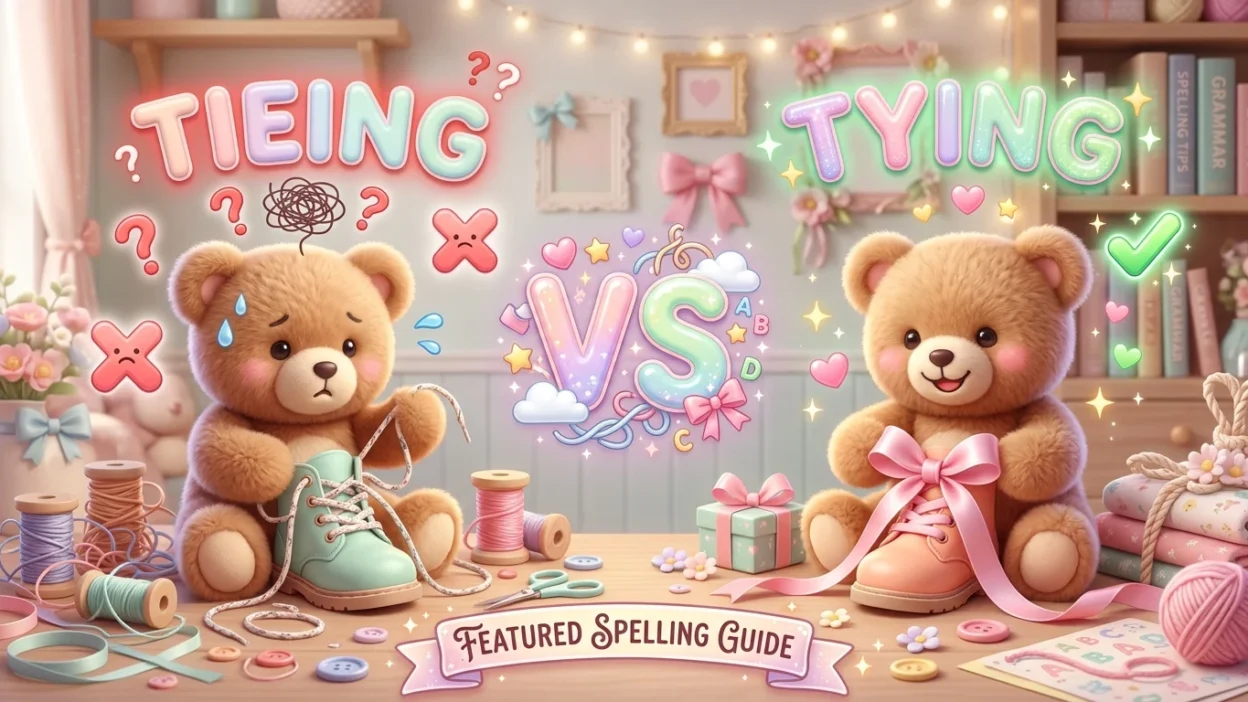
Have you ever wondered whether tieing or tying is the correct spelling? You’re not alone! Many people write tieing because they expect the verb tie to keep its final e when adding -ing. However, standard English uses a different spelling.
In this guide, you’ll learn the difference between tieing vs tying, their meanings, examples, common mistakes, and a simple memory trick to help you remember the correct form.
Quick Answer
- Tying ✅ — Correct spelling.
- Tieing ❌ — Incorrect spelling in standard modern English.
Use tying when you mean fastening, connecting, or securing something with a knot, string, rope, or similar material.
Examples:
- She is tying her shoes.
- He is tying a knot in the rope.
What Do Tieing and Tying Mean?
Although both forms are closely related, only one is the standard spelling used in modern English.
What Is Tying?
Tying is the present participle of tie. It means fastening, securing, connecting, or attaching something.
Examples:
- She is tying her shoelaces.
- He was tying the package with string.
- They are tying the boat to the dock.
- I am tying a knot.
What Is Tieing?
Tieing is generally considered an incorrect spelling of tying in standard modern English.
The confusion happens because people may assume that the final e in tie should remain before adding -ing. However, the spelling changes from tie to tying.
Tieing vs Tying Comparison Table
| Feature | Tieing | Tying |
|---|---|---|
| Standard Modern Spelling | ❌ No | ✅ Yes |
| Base Verb | Tie | Tie |
| Meaning | Usually intended to mean fastening | Fastening or securing |
| Used in Formal Writing | No | Yes |
| Used in Everyday English | No | Very Common |
Why Is “Tying” Correct?
The correct spelling is:
T-I-E → T-Y-I-N-G
When tie becomes tying, the ie changes to y before -ing is added.
This spelling pattern also appears in related verbs:
- Tie → Tying
- Lie → Lying
- Die → Dying
Therefore:
- Tying ✅ — Correct.
- Tieing ❌ — Incorrect.
Examples of Tying in Sentences
- She is tying her shoes.
- He is tying a ribbon around the gift.
- The sailor is tying the rope securely.
- We were tying balloons to the chairs.
- She spent several minutes tying the package.
- He learned how to tie a knot while tying the fishing line.
- They are tying the boat to the dock.
Common Mistakes People Make
Many writers accidentally:
- Write tieing instead of tying.
- Keep the original ie from tie.
- Apply the wrong -ing spelling pattern.
- Miss the error while proofreading.
Incorrect:
- ❌ She is tieing her shoes.
Correct:
- ✅ She is tying her shoes.
Simple Memory Trick
💡 Memory Trick
Spelling Rule Box
When tie takes -ing, change ie to y:
Tie → Tying
Remember the same pattern:
Lie → Lying
Die → Dying
Rule: IE → Y before -ing.
When Should You Use Tying?
Use tying when someone is:
- Fastening shoelaces.
- Making a knot.
- Securing a rope.
- Attaching something.
- Connecting objects.
- Fastening a package.
Examples:
- Tying shoes.
- Tying a knot.
- Tying a ribbon.
- Tying a rope.
- Tying a package.
- Tying balloons.
When Should You Use Tieing?
In standard modern English, don’t use tieing as the present participle of tie.
Use tying instead.
American vs British English
There is no spelling difference between American and British English.
Both varieties use:
- ✅ Tying
- ❌ Tieing
The spelling is the same in both forms of English.
Related Words and LSI Keywords
- tying meaning
- tying definition
- tie
- tied
- tying shoes
- tying a knot
- fastening
- securing
- connecting
- English spelling rules
- commonly misspelled words
- grammar guide
- vocabulary tips
- proofreading
- correct English usage
Tips for Remembering the Difference
- Tie → Tying.
- Change ie to y before adding -ing.
- Remember lie → lying and die → dying.
- Don’t write tieing in standard modern English.
- Proofread words ending in -ing carefully.
Frequently Asked Questions
Is tieing a correct spelling?
No. In standard modern English, tying is the correct spelling.
Which is correct: tieing or tying?
Tying is the correct spelling.
Why does tie become tying?
The ie in tie changes to y before the -ing ending is added.
Is tying used in American and British English?
Yes. Both American and British English use tying.
What is the base word of tying?
The base verb is tie.
What is the past tense of tie?
The past tense is tied.
Summary
The difference between tieing vs tying is simple. Tying is the correct standard spelling when describing the act of fastening, securing, or connecting something. Tieing is an incorrect spelling in modern standard English.
The easiest way to remember the correct form is to recognize the spelling change from tie → tying. The ie changes to y before -ing, just as it does in lie → lying and die → dying.

Cedric Halewood is known for his intricate historical narratives.
His work reflects a deep fascination with lost civilizations.
He lives near the coast, where he finds inspiration in the sea.