
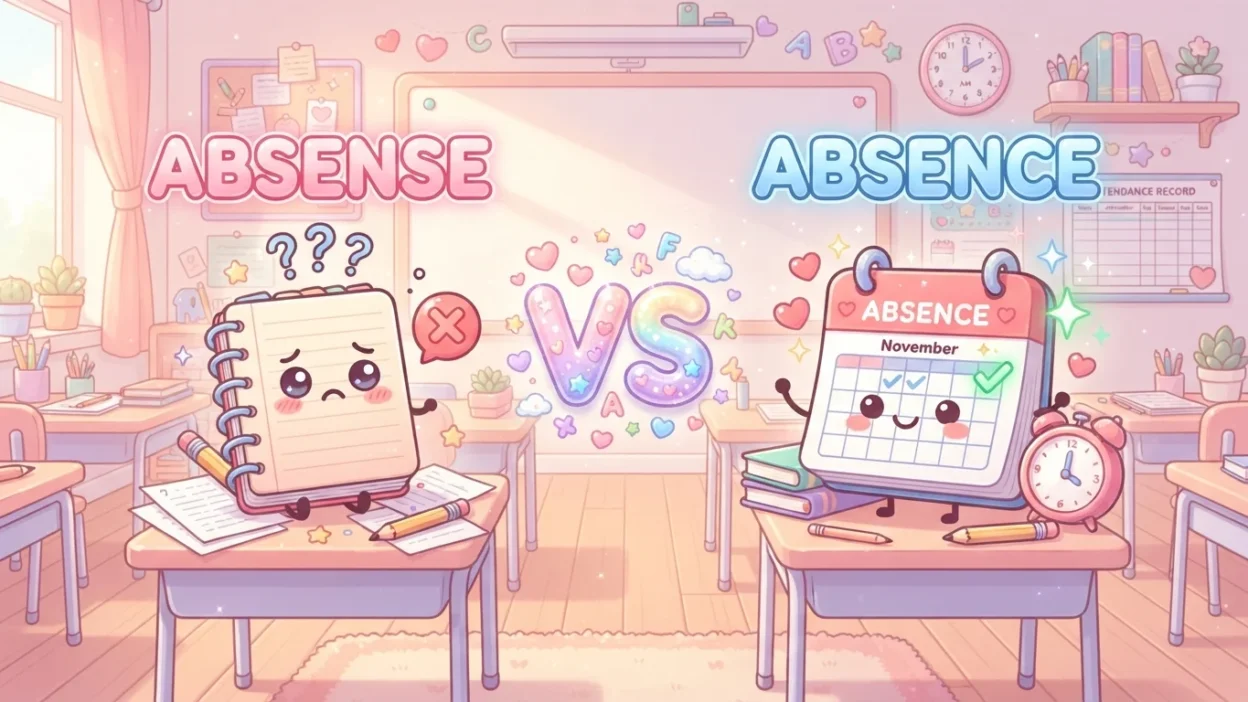
Have you ever wondered whether absence or absense is the correct spelling? You’re not alone! Many people accidentally write absense because it sounds similar to the correct word. However, only one spelling is accepted in standard English.
In this guide, you’ll learn the difference between absence vs absense, their meanings, examples, common mistakes, and an easy memory trick to help you remember the correct spelling.
Quick Answer
- Absence ✅ — Correct spelling.
- Absense ❌ — Incorrect spelling.
Use absence whenever you’re referring to the state of being away, missing, or not present.
Examples:
- Her absence was noticed during the meeting.
- The teacher explained the reason for his absence.
What Do Absence and Absense Mean?
Although these words look alike, only one is recognized in standard English.
What Is Absence?
Absence is a noun that means:
- The state of not being present.
- A period during which someone is away.
- The lack or missing of something.
Examples:
- His absence worried his friends.
- The manager approved her absence from work.
- The absence of evidence does not prove anything.
- We missed her cheerful attitude during her absence.
What Is Absense?
Absense is a misspelling of absence.
It is not recognized as a standard English word and should never be used in formal or informal writing.
Absence vs Absense Comparison Table
| Feature | Absense | Absence |
|---|---|---|
| Correct English Word | ❌ No | ✅ Yes |
| Dictionary Entry | No | Yes |
| Meaning | None | State of being away or missing |
| Used in Formal Writing | No | Yes |
| Used in Everyday English | No | Very Common |
Why Is “Absence” Correct?
The correct spelling is:
A-B-S-E-N-C-E
Many writers mistakenly replace “ce” with “se” because both endings sound similar. However, the correct noun always ends in “-ence.”
Therefore:
- Absence ✅ — Correct spelling.
- Absense ❌ — Incorrect spelling.
Examples of Absence in Sentences
- Her absence affected the entire team.
- Please explain your absence from class.
- His long absence surprised everyone.
- We noticed the absence of important documents.
- The doctor wrote a note explaining her absence.
- Their absence delayed the meeting.
- The absence of rain caused dry conditions.
Common Mistakes People Make
Many writers accidentally:
- Write absense instead of absence.
- Replace “-ence” with “-ense.”
- Spell the word based on pronunciation.
- Miss the typo while proofreading.
Incorrect:
- ❌ Your absense was noticed yesterday.
Correct:
- ✅ Your absence was noticed yesterday.
Simple Memory Trick
💡 Memory Trick
- Absence ends with “ENCE.”
- Think of presence—both words end with “ence.”
Rule: If someone is missing, always write absence with “-ence.”
When Should You Use Absence?
Use absence when talking about:
- School.
- Work.
- Meetings.
- Missing people.
- Missing objects.
- Lack of something.
Examples:
- School absence.
- Leave of absence.
- Absence from work.
- Absence of evidence.
- Absence of light.
- Unexpected absence.
When Should You Use Absense?
Never.
Absense is always a spelling mistake and should be corrected to absence.
American vs British English
There is no spelling difference between American and British English.
Both varieties use:
- ✅ Absence
- ❌ Absense
The spelling is identical throughout the English-speaking world.
Related Words and LSI Keywords
- absence meaning
- absence definition
- leave of absence
- absent
- missing
- nonattendance
- lack
- English spelling rules
- commonly misspelled words
- vocabulary guide
- grammar tips
- proofreading
- language learning
- correct English usage
Tips for Remembering the Difference
- Absence always ends with “-ence.”
- Connect absence with presence.
- Never replace “ce” with “se.”
- Proofread carefully before publishing.
- Use spell check if you’re uncertain.
Frequently Asked Questions
Is absense a real word?
No. Absense is not recognized as a standard English word.
Which is correct: absence or absense?
Absence is the correct spelling.
What does absence mean?
It means the state of being away, missing, or not present.
Is absence used in American and British English?
Yes. Both varieties use the same spelling.
Can I use absense in formal writing?
No. Always use absence.
What is the difference between absent and absence?
Absent is an adjective describing someone who is not present, while absence is the noun referring to the state of being away.
Summary
The difference between absence vs absense is simple. Absence is the correct English spelling used to describe someone or something that is not present. Absense is a common spelling mistake and should never be used in standard English.
Whenever you’re writing about someone being away or something being missing, remember that absence always ends with “-ence.”

Rowan Blythecroft crafts atmospheric fiction filled with mystery and folklore.
Her stories often blur the line between reality and imagination.
She spends most of her days wandering forests and writing by candlelight.