Have you ever written costumer when you meant customer? You’re not alone! These two words look very similar, but they have completely different meanings. Choosing the wrong one can make your writing confusing, especially in business or shopping contexts.
In this guide, you’ll learn the difference between costumer vs customer, their meanings, examples, common mistakes, and an easy memory trick to help you remember the correct word.
Quick Answer
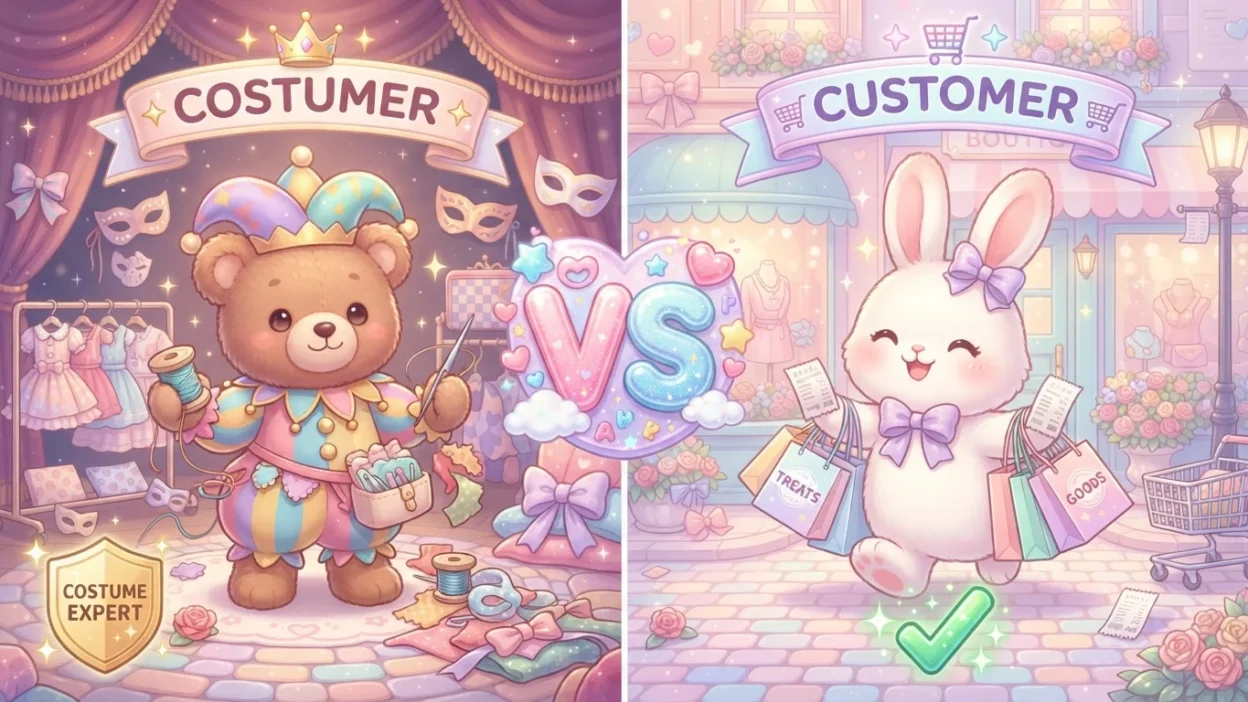
- Customer ✅ — A person who buys goods or services.
- Costumer ✅ — A person who makes, designs, or sells costumes.
Examples:
- The customer paid for the groceries.
- The theater hired a costumer to create the actors’ outfits.
What Do Customer and Costumer Mean?
Both words are real English words, but they are used in very different situations.
What Is Customer?
Customer is a noun that means:
- A person who buys products.
- A person who pays for services.
- A client or shopper.
Examples:
- The customer asked for a refund.
- Our store values every customer.
- The restaurant serves hundreds of customers each day.
- A satisfied customer is more likely to return.
What Is Costumer?
Costumer is a noun that means:
- A person who designs costumes.
- A person who makes costumes.
- A person who sells or rents costumes, especially for theater, film, or events.
Examples:
- The costumer designed beautiful dresses for the play.
- A professional costumer prepared the actors’ outfits.
- The film studio employed an experienced costumer.
Costumer vs Customer Comparison Table
| Word | Meaning | Example |
|---|---|---|
| Customer | A buyer or client | The customer paid the bill. |
| Costumer | A costume designer or seller | The costumer created the costumes. |
Why Do People Confuse Them?
The confusion happens because the words differ by only one letter:
- Customer → u
- Costumer → o
When typing quickly, it’s easy to replace u with o. However, the meanings are very different.
Incorrect:
- ❌ The costumer bought a new phone.
Correct:
- ✅ The customer bought a new phone.
Examples of Customer in Sentences
- Every customer received a discount.
- The customer service team answered my question.
- She is a loyal customer of the bakery.
- The company listens carefully to customer feedback.
- A happy customer often recommends the business to others.
Examples of Costumer in Sentences
- The costumer prepared the outfits for the parade.
- She works as a costumer in a theater company.
- The costumer repaired the actor’s jacket before the show.
- A skilled costumer can create historical clothing.
Common Mistakes People Make
Many writers accidentally:
- Use costumer when talking about shopping.
- Use customer when talking about theater or costumes.
- Miss the spelling difference while proofreading.
Wrong business sentence:
- ❌ We appreciate every costumer.
Correct business sentence:
- ✅ We appreciate every customer.
Wrong theater sentence:
- ❌ The customer designed the costumes for the movie.
Correct theater sentence:
- ✅ The costumer designed the costumes for the movie.
Simple Memory Trick
💡 Memory Trick
- Customer has U for YOU, the person buying something.
- Costumer has O for Outfit, which is related to costumes.
Rule: Buying something? Customer. Making costumes? Costumer.
When Should You Use Customer?
Use customer when talking about:
- Stores.
- Restaurants.
- Online shopping.
- Banking.
- Hotels.
- Any business that sells products or services.
Examples:
- Customer service.
- Customer support.
- Customer satisfaction.
- Customer feedback.
- Loyal customer.
- New customer.
When Should You Use Costumer?
Use costumer when talking about:
- Theater productions.
- Movies.
- Costume design.
- Fashion for performances.
- Costume rental shops.
- Historical clothing creation.
Examples:
- Theater costumer.
- Film costumer.
- Costume designer.
- Costume maker.
- Costume rental specialist.
American vs British English
There is no spelling difference between American and British English.
Both varieties use:
- Customer for a buyer.
- Costumer for a costume professional.
Related Words and LSI Keywords
- customer meaning
- costumer meaning
- customer service
- customer support
- costume designer
- theater costumes
- client
- shopper
- buyer
- costume maker
- English vocabulary
- commonly confused words
- spelling differences
- correct English usage
Tips for Remembering the Difference
- Think U = YOU = buyer = customer.
- Think O = Outfit = costumer.
- Check the context before writing.
- Proofread business documents carefully.
- Remember that both words are real, so spell check may not catch the mistake.
Frequently Asked Questions
Is costumer a real word?
Yes. Costumer is a real English word meaning a person who designs, makes, sells, or rents costumes.
Which is correct for a buyer: costumer or customer?
Customer is correct for a buyer or client.
What does costumer mean?
It refers to someone who works with costumes, especially in theater, film, or events.
Is customer used in American and British English?
Yes. Both varieties use the same word for a buyer.
Why is “We value every costumer” wrong?
Because a business values its customers (buyers), not its costume designers.
Can one person be both a customer and a costumer?
Yes. A costume designer who buys fabric from a store is both a costumer and a customer in different contexts.
Summary
The difference between costumer vs customer is all about meaning. A customer buys products or services, while a costumer designs, makes, sells, or rents costumes. Because both words are real English words, they are easy to confuse, but the context will tell you which one you need.
Whenever you’re writing about shopping, business, or clients, choose customer. Whenever you’re writing about theater, movies, or costumes, choose costumer.

Rowan Blythecroft crafts atmospheric fiction filled with mystery and folklore.
Her stories often blur the line between reality and imagination.
She spends most of her days wandering forests and writing by candlelight.