
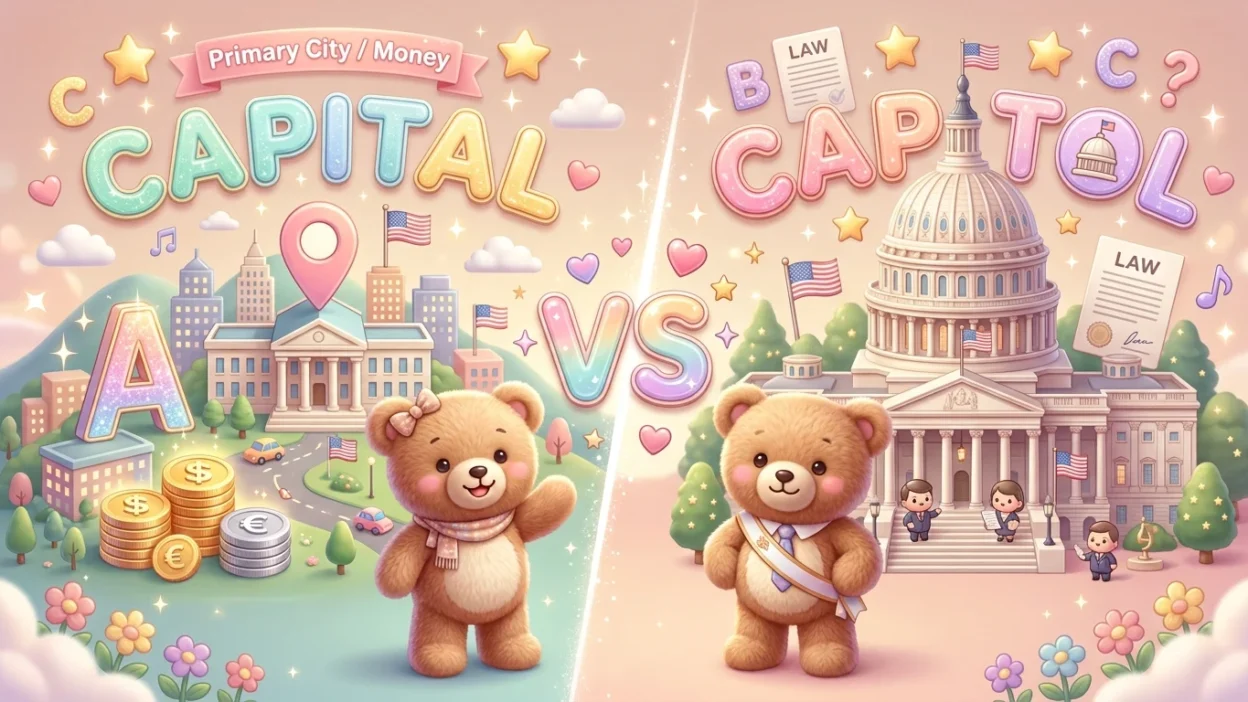
Have you ever wondered whether capital or capitol is the correct word? You’re not alone. These two words sound exactly alike in many varieties of English, but they have different meanings and uses. Capital can refer to a city, money, an uppercase letter, or something important, while capitol specifically refers to a building where a legislature meets.
In this guide, you’ll learn the difference between capital vs capitol, their meanings, examples, common mistakes, and a simple memory trick. Once you understand what each word describes, you’ll find it much easier to choose the correct spelling.
Quick Answer
- Capital ✅ — A city that serves as a seat of government, money or financial assets, an uppercase letter, or something important.
- Capitol ✅ — A building where a legislative body meets, especially a state legislature or the U.S. Congress.
Examples:
- Washington, D.C. is the capital of the United States.
- The U.S. Capitol is where the U.S. Congress meets.
What Do Capital and Capitol Mean?
What Does Capital Mean?
Capital has several meanings, making it a very common English word.
One of its most important meanings is a city that serves as the official seat of government.
Examples:
- Paris is the capital of France.
- Islamabad is the capital of Pakistan.
- Tokyo is the capital of Japan.
Capital can also refer to money, wealth, or financial resources used for business or investment.
Example:
- The company needs more capital to expand.
It can also mean an uppercase letter.
Example:
- Begin the sentence with a capital letter.
Additionally, capital can describe something extremely important or serious.
Example:
- The decision was of capital importance.
What Does Capitol Mean?
Capitol refers to a building where a legislative body meets.
The word is especially associated with the U.S. Capitol and state capitol buildings.
Examples:
- Congress meets in the U.S. Capitol.
- The state legislature gathered at the Capitol.
- Tourists visited the Capitol building.
The important distinction is:
Capital = city
Capitol = legislative building
Capital vs Capitol Comparison Table
| Feature | Capital | Capitol |
|---|---|---|
| Main Meaning | Government city, money, uppercase letter, importance | Legislative building |
| Common Context | Cities, finance, writing, importance | Government buildings |
| Example | Islamabad is the capital of Pakistan. | The legislature meets in the Capitol. |
| Pronunciation | Usually the same | Usually the same |
| Memory Clue | Capital = city | Capitol = building |
Why Are Capital and Capitol Confused?
Capital and capitol are homophones in standard English: they are pronounced the same but have different spellings and meanings.
This makes them easy to confuse when writing.
For example:
- ❌ Washington, D.C. is the Capitol of the United States.
- ✅ Washington, D.C. is the capital of the United States.
However:
- ❌ Congress meets in the U.S. capital.
- ✅ Congress meets in the U.S. Capitol.
The key is to remember whether you’re talking about a city or a building.
Examples of Capital in Sentences
- Islamabad is the capital of Pakistan.
- London is the capital of the United Kingdom.
- The company raised additional capital.
- Always use a capital letter at the beginning of a sentence.
- Education is of capital importance.
- The country moved its capital to a new city.
- The business needs more capital to grow.
Examples of Capitol in Sentences
- Congress meets in the U.S. Capitol.
- The state legislature met inside the Capitol.
- The visitors toured the Capitol building.
- Protesters gathered outside the Capitol.
- The Capitol has an impressive dome.
- The governor delivered a speech near the state Capitol.
Common Mistakes People Make
One common mistake is using capitol when referring to a city that serves as a country’s or state’s seat of government.
Incorrect:
- ❌ Islamabad is the capitol of Pakistan.
Correct:
- ✅ Islamabad is the capital of Pakistan.
Another common mistake is using capital for a legislative building.
Incorrect:
- ❌ Congress meets in the U.S. capital.
Correct:
- ✅ Congress meets in the U.S. Capitol.
Remember:
Capital = city
Capitol = building
Simple Memory Trick
💡 Memory Trick
Spelling Box
Remember:
CAPITAL = CITY
CAPITOL = BUILDING
Think of the O in Capitol as a tiny dome on a government building.
Rule: Capital is the government city; Capitol is the legislative building.
Capital as a Government City
A capital is the city where a national, regional, or state government is based.
Examples:
- Islamabad is the capital of Pakistan.
- Washington, D.C. is the capital of the United States.
- London is the capital of the United Kingdom.
- Canberra is the capital of Australia.
When you’re naming the city that serves as the official government center, use capital.
Capitol as a Legislative Building
A capitol is a building where a legislature meets.
In the United States, the term is especially associated with:
- The U.S. Capitol.
- State capitols.
For example:
- The U.S. Senate meets in the Capitol.
- The state legislature gathered at the Capitol.
The building is the capitol, while the city containing the building can be the capital.
Capital vs Capitol in the United States
The distinction becomes especially important when discussing the United States.
Washington, D.C. is the nation’s capital.
The U.S. Capitol is the building where Congress meets.
So:
- Capital → Washington, D.C.
- Capitol → U.S. Capitol building.
A simple sentence to remember is:
Washington, D.C., is the capital, and the U.S. Capitol is the legislative building.
Capital as Money
Capital has another common meaning in business and economics.
It can refer to money, wealth, property, or financial resources used to operate or expand a business.
Examples:
- The company needs more capital.
- The investor provided enough capital to launch the business.
- The business raised capital for expansion.
This meaning has nothing to do with government buildings.
Capital as an Uppercase Letter
Capital can also mean an uppercase letter.
Examples:
- Write your name with a capital letter.
- The sentence begins with a capital.
- Proper nouns usually begin with a capital letter.
For example:
- London begins with a capital L.
- Pakistan begins with a capital P.
When Should You Use Capital?
Use capital when you’re talking about:
- A government city.
- Financial resources.
- An uppercase letter.
- Something extremely important.
Examples:
- The capital of France is Paris.
- The company needs capital.
- Use a capital letter.
- The issue is of capital importance.
When Should You Use Capitol?
Use capitol when you’re talking about:
- A legislative building.
- The U.S. Capitol.
- A state capitol building.
Examples:
- Congress meets at the U.S. Capitol.
- The state legislature is inside the Capitol.
- Tourists visited the Capitol.
American vs British English
The distinction is especially important in American English because capitol is commonly used for legislative buildings.
Capital remains the standard word for a government city in both American and British English.
The word capitol is less common in British English because the governmental building terminology differs in many contexts.
However, the basic distinction remains:
- Capital = government city.
- Capitol = legislative building.
Related Words and LSI Keywords
- capital meaning
- capitol meaning
- capital vs capitol
- capital city
- capitol building
- U.S. Capitol
- state capitol
- capital city definition
- legislative building
- government city
- capital letter
- financial capital
- business capital
- homophones
- commonly confused words
- English grammar
- English vocabulary
- spelling mistakes
- correct English usage
- capital and capitol difference
Tips for Remembering the Difference
- Capital = city.
- Capitol = legislative building.
- Think of the O in Capitol as a building dome.
- Washington, D.C. is the capital.
- The U.S. Capitol is the building.
- Capital can also mean money or an uppercase letter.
Frequently Asked Questions
Is it capital or capitol?
Both are correct words, but they have different meanings. Capital can refer to a government city, money, or an uppercase letter. Capitol refers to a legislative building.
What is the difference between capital and capitol?
A capital is often a city that serves as a government center, while a capitol is a building where a legislature meets.
Is Washington, D.C. a capital or capitol?
Washington, D.C. is the capital of the United States.
Is the U.S. Capitol a capital or capitol?
The correct term is U.S. Capitol because it refers to the building where the U.S. Congress meets.
Is capitol used for a city?
No. When referring to a city that serves as a government center, use capital.
Are capital and capitol pronounced the same?
Yes. In standard English, capital and capitol are pronounced the same.
What is an easy way to remember capital vs capitol?
Remember capital = city and capitol = building. You can also imagine the O in Capitol as the rounded dome of a government building.
Summary
The difference between capital vs capitol becomes simple when you focus on what you’re describing. Capital has several meanings, including a government city, financial resources, and an uppercase letter. Capitol, however, specifically refers to a legislative building, especially in the United States.
The easiest memory trick is capital = city and capitol = building. Washington, D.C. is the capital of the United States, while the U.S. Capitol is the building where Congress meets. Remembering this distinction will help you avoid one of the most common English homophone mistakes.

Rowan Blythecroft crafts atmospheric fiction filled with mystery and folklore.
Her stories often blur the line between reality and imagination.
She spends most of her days wandering forests and writing by candlelight.