Have you ever wondered whether anyway or anyways is the correct word? You’re not alone. Both forms appear frequently in everyday English, especially in conversations, texts, and informal writing. However, anyway is the standard form used in formal and standard English, while anyways is generally considered informal and is more common in casual speech.
In this guide, you’ll learn the difference between anyway vs anyways, including their meanings, examples, grammar rules, common mistakes, American and British English usage, and a simple memory trick. By the end, you’ll know exactly which form to choose in professional and casual situations.
Quick Answer
- Anyway ✅ — The standard and widely accepted form. It can mean regardless, in any case, or returning to a previous point.
- Anyways ⚠️ — An informal variant of anyway, commonly heard in casual speech, especially in American English.
Examples:
- Anyway, let’s continue with the discussion.
- I’ll go anyway, even if nobody else comes.
What Do Anyway and Anyways Mean?
What Does Anyway Mean?
Anyway is an adverb with several related uses.
It can mean regardless, in any case, or despite what was just mentioned.
Example:
- It was raining, but we went outside anyway.
Here, anyway means despite the rain or regardless.
It can also help someone return to the main topic of a conversation.
Example:
- Anyway, let’s get back to the main point.
Another common use is to emphasize that something is true regardless of circumstances.
Example:
- I wasn’t sure about the plan, but I decided to try it anyway.
What Does Anyways Mean?
Anyways is an informal variant of anyway.
It is common in casual conversations, texts, social media posts, and informal speech.
Examples:
- Anyways, what were you saying?
- I didn’t like the movie anyways.
- Anyways, let’s move on.
Although many native speakers use anyways, it is generally less appropriate in formal writing.
For professional emails, academic assignments, reports, and formal documents, anyway is usually the better choice.
Anyway vs Anyways Comparison Table
| Feature | Anyway | Anyways |
|---|---|---|
| Standard English | ✅ Yes | ⚠️ Informal |
| Part of Speech | Adverb | Adverb |
| Common Use | Formal and informal | Mostly casual |
| Meaning | Regardless, in any case | Usually the same as anyway |
| Example | Anyway, let’s continue. | Anyways, let’s continue. |
| Best for Formal Writing | ✅ Yes | ❌ Usually avoid |
Why Are Anyway and Anyways Confused?
The confusion comes from the fact that anyways sounds natural in casual conversation.
English contains many words that have informal variants, and anyways has become familiar to many speakers.
However, the standard form is anyway.
Compare:
- Anyway, let’s begin.
- Anyways, let’s begin.
The first version is standard and works in virtually every context. The second sounds casual and conversational.
Therefore, if you’re unsure, choose anyway.
Examples of Anyway in Sentences
- I was tired, but I finished the work anyway.
- Anyway, let’s talk about something else.
- She didn’t want to go, but she came anyway.
- It may be difficult, but I’ll try anyway.
- I don’t completely agree, but I understand your point anyway.
- Anyway, what happened next?
- We missed the bus, so we walked anyway.
Examples of Anyways in Sentences
- Anyways, what are you doing tomorrow?
- I didn’t really want it anyways.
- Anyways, let’s get started.
- She wasn’t interested anyways.
- Anyways, that’s all I wanted to say.
- I was going to call you anyways.
These examples are natural in casual conversation, but anyway is generally preferable in formal writing.
Common Mistakes People Make
The most common mistake is assuming that anyways is always incorrect.
It isn’t necessarily wrong in informal speech. Many speakers use it naturally.
However, using anyways in formal writing can make your writing sound overly casual.
For example, in a professional email:
- ⚠️ Anyways, I wanted to follow up on our discussion.
Better:
- ✅ Anyway, I wanted to follow up on our discussion.
Another mistake is believing that anyway and anyways must always have different meanings. In most modern usage, they can perform the same basic functions, but anyways carries a more informal tone.
Simple Memory Trick
💡 Memory Trick
Spelling Box
Remember:
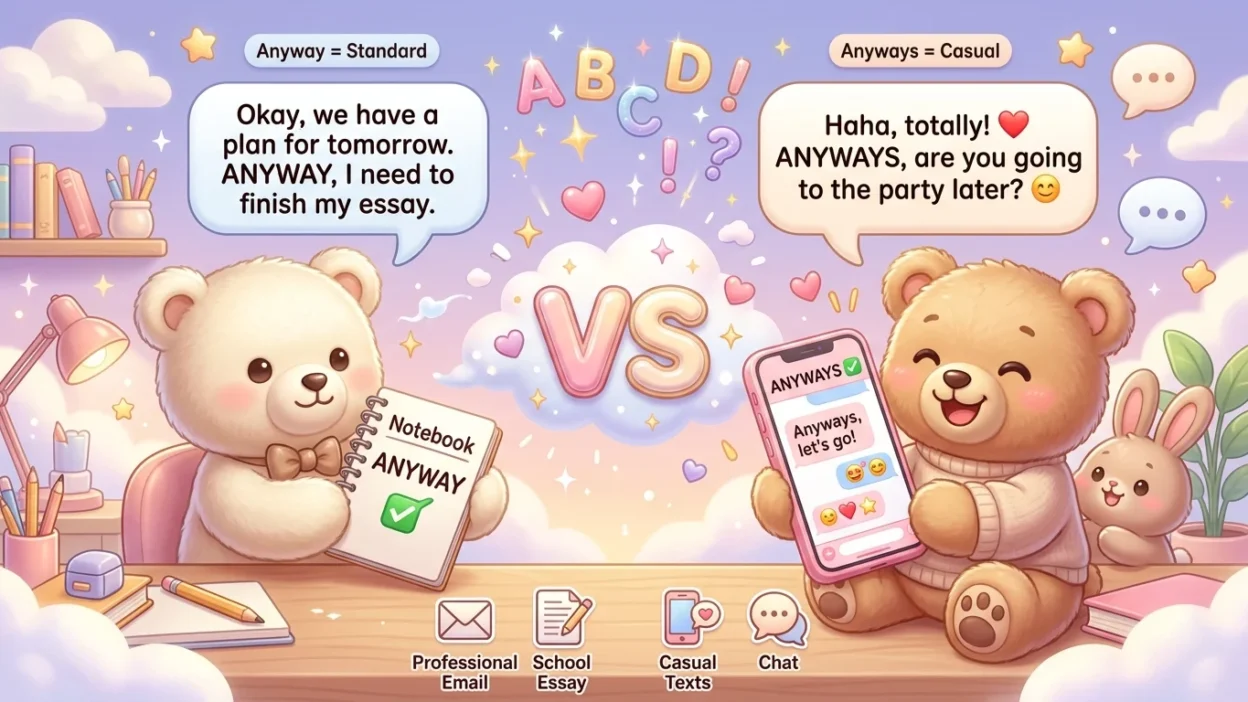
ANYWAY = STANDARD
ANYWAYS = CASUAL
If you’re writing an email, essay, report, or professional message, choose anyway.
If you’re chatting casually, anyways may appear naturally.
Rule: When in doubt, use anyway.
Anyway as “Regardless”
One of the most common uses of anyway is to mean regardless or in spite of something.
Examples:
- It was expensive, but I bought it anyway.
- He was nervous, but he gave the presentation anyway.
- She knew it would be difficult, but she tried anyway.
In these examples, anyway shows that the action happened despite a difficulty or reason not to do it.
Anyway for Changing or Returning to a Topic
Anyway is also useful in conversations when someone wants to return to the main topic.
Examples:
- Anyway, where were we?
- Anyway, let’s get back to work.
- Anyway, I wanted to tell you something.
- Anyway, what happened after that?
This use is especially common in everyday speech.
Anyway at the End of a Sentence
Anyway can appear at the end of a sentence.
Examples:
- I didn’t really like it anyway.
- We were going to leave anyway.
- She wasn’t interested anyway.
In these cases, anyway often reinforces the idea that something would have happened regardless.
Anyways in Casual Conversation
Anyways is often heard in casual conversations.
Examples:
- Anyways, what are we doing tonight?
- Anyways, I have to go.
- I wasn’t interested anyways.
While this form is common, it can sound less polished in formal contexts.
If you’re writing for school, work, business, or professional communication, anyway is the safer choice.
When Should You Use Anyway?
Use anyway when:
- Writing formally.
- Writing academically.
- Sending professional emails.
- Writing reports or articles.
- Speaking in standard English.
- Meaning “regardless” or “in any case.”
- Returning to a previous topic.
Examples:
- Anyway, let’s continue.
- I’ll do it anyway.
- Anyway, let’s discuss the next point.
When Should You Use Anyways?
Use anyways mainly when:
- Speaking casually.
- Texting friends.
- Writing informal social media posts.
- Reproducing conversational speech.
- Intentionally creating a relaxed tone.
Examples:
- Anyways, I’ll see you tomorrow.
- I didn’t want to go anyways.
Even in casual writing, anyway is always acceptable, so it is the safer option.
Anyway vs Anyways in Professional Writing
In professional writing, anyway is strongly preferred.
For example:
- ❌ Anyways, I wanted to follow up.
- ✅ Anyway, I wanted to follow up.
The standard form looks cleaner and more polished.
For business emails, resumes, reports, articles, and academic writing, use anyway unless you’re intentionally quoting informal speech.
American vs British English
Anyway is standard in both American and British English.
Anyways is also heard in both varieties, but it is generally informal.
In American English, anyways is particularly familiar in casual speech and informal writing.
British English also uses anyways, especially in informal or conversational contexts, but anyway remains the standard form.
Therefore, if you’re writing formally for either audience, anyway is the best choice.
Related Words and LSI Keywords
- anyway meaning
- anyways meaning
- anyway vs anyways
- is anyways a word
- is anyways correct
- anyway definition
- anyways definition
- anyway in a sentence
- anyways in a sentence
- informal English
- formal English
- standard English
- casual English
- conversational English
- regardless
- in any case
- despite that
- English grammar
- commonly confused words
- correct English usage
- professional writing
Tips for Remembering the Difference
- Anyway is the standard form.
- Anyways is informal.
- Use anyway in professional and academic writing.
- Anyway can mean “regardless” or “in any case.”
- Anyway can help return a conversation to the main topic.
- When you’re unsure, always choose anyway.
Frequently Asked Questions
Is it anyway or anyways?
Both forms are used, but anyway is the standard form. Anyways is generally informal and more common in casual speech.
Is anyways a real word?
Yes, anyways is used in English, particularly in informal speech and writing. However, anyway is the standard form and is preferred in formal contexts.
Is anyway more correct than anyways?
For standard and formal English, anyway is generally the better choice. Anyways is an informal variant.
Can I use anyways in a formal email?
It’s better to avoid anyways in formal emails. Use anyway instead.
What does anyway mean?
Anyway can mean regardless, in any case, or can be used to return to a previous topic in conversation.
Is anyways used in American English?
Yes. Anyways is common in informal American English, especially in casual conversation.
Is anyways used in British English?
Yes, but it is generally informal. Anyway remains the standard choice for formal British English.
What is an easy way to remember anyway vs anyways?
Remember ANYWAY = STANDARD and ANYWAYS = CASUAL. When you’re unsure, choose anyway.
Summary
The difference between anyway vs anyways is mainly one of standard usage and formality. Anyway is the standard English form and works naturally in formal writing, professional communication, academic work, and everyday conversation. It can mean “regardless,” “in any case,” or help someone return to the main point.
Anyways is also used by many English speakers, especially in casual conversations, texts, and informal writing. It usually carries the same basic meaning as anyway, but it sounds more relaxed and conversational. If you want the safest choice in any situation, choose anyway.