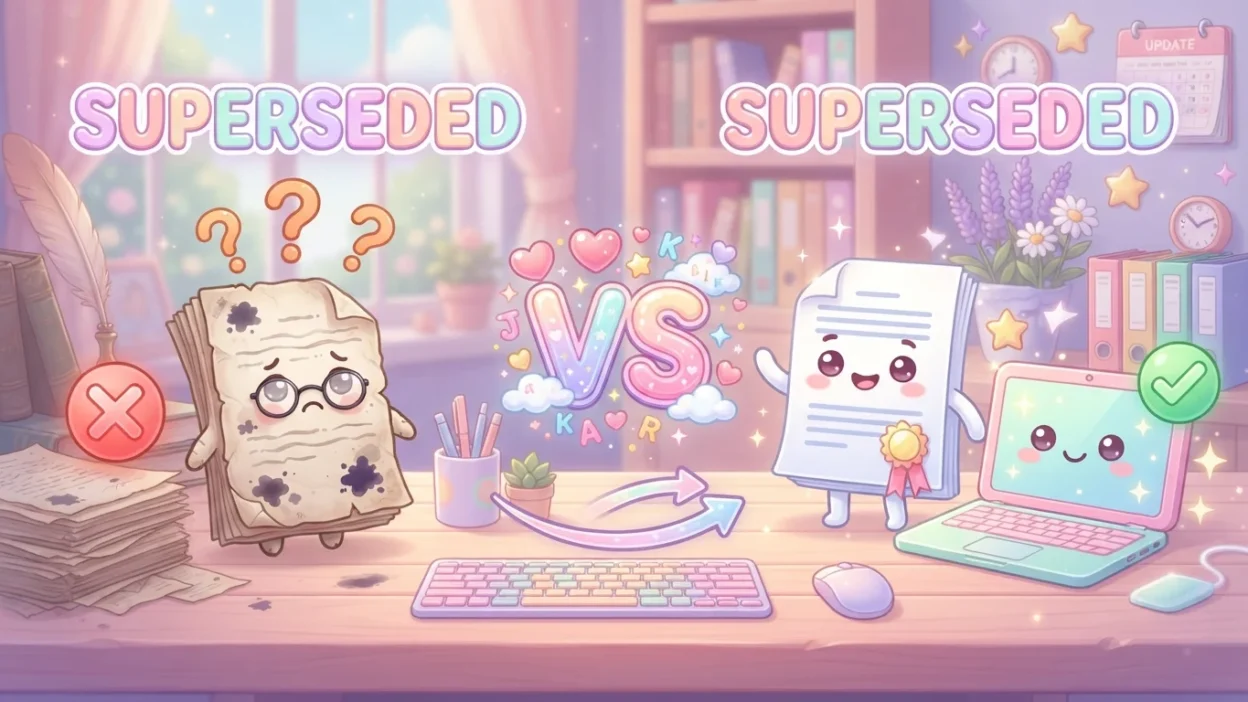
Have you ever wondered whether superseded or superceded is the correct spelling? You’re not alone! This is one of the most commonly misspelled words in English because many people assume it follows the same spelling pattern as words ending in -cede, such as proceed, precede, and recede. However, this word is an exception.
In this guide, you’ll learn the difference between superseded vs superceded, their meanings, examples, common mistakes, and an easy memory trick to help you remember the correct spelling.
Quick Answer
- Superseded ✅ — Correct spelling.
- Superceded ❌ — Incorrect spelling.
Use superseded whenever you mean that something has been replaced, made obsolete, or taken the place of something older.
Examples:
- The old policy has been superseded by a new one.
- This software version was superseded last year.
What Do Superseded and Superceded Mean?
Although these words look similar, only one is recognized in standard English.
What Is Superseded?
Superseded is the past tense and past participle of the verb supersede. It means:
- Replaced by something newer or better.
- Made obsolete.
- Taken the place of something else.
Examples:
- The outdated law was superseded by new legislation.
- The latest model has superseded the previous version.
- Digital cameras superseded many film cameras.
- The revised guidelines superseded the earlier document.
What Is Superceded?
Superceded is a misspelling of superseded.
It is not recognized as a standard English spelling and should never be used in formal or informal writing.
Superseded vs Superceded Comparison Table
| Feature | Superceded | Superseded |
|---|---|---|
| Correct English Word | ❌ No | ✅ Yes |
| Dictionary Entry | No | Yes |
| Meaning | None | Replaced or made obsolete |
| Used in Formal Writing | No | Yes |
| Used in Everyday English | No | Common |
Why Is “Superseded” Correct?
The correct spelling is:
S-U-P-E-R-S-E-D-E-D
Many writers mistakenly use superceded because they think the word follows the -cede spelling pattern. However, supersede is a historical exception and has always been spelled with -sede.
Therefore:
- Superseded ✅ — Correct spelling.
- Superceded ❌ — Incorrect spelling.
Examples of Superseded in Sentences
- The old agreement was superseded by a new contract.
- Modern technology has superseded many traditional methods.
- The updated manual superseded the previous edition.
- His recommendation was superseded by the committee’s decision.
- The original proposal has been superseded.
- A newer regulation superseded the earlier rule.
- The latest edition has superseded all previous versions.
Common Mistakes People Make
Many writers accidentally:
- Write superceded instead of superseded.
- Assume the word follows proceed or precede.
- Spell the word based on other -cede verbs.
- Miss the typo while proofreading.
Incorrect:
- ❌ The old document was superceded.
Correct:
- ✅ The old document was superseded.
Simple Memory Trick
💡 Memory Trick
- Supersede is the famous exception that uses “sede,” not “cede.”
- Think: “Super SEDE is the special spelling.”
Rule: Even though many similar words end in -cede, supersede always ends in -sede.
When Should You Use Superseded?
Use superseded when talking about:
- Laws.
- Policies.
- Rules.
- Software.
- Technology.
- Documents.
- Products.
Examples:
- Superseded policy.
- Superseded version.
- Superseded document.
- Superseded regulation.
- Superseded agreement.
- Superseded standard.
When Should You Use Superceded?
Never.
Superceded is always a spelling mistake and should be corrected to superseded.
American vs British English
There is no spelling difference between American and British English.
Both varieties use:
- ✅ Superseded
- ❌ Superceded
The spelling is identical throughout the English-speaking world.
Related Words and LSI Keywords
- superseded meaning
- supersede definition
- replaced
- obsolete
- updated version
- previous version
- English spelling rules
- commonly misspelled words
- grammar guide
- vocabulary tips
- proofreading
- language learning
- correct English usage
- word comparison
Tips for Remembering the Difference
- Superseded always contains “sede.”
- Don’t confuse it with words ending in -cede.
- Remember that supersede is an exception.
- Proofread carefully before publishing.
- Use spell check if you’re uncertain.
Frequently Asked Questions
Is superceded a real word?
No. Superceded is not recognized as a standard English spelling.
Which is correct: superseded or superceded?
Superseded is the correct spelling.
Why is superseded spelled with “sede” instead of “cede”?
It is a historical exception in English and has retained the -sede spelling over time.
Is superseded used in American and British English?
Yes. Both varieties use the same spelling.
Can I use superceded in formal writing?
No. Always use superseded.
What does superseded mean?
It means replaced, made obsolete, or taken over by something newer or better.
Summary
The difference between superseded vs superceded is simple. Superseded is the correct English spelling used when something has been replaced or made obsolete. Superceded is a common spelling mistake caused by confusion with other -cede words and should never be used in standard English.
Whenever you’re writing about something being replaced by a newer version, remember that supersede is the exception that ends with -sede.

Alistair Fenwicke is a quiet observer of rural life and forgotten histories.
His novels explore memory, solitude, and the passing of time.
He writes from a small countryside cottage surrounded by fields.