
Have you ever stopped while writing and wondered whether to use gases or gasses? You’re not alone. These two words look almost identical, but they have different meanings and uses in English.
The confusion happens because both words are technically correct—but they are used in completely different contexts. In this guide, you’ll learn the difference between gases or gasses, when to use each one, examples, and easy tips to remember them.
Quick Answer
Here’s the simple answer:
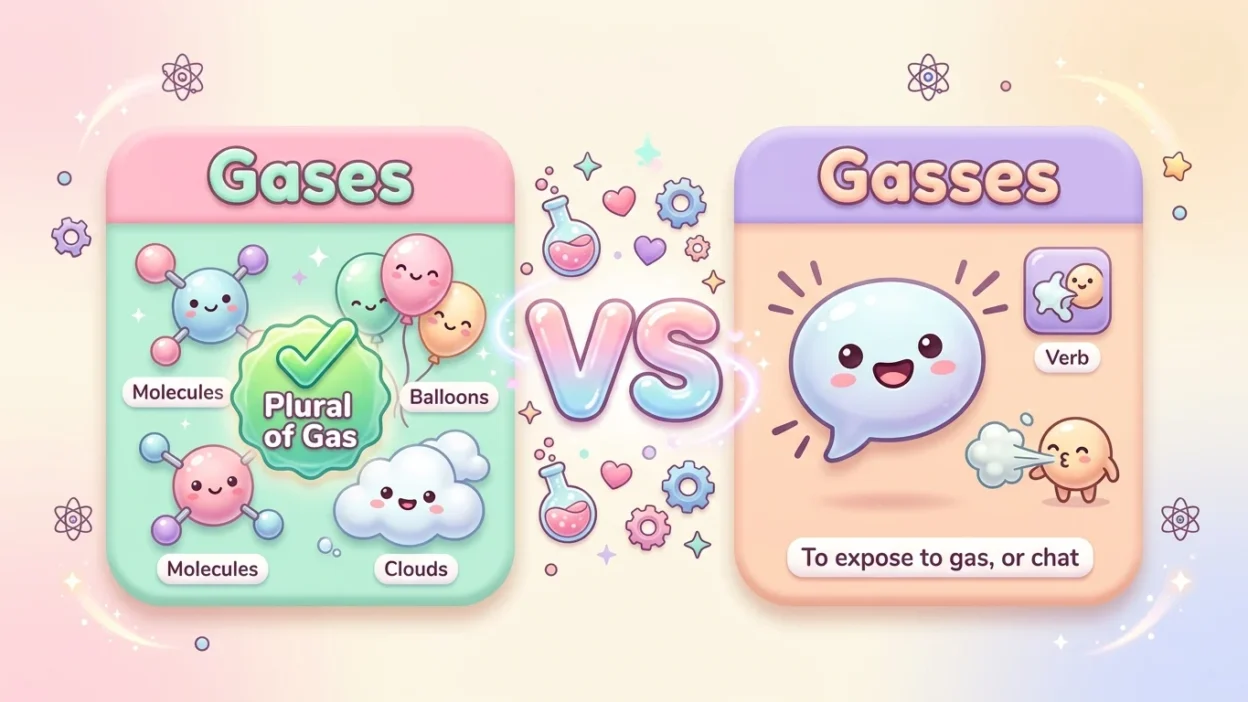
- Gases ✅ is the plural form of gas.
- Gasses ✅ is the third-person singular form of the verb gass (meaning to poison or expose someone to gas) or, informally, to chat.
Examples:
- The laboratory contains several gases.
- The army gasses the area during training exercises.
For most everyday situations, you’ll use gases.
What Do Gases and Gasses Mean?
Although they differ by only one letter, these words have distinct meanings.
What Is Gases?
Gases is the plural noun of gas.
It refers to:
- Substances like oxygen, helium, and nitrogen.
- Fuel gases.
- Intestinal gas (informally).
Examples:
- Earth’s atmosphere contains several gases.
- Scientists studied the properties of different gases.
- Natural gases are important energy sources.
- The balloon was filled with harmless gases.
What Is Gasses?
Gasses is a verb form.
It means:
- To expose someone or something to gas.
- To poison using gas.
- Informally, to chat or gossip (mainly in some dialects).
Examples:
- The villain gasses the room in the movie.
- She often gasses with her neighbors over coffee.
Gases vs Gasses Comparison Table
| Word | Part of Speech | Meaning | Example |
|---|---|---|---|
| Gases | Noun | More than one gas | The experiment used several gases. |
| Gasses | Verb | Exposes to gas or chats | He gasses the chamber. |
Why Is “Gases” More Common?
Most people encounter gas as a noun, so the plural form gases appears far more often in everyday writing.
You’ll commonly see:
- Greenhouse gases
- Industrial gases
- Toxic gases
- Noble gases
- Medical gases
Meanwhile, gasses is relatively uncommon and is usually found in historical, military, or specialized contexts.
Examples of Gases in Sentences
- Greenhouse gases contribute to climate change.
- The teacher explained how different gases behave.
- Several gases were released during the experiment.
- Noble gases include helium and neon.
- The factory handles dangerous gases safely.
Examples of Gasses in Sentences
- The character gasses his enemies in the film.
- He frequently gasses with his friends after work.
- The machine automatically gasses the storage container.
- The story describes a villain who gasses entire rooms.
Common Mistakes People Make
Many writers mistakenly:
- Use gasses as the plural of gas.
- Assume both words are interchangeable.
- Add an extra s when talking about scientific gases.
- Forget that gasses is primarily a verb.
Incorrect:
- ❌ The atmosphere contains many gasses.
Correct:
- ✅ The atmosphere contains many gases.
Simple Memory Trick
Here’s an easy trick:
- Gases = Things
- Gasses = Actions
Think:
“If it’s something you can study in science class, it’s probably gases.”
When Should You Use Gases?
Use gases when referring to:
- Oxygen
- Nitrogen
- Carbon dioxide
- Fuel gases
- Greenhouse gases
- Scientific or chemical substances
When Should You Use Gasses?
Use gasses when referring to:
- Exposing someone to gas
- Poisoning with gas
- Informal chatting or gossiping
American vs British English
There is no significant difference between American and British English.
Both use:
- Gases as the plural noun.
- Gasses as the verb form.
The meanings remain the same.
Related Words and LSI Keywords
- gas plural
- gases meaning
- gasses meaning
- greenhouse gases
- noble gases
- English grammar
- spelling differences
- commonly confused words
- vocabulary guide
- language learning
- English usage
- word comparison
- scientific terminology
- grammar tips
Tips for Remembering the Difference
Keep these tips in mind:
- If you’re talking about science, use gases.
- If it’s an action, consider gasses.
- Remember: gases = plural noun.
- Remember: gasses = verb.
- Proofread technical writing carefully.
Frequently Asked Questions
Which is correct: gases or gasses?
Both are correct, but they have different meanings. Gases is the plural of gas, while gasses is a verb.
Is gasses a real word?
Yes. It is the third-person singular form of the verb gass.
What is the plural of gas?
The standard plural is gases.
Can I write “greenhouse gasses”?
No. The correct term is greenhouse gases.
Is there a difference in British English?
No. Both American and British English use the same forms.
Which word is more common?
Gases is much more common in everyday English.
Summary
The difference between gases or gasses comes down to grammar. Gases is the plural noun used for substances like oxygen, nitrogen, and carbon dioxide, while gasses is a verb meaning to expose someone to gas or, informally, to chat.
In most situations, you’ll use gases. If you’re writing about science, chemistry, or the environment, that’s almost certainly the correct choice. Remember: gases are things, gasses are actions.

Rowan Blythecroft crafts atmospheric fiction filled with mystery and folklore.
Her stories often blur the line between reality and imagination.
She spends most of her days wandering forests and writing by candlelight.