
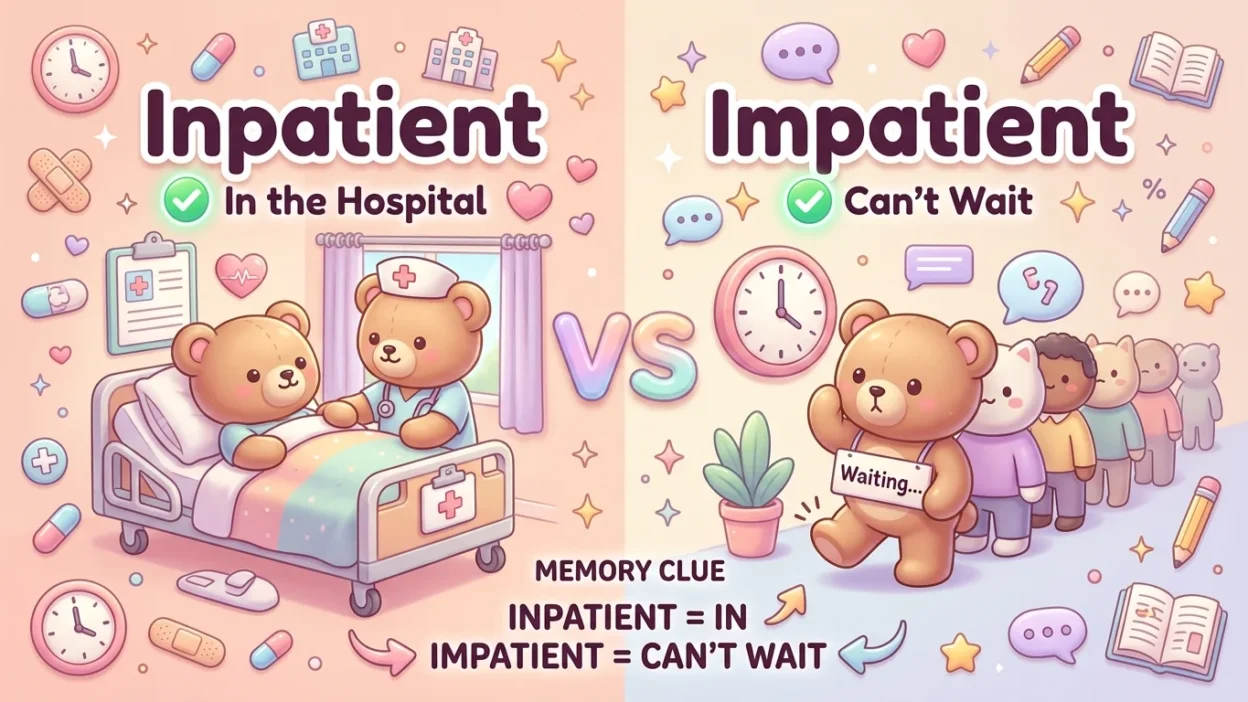
Have you ever confused inpatient vs impatient? These words look almost identical, but they have completely different meanings. Inpatient refers to a person who stays in a hospital or healthcare facility for treatment, while impatient describes someone who is unable or unwilling to wait calmly.
In this guide, you’ll learn the difference between inpatient and impatient, their meanings, examples, common mistakes, spelling rules, American and British English usage, and an easy memory trick.
Quick Answer
- Inpatient ✅ = a person who stays in a hospital or healthcare facility for treatment.
- Impatient ✅ = unable to wait calmly or becoming annoyed by delays.
Examples:
- The inpatient received treatment overnight. ✅
- She became impatient while waiting for the bus. ✅
The easiest rule is:
Inpatient = hospital patient
Impatient = cannot wait
What Does Inpatient Mean?
Inpatient is a noun or adjective used in healthcare.
As a noun, an inpatient is a person who is admitted to a hospital or healthcare facility and stays there for treatment.
Example:
- The hospital has 200 inpatients.
As an adjective, it describes something related to patients who stay in a healthcare facility.
Examples:
- Inpatient care
- Inpatient treatment
- Inpatient services
- Inpatient rehabilitation
- Inpatient unit
For example:
- She received inpatient treatment for several days.
- The doctor recommended inpatient care.
What Does Impatient Mean?
Impatient is an adjective that describes someone who does not like waiting or becomes annoyed when something takes too long.
Examples:
- He became impatient while waiting for the train.
- She was impatient to hear the results.
- The children grew impatient after waiting for an hour.
- Don’t be impatient; we’ll be there soon.
Impatient can also describe someone who wants something to happen immediately.
Example:
- He was impatient to start the project.
Inpatient vs Impatient Comparison Table
| Feature | Inpatient | Impatient |
|---|---|---|
| Meaning | Hospitalized person or hospital-based care | Unable or unwilling to wait calmly |
| Part of speech | Noun / adjective | Adjective |
| Context | Healthcare | Behavior, emotions, waiting |
| Example | The inpatient stayed overnight. | She became impatient waiting. |
| Memory clue | In + patient = inside hospital | Impatient = can’t wait |
| Opposite | Outpatient | Patient |
Why Are Inpatient and Impatient Confused?
The confusion comes from their similar spelling.
Compare:
inpatient
impatient
Only one letter changes:
- inpatient → n
- impatient → m
However, the meanings are completely different.
Inpatient is connected to medical care.
Impatient is connected to waiting and behavior.
Examples of Inpatient in Sentences
Here are some correct examples of inpatient:
- The hospital admitted the patient as an inpatient.
- The facility provides inpatient care.
- The doctor recommended inpatient treatment.
- The inpatient remained in the hospital overnight.
- The hospital has a dedicated inpatient unit.
- Some patients require inpatient rehabilitation.
- The program offers both inpatient and outpatient services.
- The nurse checked on every inpatient.
Examples of Impatient in Sentences
Here are some correct examples of impatient:
- She became impatient while waiting in line.
- He was impatient for the meeting to begin.
- The children grew impatient after waiting so long.
- Don’t become impatient with the process.
- She was impatient to hear the news.
- He gets impatient when traffic moves slowly.
- The customer became impatient after a long delay.
- I was too impatient to wait for the results.
Inpatient Means “Staying In”
One of the easiest ways to remember inpatient is to focus on the word in.
An inpatient stays in a hospital or healthcare facility.
Think:
IN + PATIENT = INPATIENT
Example:
- The patient stayed in the hospital overnight.
- Therefore, the person is an inpatient.
Impatient Means “Cannot Wait”
The word impatient is related to patience.
Someone who is impatient does not want to wait.
Examples:
- I’m impatient to know the answer.
- She became impatient in the long line.
- He is impatient with delays.
Think:
IMpatient = NOT patient
Here, patient means calm and willing to wait.
Inpatient vs Outpatient
Inpatient is often confused with outpatient, which is its common healthcare counterpart.
Inpatient
An inpatient stays at a hospital or healthcare facility for treatment.
Example:
- He was admitted as an inpatient.
Outpatient
An outpatient receives medical care without staying overnight or being admitted for extended care.
Example:
- She received treatment as an outpatient.
So remember:
Inpatient = stays in
Outpatient = receives care without staying in
Impatient vs Patient
Impatient is the opposite of patient when patient describes someone’s ability to wait calmly.
Patient
Someone who can wait calmly:
- She was patient while waiting for the results.
Impatient
Someone who does not want to wait:
- She became impatient while waiting for the results.
Think:
Patient = willing to wait
Impatient = unwilling to wait
Common Mistakes People Make
Mistake 1: Using Inpatient for Someone Who Cannot Wait
Incorrect:
- ❌ He is inpatient because he hates waiting.
Correct:
- ✅ He is impatient because he hates waiting.
Someone who hates waiting is impatient.
Mistake 2: Using Impatient for a Hospital Patient
Incorrect:
- ❌ The impatient was admitted to the hospital.
Correct:
- ✅ The inpatient was admitted to the hospital.
A person receiving treatment while staying in a healthcare facility is an inpatient.
Mistake 3: Confusing Inpatient With Outpatient
An inpatient stays in the healthcare facility.
An outpatient receives care without being admitted for an inpatient stay.
Mistake 4: Forgetting the “M” in Impatient
When you mean unable to wait, remember:
IMpatient
It comes from patient, with the prefix im- creating the opposite meaning.
Simple Memory Trick
💡 Memory Trick
Spelling Box
Remember:
INPATIENT = IN the hospital 🏥
IMPATIENT = CAN’T WAIT ⏳
Think:
IN + PATIENT → stays IN
IM + PATIENT → not patient
Examples:
Inpatient care → hospital care
Impatient person → someone who doesn’t want to wait
Inpatient in Healthcare
Inpatient is commonly used in medical and healthcare contexts.
Common phrases include:
- inpatient care
- inpatient treatment
- inpatient services
- inpatient unit
- inpatient admission
- inpatient facility
- inpatient rehabilitation
- inpatient program
Examples:
- The hospital provides specialized inpatient care.
- The doctor recommended inpatient treatment.
- The patient was transferred to an inpatient unit.
Impatient in Everyday English
Impatient is much more common in everyday conversations.
It can describe someone who becomes frustrated by:
- Waiting
- Delays
- Slow progress
- Long lines
- Slow traffic
- Repeated explanations
- Unfinished tasks
Examples:
- He became impatient in traffic.
- She was impatient for the results.
- The children were impatient to open their presents.
Impatient With vs Impatient To
Impatient with is commonly used when someone is annoyed by a person, situation, or delay.
Examples:
- She became impatient with the slow service.
- He is impatient with delays.
- The teacher was impatient with the repeated questions.
Impatient to is commonly used when someone strongly wants something to happen.
Examples:
- She was impatient to hear the results.
- He was impatient to begin the journey.
- They were impatient to see the new building.
You can also use:
impatient for + noun
- She was impatient for good news.
Inpatient as a Noun
Inpatient can directly refer to the person receiving care.
Examples:
- The nurse checked on the inpatient.
- Each inpatient received an identification bracelet.
- The facility can accommodate 50 inpatients.
As a noun, it is particularly common in healthcare settings.
Inpatient as an Adjective
Inpatient can also describe healthcare services or treatment involving admitted patients.
Examples:
- Inpatient care
- Inpatient treatment
- Inpatient rehabilitation
- Inpatient services
- Inpatient facility
Example:
- The hospital expanded its inpatient services.
American vs British English
The meanings of inpatient and impatient are essentially the same in American and British English.
Both varieties use:
- Inpatient = a hospitalized patient or healthcare provided to admitted patients.
- Impatient = unable or unwilling to wait calmly.
The spelling remains the same in both varieties.
When Should You Use Inpatient?
Use inpatient when talking about:
- Hospital stays
- Healthcare facilities
- Medical admissions
- Hospital-based treatment
- Patients who remain in a healthcare facility
Examples:
- Inpatient care
- Inpatient treatment
- Inpatient services
- The inpatient was discharged.
Ask yourself:
“Is this person staying in a healthcare facility?”
If yes, inpatient is likely the correct word.
When Should You Use Impatient?
Use impatient when describing someone who:
- Does not want to wait
- Becomes annoyed by delays
- Wants something immediately
- Has little patience
Examples:
- Impatient customer
- Impatient child
- Impatient driver
- Impatient reaction
Ask yourself:
“Is this person having trouble waiting calmly?”
If yes, use impatient.
Related Words and LSI Keywords
- inpatient meaning
- impatient meaning
- inpatient vs impatient
- impatient vs inpatient
- inpatient definition
- impatient definition
- inpatient care
- inpatient treatment
- impatient person
- impatient meaning in a sentence
- inpatient meaning in a sentence
- inpatient vs outpatient
- patient vs impatient
- hospital terminology
- healthcare vocabulary
- English grammar
- English spelling
- commonly confused words
- common spelling mistakes
- correct English usage
- English language learning
Tips for Remembering the Difference
- Inpatient = in the hospital.
- Impatient = can’t wait.
- Think IN + PATIENT → staying IN.
- Think IM + PATIENT → not patient.
- Inpatient is mainly a healthcare term.
- Impatient describes behavior or attitude.
- The opposite of inpatient in healthcare is generally outpatient.
- The opposite of impatient is patient.
- Remember: inpatient stays in; impatient hates waiting.
Frequently Asked Questions
What is the difference between inpatient and impatient?
Inpatient refers to a person who stays in a hospital or healthcare facility for treatment. Impatient describes someone who is unwilling or unable to wait calmly.
Is an inpatient a hospital patient?
Yes. An inpatient is generally a person who has been admitted to a hospital or healthcare facility and stays there for treatment.
What does impatient mean?
Impatient means unable or unwilling to wait calmly, often because of frustration, delay, or a strong desire for something to happen.
Is inpatient one word?
Yes. Inpatient is written as one word.
Is impatient one word?
Yes. Impatient is also written as one word.
What is the difference between inpatient and outpatient?
An inpatient is admitted to a healthcare facility and stays there for treatment. An outpatient receives healthcare without an inpatient stay.
Is impatient the opposite of patient?
Yes, when patient means calm and willing to wait. For example, a patient person can wait calmly, while an impatient person may become frustrated by waiting.
Can inpatient be an adjective?
Yes. For example:
- inpatient care
- inpatient treatment
- inpatient services
Can inpatient be a noun?
Yes. It can refer directly to a person receiving treatment as an admitted patient.
What is an impatient person?
An impatient person is someone who dislikes waiting or becomes frustrated when something takes too long.
Is “inpatient care” correct?
Yes. Inpatient care refers to healthcare provided to patients who are admitted to a facility and stay there for treatment.
Is “impatient care” correct?
Generally, no, if you’re talking about healthcare. The correct phrase is inpatient care.
What is an easy way to remember inpatient vs impatient?
Remember: INPATIENT = IN the hospital, while IMPATIENT = CAN’T WAIT. The first relates to healthcare; the second relates to someone’s attitude toward waiting.
Summary
The difference between inpatient vs impatient is easy to remember once you focus on the context. Inpatient is a healthcare term for a person who stays in a hospital or healthcare facility for treatment, or for services provided to such patients. Impatient, on the other hand, describes someone who does not want to wait calmly or becomes frustrated by delays.
Use the simple memory trick “inpatient stays in, impatient can’t wait.” If you’re discussing hospital treatment, choose inpatient. If you’re describing someone who wants something immediately or dislikes waiting, choose impatient. Also remember outpatient as the common healthcare contrast to inpatient, and patient as the opposite of impatient.