
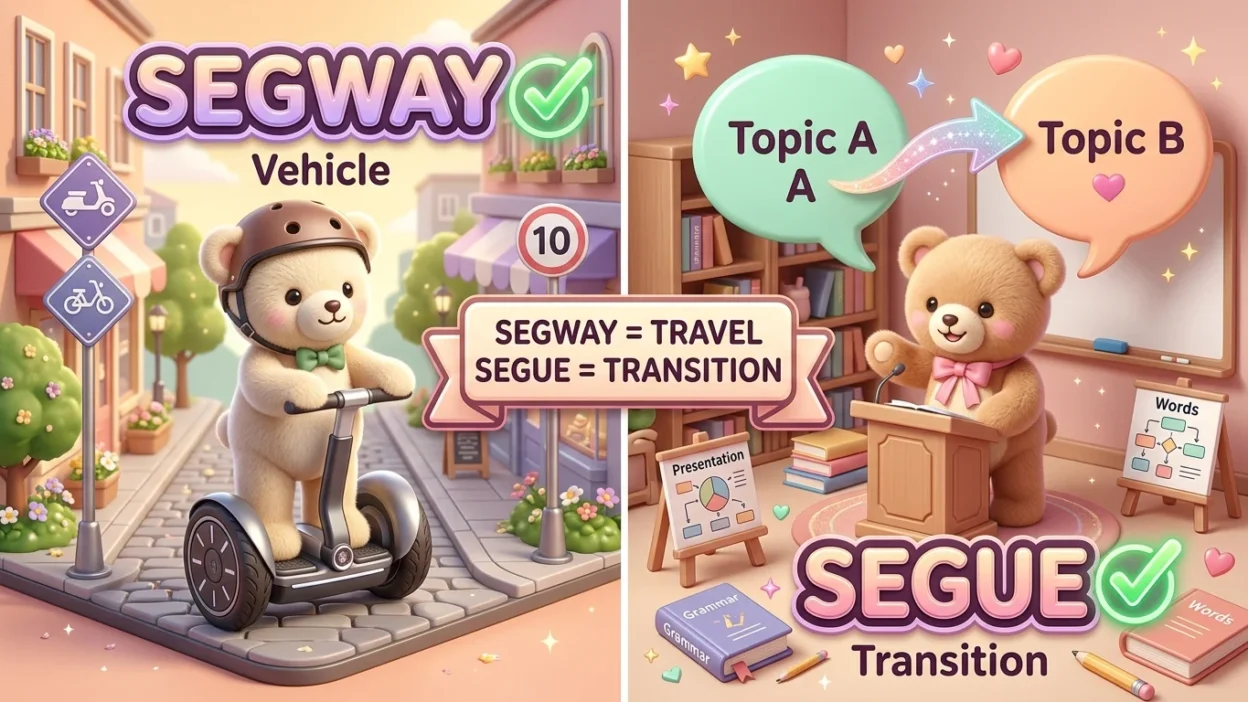
Have you ever confused segway vs segue? These two words look and sound similar, but they have completely different meanings. Segway is a proper noun associated with a type of two-wheeled personal transporter, while segue is a verb or noun meaning a smooth transition from one topic, activity, or part of a piece of music to another.
In this guide, you’ll learn the difference between Segway and segue, their meanings, examples, common mistakes, American and British English usage, and an easy memory trick.
Quick Answer
- Segway ✅ = a brand name for a type of two-wheeled personal transporter.
- Segue ✅ = a smooth transition from one subject, activity, or section to another.
- Segway ❌ when you mean a transition.
- Segue ❌ when you mean the personal transporter.
Examples:
- He rode a Segway around the city.
- The speaker used the story as a segue into the next topic.
The easiest rule is:
Segway = vehicle
Segue = transition
What Does Segway Mean?
Segway is a trademarked brand name associated with self-balancing, two-wheeled personal transportation devices.
The word is usually capitalized when referring specifically to the brand:
- Segway
Examples:
- We rented a Segway for the city tour.
- She learned how to ride a Segway.
- The guide traveled around the park on a Segway.
Because Segway is a brand name, you may also see the term used in references to the company’s products rather than as a general word for every type of personal transporter.
What Does Segue Mean?
Segue is a noun and verb meaning a smooth transition from one thing to another.
It is commonly used when talking about:
- Conversations
- Speeches
- Presentations
- Writing
- Music
- Television
- Films
- Podcasts
- Discussions
As a verb, it means to move smoothly from one subject or activity to another.
Example:
- The presenter segueed into the next topic.
As a noun, it means the transition itself.
Example:
- The question provided a natural segue into the next discussion.
Segway vs Segue Comparison Table
| Feature | Segway | Segue |
|---|---|---|
| Meaning | Brand associated with a two-wheeled transporter | Smooth transition |
| Part of speech | Proper noun / brand name | Noun / verb |
| Common context | Transportation | Conversation, writing, music, presentations |
| Example | He rode a Segway. | That was a smooth segue. |
| Pronunciation | Usually pronounced like “SEG-way” | Usually pronounced “SEG-way” |
| Memory clue | Vehicle | Transition |
Why Are Segway and Segue Confused?
The main reason is pronunciation.
Segway and segue are pronounced essentially the same way in standard English:
SEG-way
However, their meanings are completely different.
This makes them a classic example of homophones or near-homographic confusion: the words look different but sound alike.
Compare:
- Segway → transportation brand
- segue → transition
Examples of Segway in Sentences
Here are some correct examples of Segway:
- We took a Segway tour through the city.
- He rented a Segway for the afternoon.
- The tourists traveled around the park on Segways.
- She learned to balance on a Segway.
- The guide demonstrated how to operate the Segway.
- They used Segways to explore the large park.
When referring to multiple vehicles, Segways is commonly used.
Examples of Segue in Sentences
Here are some correct examples of segue:
- The speaker made a smooth segue into the next topic.
- Her story provided a natural segue to the main discussion.
- The host segueed from sports to entertainment.
- The presenter used a question to segue into the next section.
- The song segues smoothly into the next track.
- His comment was a perfect segue into the discussion about technology.
Segue as a Noun
As a noun, segue means a smooth transition.
Examples:
- That was an excellent segue into the next topic.
- The interviewer’s question created a natural segue.
- The music contained a beautiful segue between two sections.
- The story provided a useful segue into the conclusion.
Think:
A segue = the transition itself.
Segue as a Verb
As a verb, segue means to transition smoothly from one thing to another.
Examples:
- The presenter segueed into the next topic.
- The discussion segues from history into politics.
- The song segues into another track.
- She segued from the introduction to the main argument.
Think:
To segue = to transition smoothly.
Segue in Presentations
Segue is especially common in presentations.
For example:
“Now that we’ve discussed the problem, let’s segue into the possible solutions.”
Here, segue into means transition smoothly into.
Other examples:
- Let’s segue into our next topic.
- The speaker segued into the conclusion.
- This provides a natural segue into the next section.
Segue in Writing
Writers can use segue when moving from one idea to another.
Example:
The first section discusses the causes of the problem. The next section segues into possible solutions.
It can also describe transitions between paragraphs, subjects, or sections.
Segue in Music
The word segue is also used in music.
It can describe a smooth transition from one musical section or piece into another without a significant break.
Examples:
- The final notes segue into the next song.
- The album contains several smooth segues between tracks.
- The music segued from one movement into another.
Segue vs Transition
Segue and transition are closely related.
Transition is the broader and more common word.
Segue often emphasizes a smooth or natural movement from one thing to another.
Compare:
- The presentation has a transition between sections.
- The speaker made a smooth segue into the next topic.
Both can be correct, but segue often sounds more polished when describing a conversational or rhetorical shift.
Common Mistakes People Make
Mistake 1: Writing Segway When You Mean Transition
Incorrect:
- ❌ That was a great Segway into the next topic.
Correct:
- ✅ That was a great segue into the next topic.
You’re describing a transition, so use segue.
Mistake 2: Writing Segue for the Vehicle
Incorrect:
- ❌ We rented a segue for the tour.
Correct:
- ✅ We rented a Segway for the tour.
You’re referring to the transportation brand, so use Segway.
Mistake 3: Capitalizing Segue
Incorrect:
- ❌ The presenter made a smooth Segue.
Correct:
- ✅ The presenter made a smooth segue.
Segue is normally lowercase unless it begins a sentence or appears in a title.
Segway, when referring to the brand, is capitalized.
Mistake 4: Assuming Segway and Segue Have the Same Meaning
They do not.
Although they sound the same, their meanings are completely different.
- Segway = transportation brand
- Segue = transition
Simple Memory Trick
💡 Memory Trick
Spelling Box
SEGWAY = WAY TO TRAVEL 🛴
SEGUE = WAY TO TRANSITION 💬
Think:
Segway → vehicle
Segue → smooth transition
If you’re talking about moving physically, think Segway.
If you’re talking about moving from one idea or topic to another, think segue.
Segue Into vs Segue To
Both constructions can appear, but segue into is especially common when describing a smooth transition into a new topic or activity.
Examples:
- The speaker segued into the next topic.
- The conversation segued into a discussion about education.
- The song segued into the next track.
You may also see:
- segue to the next topic
- segue from one idea to another
Examples:
- Let’s segue to the next point.
- The discussion segued from business to technology.
Segue From … To …
A useful structure is:
segue from A to B
Examples:
- The speaker segued from history to modern politics.
- The conversation segued from work to family life.
- The film segued from comedy to drama.
This structure clearly shows the movement between two subjects.
Segway as a Brand Name
Segway is a brand name, so capitalization matters when you’re specifically referring to the brand.
Examples:
- a Segway
- Segway tour
- Segway vehicle
- Segway rider
- Segway rental
For example:
- We booked a Segway tour.
The word is not interchangeable with segue.
American vs British English
The meanings and spellings of Segway and segue are essentially the same in American and British English.
Both use:
- Segway = the transportation brand.
- segue = a smooth transition.
The pronunciation is also essentially the same.
When Should You Use Segway?
Use Segway when referring to:
- The Segway brand
- A Segway personal transporter
- Segway tours
- Riding a Segway
Examples:
- We rented a Segway.
- They took a Segway tour.
- He learned to ride a Segway.
Ask yourself:
“Am I talking about a vehicle?”
If yes, Segway is the word you need.
When Should You Use Segue?
Use segue when referring to:
- A smooth transition
- Moving between topics
- Moving between ideas
- Moving between activities
- Music transitions
- Conversational transitions
Examples:
- a smooth segue
- segue into a topic
- segue from one subject to another
- segue to the next point
Ask yourself:
“Am I talking about a transition?”
If yes, use segue.
Related Words and LSI Keywords
- segway meaning
- segue meaning
- segway vs segue
- segue vs segway
- segway spelling
- segue spelling
- segue meaning in a sentence
- segway meaning in a sentence
- segue into meaning
- segue to meaning
- segue from one topic to another
- smooth transition
- transition meaning
- Segway vehicle
- Segway tour
- English grammar
- commonly confused words
- homophones
- English spelling
- common spelling mistakes
- correct English usage
- English vocabulary
Tips for Remembering the Difference
- Segway = transportation brand.
- Segue = smooth transition.
- Both are pronounced approximately SEG-way.
- Use segue when moving from one topic to another.
- Use Segway when talking about the personal transporter.
- Segue into is a common phrase.
- Remember: Segway = way to travel; segue = way to transition.
Frequently Asked Questions
What is the difference between Segway and segue?
Segway is a brand name associated with a two-wheeled personal transporter, while segue means a smooth transition from one subject, activity, or section to another.
Is it Segway or segue into a topic?
Segue into is correct.
Example:
- The presenter segued into the next topic.
Is Segway a word?
Yes. Segway is a brand name associated with personal transportation devices.
Is segue a word?
Yes. Segue is a standard English word meaning a smooth transition.
Are Segway and segue pronounced the same?
Yes. They are generally pronounced SEG-way.
Why do people confuse Segway and segue?
They are commonly confused because they sound essentially identical but have completely different meanings.
What does segue mean?
Segue means to move smoothly from one subject, activity, or section to another. It can be a noun or a verb.
What does Segway mean?
Segway refers to a brand associated with self-balancing personal transportation devices.
Is “Segway into” correct?
No, not when you mean a transition. The correct phrase is segue into.
Example:
- She segued into the next topic.
Is “segue” a verb?
Yes. Segue can be used as a verb meaning to transition smoothly from one thing to another.
Is “segue” a noun?
Yes. As a noun, segue refers to a smooth transition.
Example:
- That was a natural segue into the next subject.
Is Segway capitalized?
When referring specifically to the brand, Segway is capitalized.
Is segue capitalized?
Normally, segue is lowercase unless it begins a sentence or appears as part of a title.
What is an easy way to remember Segway vs segue?
Remember: SEGWAY = WAY TO TRAVEL and SEGUE = WAY TO TRANSITION. If you’re talking about a vehicle, use Segway. If you’re talking about moving between ideas or topics, use segue.
Summary
The difference between Segway vs segue becomes simple once you connect each word with its meaning. Segway is a brand name associated with a type of personal transporter, while segue means a smooth transition from one topic, activity, idea, or section to another. Although they are pronounced essentially the same, they should not be used interchangeably.
Remember the simple distinction: Segway = vehicle, while segue = transition. When you’re introducing a new topic, use phrases such as “segue into the next topic” or “segue from one idea to another.” When you’re talking about riding or renting the personal transporter, use Segway.

Cedric Halewood is known for his intricate historical narratives.
His work reflects a deep fascination with lost civilizations.
He lives near the coast, where he finds inspiration in the sea.