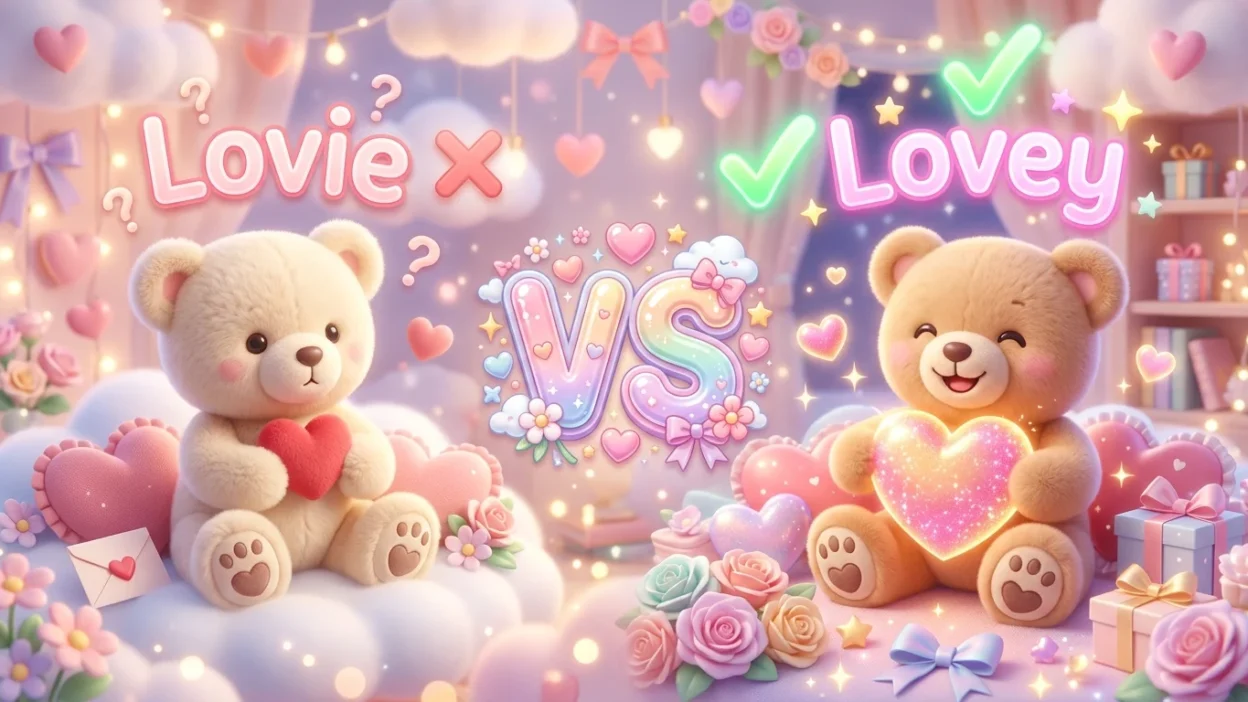
Have you ever wondered whether lovie or lovey is the correct spelling? You’re not alone. Both forms can appear in informal messages, nicknames, and affectionate conversations, which makes this spelling confusing. However, lovey is the more widely recognized standard spelling when you use it as an affectionate term.
In this guide, you’ll learn the difference between lovie vs lovey, what each form means, how they are used, examples, common mistakes, and an easy way to remember the preferred spelling.
Quick Answer
- Lovey ✅ — Standard and widely recognized spelling.
- Lovie ⚠️ — Can appear as an informal or personal spelling, but it is less standard.
If you’re looking for a general affectionate term meaning dear, darling, or sweetheart, lovey is the safer choice.
Example:
- Come here, lovey.
What Do Lovie and Lovey Mean?
What Is Lovey?
Lovey is an informal term of affection. People may use it when speaking warmly to someone they care about.
It can be similar in meaning to:
- Darling
- Dear
- Sweetheart
- Honey
- Love
Examples:
- Are you okay, lovey?
- Good morning, lovey.
- Don’t worry, lovey.
- Come sit with me, lovey.
The word can sound warm, playful, caring, or affectionate depending on the relationship and context.
What Is Lovie?
Lovie can also appear as an informal spelling of an affectionate nickname, particularly in personal messages or creative writing.
However, if you are asking which spelling is more broadly recognized for the affectionate term, lovey is generally the better choice.
For example:
- Informal/personal: Good night, lovie.
- More standard: Good night, lovey.
Lovie may also appear as a personal name or nickname, so context matters.
Lovie vs Lovey Comparison Table
| Feature | Lovie | Lovey |
|---|---|---|
| Common as an affectionate spelling | Yes, informally | Yes |
| Standard/general spelling | Less common | More widely recognized |
| Meaning | Affectionate nickname in informal use | Dear, darling, sweetheart |
| Formal English | Not appropriate | Not usually formal either |
| Personal nickname | Possible | Possible |
Why Is “Lovey” Usually Preferred?
Lovey is the more established spelling when used as an affectionate form of address.
The ending -ey appears in many informal affectionate words and nicknames.
For example:
- Lovey
- Honey
- Sweetie
- Dearie
That doesn’t mean lovie can never appear. People often create personal spellings for nicknames, and informal language has flexibility. However, if you want the spelling most readers will recognize immediately, lovey is usually the better option.
Examples of Lovey in Sentences
- Good morning, lovey.
- How are you feeling, lovey?
- Come here, lovey.
- Don’t worry about it, lovey.
- Thank you, lovey.
- Sleep well, lovey.
- I missed you, lovey.
Examples of Lovie in Informal Use
Because lovie can function as a personal or creative spelling, you may see it in casual communication.
Examples:
- Good night, lovie.
- I miss you, lovie.
- Thanks for helping me, lovie.
- See you tomorrow, lovie.
These examples can work as personal nickname choices, but lovey is more broadly recognizable as the standard affectionate form.
Common Mistakes People Make
People sometimes assume that lovie must be the correct spelling because the word love is pronounced with an “uh” sound and because many affectionate nicknames have different endings.
Common issues include:
- Assuming lovie is always the standard spelling.
- Treating personal nicknames as formal vocabulary.
- Using either spelling without considering context.
- Assuming informal terms have one fixed spelling in every situation.
If you’re writing a general article, message, or piece of dialogue and want the most recognizable spelling, lovey is usually the safer choice.
Simple Memory Trick
💡 Memory Trick
Spelling Box
Think:
LOVE → LOVEY
Keep the E from LOVE and add Y:
LOVE + Y = LOVEY
Rule: For the general affectionate term, remember love → lovey.
Lovey as a Term of Endearment
Lovey is commonly used as a term of endearment, meaning an affectionate name used for someone you care about.
It can be used between:
- Romantic partners.
- Family members.
- Close friends.
- Parents and children.
The exact feeling depends on the relationship and tone.
For example:
- A parent might say, “Are you okay, lovey?”
- A romantic partner might say, “Good night, lovey.”
Because it is informal and affectionate, it generally doesn’t belong in professional or formal communication.
When Should You Use Lovey?
Use lovey when you want to express affection in casual communication.
It can work well in:
- Text messages.
- Personal conversations.
- Friendly notes.
- Romantic messages.
- Informal dialogue.
- Creative writing.
Example:
- Don’t worry, lovey. Everything will be okay.
When Should You Use Lovie?
Use lovie if it is someone’s chosen nickname, personal spelling, character name, or a deliberately cute spelling in informal communication.
For example:
- She always signs her messages “Lovie.”
However, if you simply want the standard affectionate term, lovey is generally the safer choice.
American vs British English
Lovey is recognized in both American and British English as an informal affectionate expression.
However, lovey can have somewhat different associations depending on region and context. In British English, it can be a familiar term of address, sometimes used warmly toward someone.
Lovie is more likely to be understood as a personal or creative spelling rather than the standard form of the affectionate expression.
Related Words and LSI Keywords
- lovey meaning
- lovie meaning
- lovey definition
- lovie definition
- term of endearment
- affectionate nickname
- nickname
- darling
- sweetheart
- dear
- honey
- sweetie
- affectionate term
- informal English
- casual language
- English spelling
- commonly confused words
- vocabulary guide
- correct English usage
Tips for Remembering the Difference
- Think love → lovey.
- Lovey is the more widely recognized spelling for the affectionate term.
- Lovie can work as a personal or creative nickname.
- Consider the context before choosing a spelling.
- Use lovey when you want the safest general choice.
Frequently Asked Questions
Is lovie a correct word?
Lovie can appear as an informal or personal spelling, but lovey is generally the more widely recognized spelling for the affectionate term.
Which is correct: lovie or lovey?
For the general term of affection, lovey is usually the preferred spelling.
What does lovey mean?
Lovey is an informal affectionate term that can mean something like dear, darling, or sweetheart.
Is lovey a nickname?
Yes. Lovey can be used as a nickname or term of endearment for someone you care about.
Can I use lovie as a nickname?
Yes. Lovie can be used as a personal or creative nickname, especially in informal communication.
Is lovey formal English?
No. Lovey is informal and affectionate, so it is generally unsuitable for professional or formal writing.
Is lovey used in American and British English?
Yes. Lovey is used in both varieties of English, although its tone and frequency can vary by region and context.
Summary
The difference between lovie vs lovey depends partly on context. Lovey is the more widely recognized spelling when you’re using the word as an affectionate term meaning dear, darling, or sweetheart. Lovie can still appear in personal messages, nicknames, and creative writing.
If you want the safest general spelling, choose lovey. If Lovie is someone’s personal nickname or preferred spelling, however, that spelling can be perfectly appropriate for that individual.