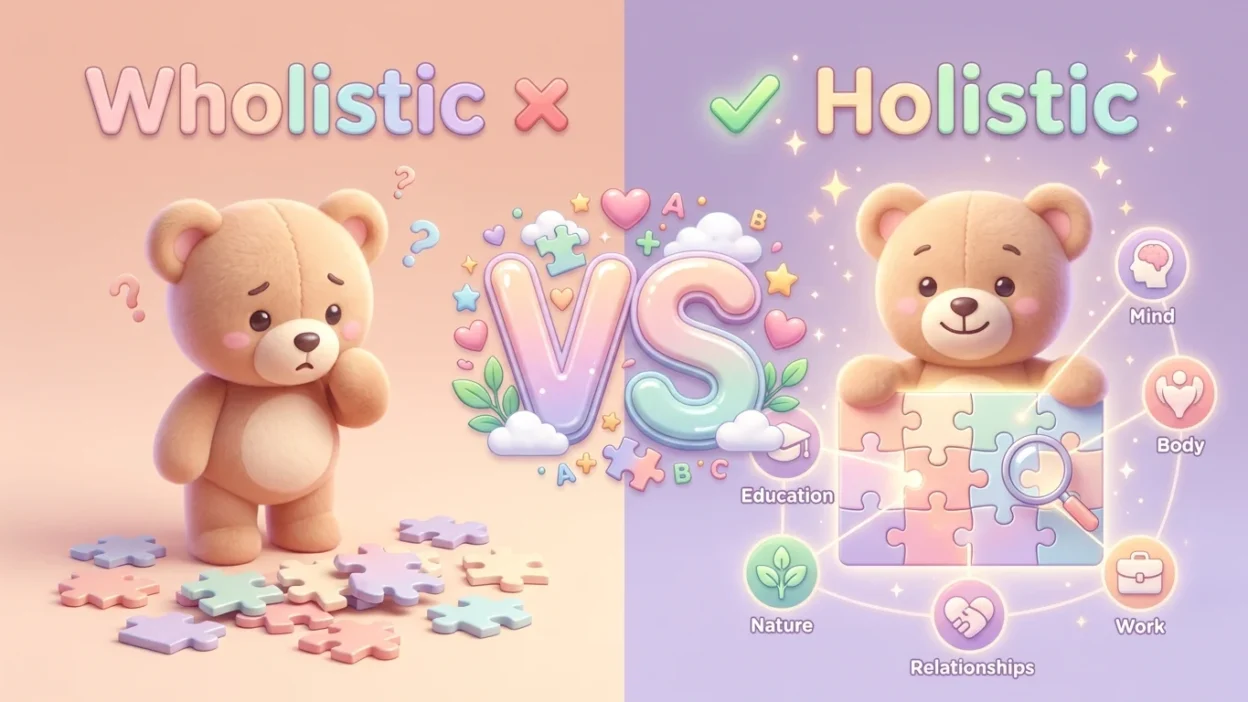
Have you ever wondered whether wholistic or holistic is the correct spelling? You’re not alone. These two words look and sound very similar, and both can appear in English writing. However, holistic is the standard and much more widely accepted spelling in modern English.
In this guide, you’ll learn the difference between wholistic vs holistic, what each word means, how to use them correctly, common mistakes, examples, and an easy memory trick. By the end, you’ll know which form works best in professional, academic, and everyday writing.
Quick Answer
- Holistic ✅ — The standard and widely preferred spelling.
- Wholistic ⚠️ — A less common variant that exists but is generally avoided in standard professional writing.
Holistic means considering something as a complete whole rather than focusing only on individual parts.
Example:
- The doctor takes a holistic approach to patient care.
What Do Wholistic and Holistic Mean?
What Is Holistic?
Holistic is an adjective that describes an approach that considers the whole system, person, situation, or problem rather than examining only separate parts.
For example, a holistic approach to education might consider a student’s academic performance, emotional development, social skills, creativity, and overall well-being.
Examples:
- We need a holistic approach to education.
- The company developed a holistic strategy.
- She takes a holistic view of wellness.
- The therapist uses a holistic approach.
The central idea is simple: look at the whole, not just the individual pieces.
What Is Wholistic?
Wholistic is a variant spelling that has been used to emphasize the connection between the word and whole.
However, it is much less common than holistic and may look unusual or incorrect to many readers.
For general writing, especially professional, academic, or SEO content, holistic is usually the safer and more recognizable choice.
Example:
- Preferred: The organization takes a holistic approach.
- Less common: The organization takes a wholistic approach.
Wholistic vs Holistic Comparison Table
| Feature | Wholistic | Holistic |
|---|---|---|
| Standard Preferred Form | ⚠️ Less common | ✅ Yes |
| Meaning | Considering the whole | Considering the whole |
| Common Usage | Less common | Very common |
| Professional Writing | Usually avoided | Recommended |
| Academic Writing | Less preferred | Preferred |
| General English | Understandable | Standard choice |
Why Is “Holistic” Usually Preferred?
Holistic is the established spelling in modern standard English.
Although wholistic seems logical because it resembles the word whole, spelling does not always develop by directly combining related words.
The standard form is:
Holistic
It is widely used in fields such as:
- Healthcare.
- Education.
- Psychology.
- Business.
- Sustainability.
- Wellness.
- Social sciences.
- Personal development.
For example:
- A holistic approach to health considers multiple aspects of a person’s well-being.
- A holistic business strategy considers customers, employees, finances, and long-term goals.
Examples of Holistic in Sentences
- The school takes a holistic approach to student development.
- We need a holistic solution to this problem.
- The company created a holistic marketing strategy.
- She believes in holistic wellness.
- The therapist uses a holistic approach.
- A holistic education supports both academic and personal growth.
- The project requires a holistic understanding of the environment.
Common Mistakes People Make
The most common mistake is choosing wholistic because it appears to connect naturally with the word whole.
People may think:
Whole → Wholistic
However, the standard spelling is:
Holistic
Common errors include:
- Writing wholistic in formal documents.
- Assuming whole must be the root of the spelling.
- Using the less common variant when the standard form is expected.
- Believing that both spellings have equal frequency and acceptance.
Instead of:
- ❌ We need a wholistic solution.
Prefer:
- ✅ We need a holistic solution.
Simple Memory Trick
💡 Memory Trick
Spelling Box
Remember:
HOLISTIC = WHOLE IDEA
Even though holistic doesn’t contain the word whole, it means looking at the whole picture.
Rule: Think HOLISTIC = THE WHOLE PICTURE.
Holistic Meaning in Different Contexts
The meaning of holistic remains centered on considering the whole, but the specific application can change.
Holistic Healthcare
A holistic approach to healthcare considers different aspects of well-being rather than focusing on a single symptom or issue.
Holistic Education
Holistic education considers a student’s academic, emotional, social, creative, and personal development.
Holistic Business
A holistic business approach considers multiple parts of an organization, such as employees, customers, finances, operations, and long-term objectives.
Holistic Approach to Problems
A holistic approach looks at the broader situation before deciding how to solve a problem.
When Should You Use Holistic?
Use holistic when you mean:
- Considering the whole.
- Looking at all connected parts.
- Taking a broad approach.
- Understanding a complete system.
- Examining multiple factors together.
Examples:
- Holistic approach.
- Holistic view.
- Holistic solution.
- Holistic education.
- Holistic development.
- Holistic strategy.
When Should You Use Wholistic?
Wholistic does exist as a variant spelling, but it is considerably less common.
If you are writing for a general audience, academic readers, customers, or professional readers, holistic is normally the better choice.
Use wholistic only when a specific person, organization, publication, or source intentionally uses that spelling.
American vs British English
Holistic is the standard spelling in both American and British English.
There is no major regional spelling difference:
- Holistic ✅
- Wholistic ⚠️ Less common variant
Regardless of whether you’re writing for an American or British audience, holistic is generally the safest choice.
Related Words and LSI Keywords
- holistic meaning
- holistic definition
- wholistic meaning
- wholistic definition
- holistic approach
- holistic view
- holistic solution
- holistic health
- holistic wellness
- holistic education
- holistic development
- whole-person approach
- complete approach
- comprehensive approach
- broad perspective
- integrated approach
- English spelling
- commonly confused words
- correct English usage
- professional writing
Tips for Remembering the Difference
- Holistic is the standard spelling.
- Think holistic = whole picture.
- Don’t assume whole must produce wholistic.
- Use holistic in professional and academic writing.
- Remember that wholistic is a much less common variant.
Frequently Asked Questions
Is wholistic a correct word?
Wholistic exists as a variant spelling, but it is much less common. Holistic is the standard and preferred form in most modern English writing.
Which is correct: wholistic or holistic?
Holistic is generally the preferred spelling.
What does holistic mean?
Holistic means considering something as a complete whole rather than focusing only on separate parts.
Why do people spell holistic as wholistic?
The spelling wholistic may seem logical because it resembles whole. However, holistic is the established standard spelling.
Is holistic used in professional writing?
Yes. Holistic is widely used in professional, academic, healthcare, educational, business, and other contexts.
Is holistic used in American and British English?
Yes. Holistic is standard in both American and British English.
Can I use wholistic in formal writing?
You can encounter wholistic, but holistic is generally the safer and more widely accepted choice for formal writing.
Summary
The difference between wholistic vs holistic is mainly a matter of standard usage. Holistic is the established and widely preferred spelling. It describes an approach that considers something as a complete whole rather than focusing only on individual parts.
Wholistic exists as a less common variant, often influenced by the word whole, but it is not usually the best choice for general or professional writing. If you want your writing to sound natural and widely accepted, choose holistic.

Cedric Halewood is known for his intricate historical narratives.
His work reflects a deep fascination with lost civilizations.
He lives near the coast, where he finds inspiration in the sea.