Have you ever wondered whether minuscule or miniscule is the correct spelling? You’re not alone.
These two words are commonly confused because they sound almost identical when spoken. However, only one is considered the standard spelling in modern English.
In this guide, you’ll learn the difference between minuscule vs miniscule, their meanings, examples, common mistakes, and easy tips to remember the correct spelling.
Quick Answer
Here’s the simple answer:
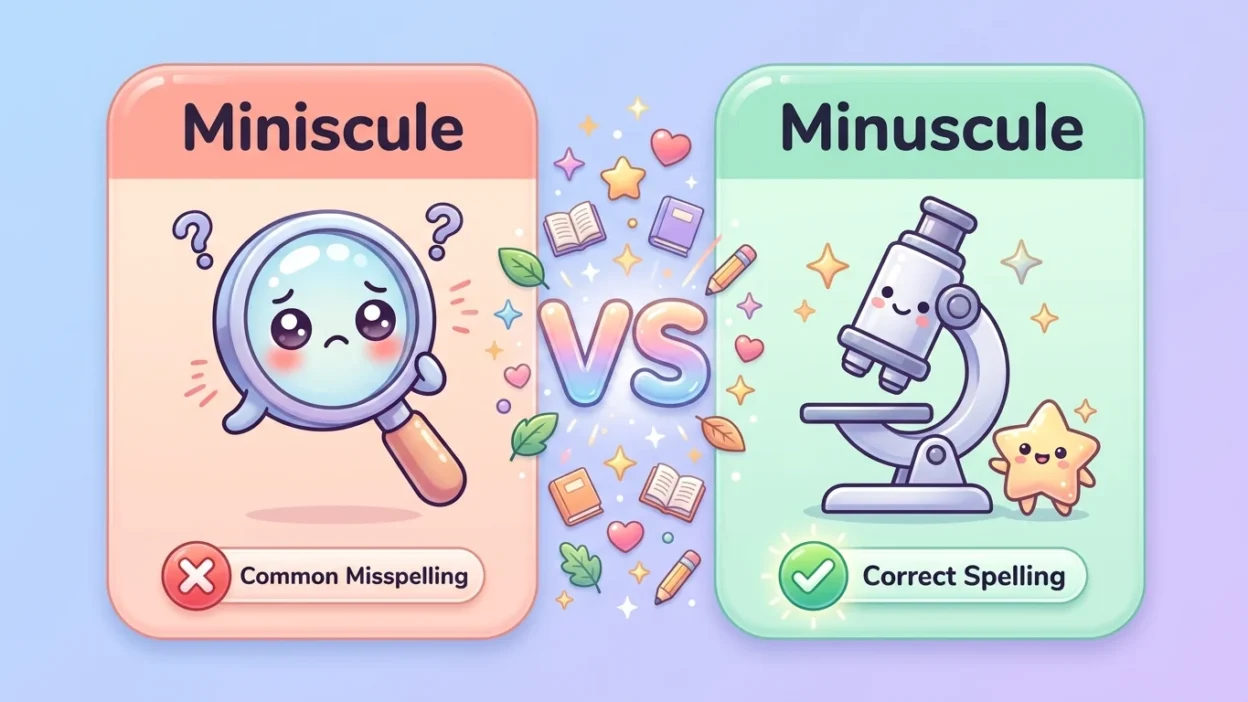
- Minuscule ✅ is the correct and standard spelling.
- Miniscule ❌ is a common misspelling, although some dictionaries list it as a variant because of its widespread use.
For formal writing, academic work, and professional communication, always use minuscule.
What Does Minuscule vs Miniscule Mean?
These spellings refer to the same idea, but only one is preferred.
What Is Minuscule?
Minuscule is an adjective that means extremely small, tiny, or insignificant in size or amount. It can also refer to lowercase letters in typography.
Examples:
- The insect was minuscule.
- We found only a minuscule amount of evidence.
- The difference between the two products is minuscule.
- Please write your password in minuscule letters.
The word is common in everyday English, science, business, and academic writing.
What Is Miniscule?
Miniscule is a nonstandard variant spelling that likely developed because people associate the word with mini, meaning “small.”
Although some modern dictionaries acknowledge miniscule due to common usage, minuscule remains the preferred and correct spelling in standard English.
Minuscule vs Miniscule Comparison Table
| Feature | Miniscule | Minuscule |
|---|---|---|
| Standard English Spelling | ❌ No | ✅ Yes |
| Dictionary Recognition | Variant in some dictionaries | Standard spelling |
| Meaning | Extremely small | Extremely small |
| Recommended for Formal Writing | No | Yes |
| Everyday Usage | Occasionally seen | Very common |
Why Is “Minuscule” the Correct Spelling?
The word minuscule comes from the Latin word minusculus, meaning rather small.
Many people mistakenly write miniscule because they think of the word mini. This pronunciation has influenced the incorrect spelling over time, but the original and preferred form remains minuscule.
Examples of Minuscule in Sentences
Here are some correct examples:
- The chances of winning are minuscule.
- Scientists detected a minuscule crack in the material.
- She noticed a minuscule typo in the document.
- The improvement was minuscule but still meaningful.
- A minuscule amount of sugar changed the flavor.
- The star appeared as a minuscule dot in the sky.
- The price difference was minuscule.
Common Mistakes People Make
Many writers confuse these spellings.
Common mistakes include:
- Writing miniscule because it resembles mini.
- Assuming both spellings are equally correct.
- Using miniscule in formal or academic writing.
- Relying on pronunciation instead of the standard spelling.
Simple Memory Trick
Here’s an easy trick:
Think of the word:
MINUS + CULE = MINUSCULE
Although it means very small, it does not contain the word mini.
This simple reminder helps you remember the standard spelling.
When Should You Use Minuscule?
Use minuscule whenever you describe:
- Tiny objects
- Small differences
- Very low amounts
- Insignificant changes
- Lowercase letters (typography)
- Scientific measurements
When Should You Use Miniscule?
In most cases, you shouldn’t.
Although some dictionaries list miniscule as a variant because of its popularity, minuscule is the spelling recommended by style guides, educators, and editors.
American vs British English
There is no spelling difference between American English and British English.
Both varieties prefer:
- ✅ Minuscule
- ⚠️ Miniscule (recognized by some dictionaries but generally discouraged in formal writing)
Related Words and LSI Keywords
Related terms include:
- tiny
- microscopic
- minute
- miniature
- little
- insignificant
- negligible
- small amount
- lowercase letters
- typography
- spelling difference
- English vocabulary
- grammar guide
- commonly confused words
- language learning
- correct spelling
- writing tips
- academic English
- word comparison
- English usage
Tips for Remembering the Difference
Remember these simple tips:
- Think minuscule, not mini.
- The correct spelling contains “nu”, not “ni.”
- Use minuscule in essays, reports, and professional writing.
- If you’re unsure, check a dictionary or spell checker.
Frequently Asked Questions
What is the difference between minuscule and miniscule?
Both refer to something extremely small, but minuscule is the standard spelling, while miniscule is a common variant that is generally avoided in formal writing.
Is miniscule a real word?
Some dictionaries recognize miniscule as a variant because it is widely used. However, minuscule is the preferred spelling.
Which spelling should I use?
Use minuscule, especially in professional, academic, and formal writing.
Why do people write miniscule?
Many people mistakenly connect the word with mini, leading to the incorrect or nonstandard spelling.
Is minuscule correct in American and British English?
Yes. Both American and British English prefer minuscule.
Can minuscule describe lowercase letters?
Yes. In typography, minuscule refers to lowercase letters, while majuscule refers to uppercase letters.
Summary
The difference between minuscule vs miniscule comes down to standard spelling.
Minuscule is the correct and preferred form in modern English, meaning extremely small or tiny. Miniscule is a common variant that appears because many people associate the word with mini, but it is generally discouraged in formal writing.
Whenever you’re writing essays, articles, emails, or professional documents, choose minuscule. Remember the simple rule: it starts with “minu,” not “mini.” Using the standard spelling will make your writing clearer, more accurate, and more polished.

Rowan Blythecroft crafts atmospheric fiction filled with mystery and folklore.
Her stories often blur the line between reality and imagination.
She spends most of her days wandering forests and writing by candlelight.