Have you ever written panick and wondered if it should be panic instead? You’re not alone! English spelling can be confusing, especially when words change form.
However, when comparing panic vs panick, the answer is simple: only one is a correct standalone word.
In this guide, you’ll learn the difference between panic and panick, their meanings, examples, common mistakes, and easy tricks to remember the correct spelling.
Quick Answer
Here’s the simple answer:
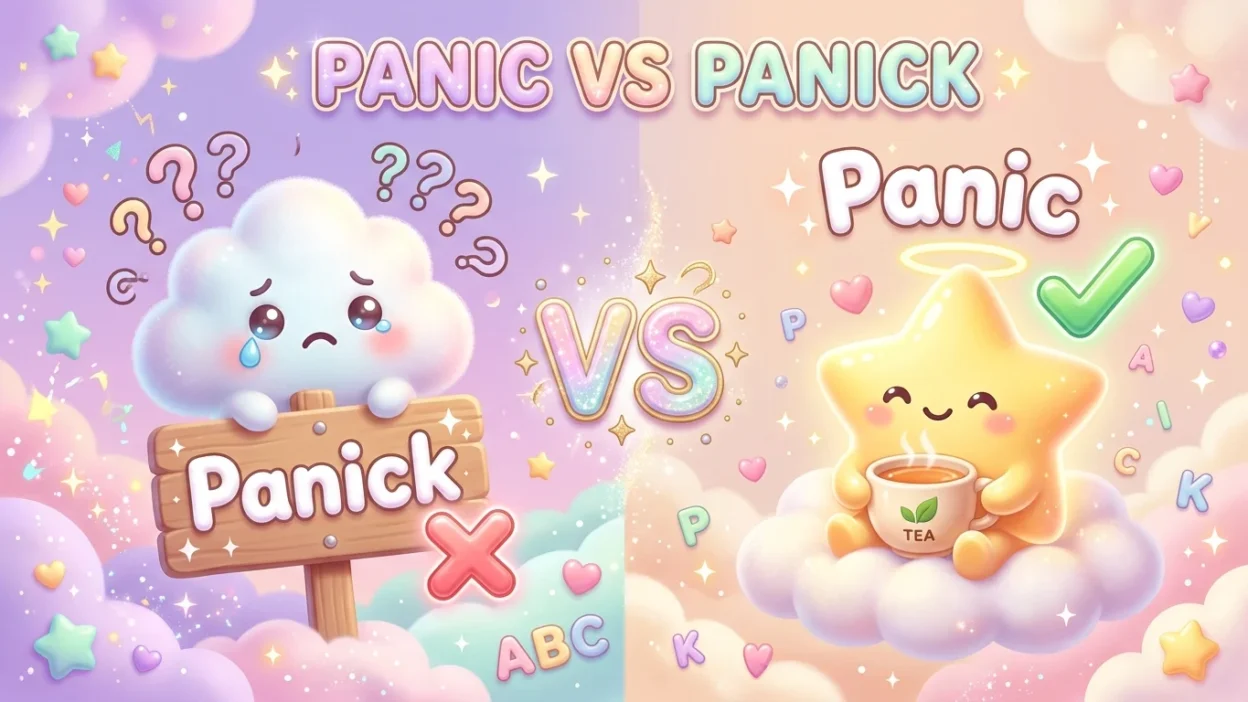
- Panic ✅ is correct.
- Panick ❌ is incorrect.
The word panic refers to a sudden feeling of fear, anxiety, or alarm. The spelling panick is not recognized in standard English dictionaries.
What Do Panic and Panick Mean?
Although these words look similar, only one is accepted in modern English.
What Is Panic?
Panic can be used as both a noun and a verb.
As a noun, it means:
- A sudden feeling of intense fear or anxiety.
As a verb, it means:
- To become frightened or anxious suddenly.
Examples:
- She felt a wave of panic before the presentation.
- Don’t panic—everything will be okay.
- The crowd began to panic during the storm.
- His face showed clear signs of panic.
What Is Panick?
Panick is a misspelling of panic.
It is not a standard English word and should never be used in writing.
Panic vs Panick Comparison Table
| Word | Correct? | Meaning |
|---|---|---|
| Panic | ✅ Yes | Sudden fear or to become afraid |
| Panick | ❌ No | Misspelling of panic |
Why Is “Panic” the Correct Spelling?
The word comes from the Greek god Pan, who was associated with sudden fear and terror.
The accepted English spelling is:
Panic
Many people mistakenly add a k because some related forms include one:
- Panic → Panicked
- Panic → Panicking
However, the base word itself remains:
Panic
Examples of Panic in Sentences
Here are some correct examples:
- Try not to panic during an emergency.
- I experienced a moment of panic when I lost my wallet.
- The passengers started to panic.
- Her voice revealed her panic.
- Don’t let fear cause you to panic.
- He remained calm while others were in panic.
- The announcement caused widespread panic.
Common Mistakes People Make
Many writers accidentally:
- Write panick instead of panic.
- Add a k because of panicked and panicking.
- Assume both spellings are acceptable.
- Miss the typo while proofreading.
Incorrect:
- ❌ Don’t panick!
Correct:
- ✅ Don’t panic!
Simple Memory Trick
Here’s an easy trick:
Panic has no K—but panicked does!
Remember:
- Panic
- Panicked
- Panicking
Think:
“Keep the K for the endings.”
When Should You Use Panic?
Use panic when talking about:
- Fear
- Anxiety
- Emergencies
- Stressful situations
- Emotional reactions
Examples:
- Panic attack
- Public panic
- Financial panic
- Don’t panic
When Should You Use Panick?
Never.
Panick is always a spelling mistake and should be corrected to panic.
American vs British English
There is no difference between American and British English.
Both use:
- ✅ Panic
- ❌ Panick
The spelling is the same worldwide.
Related Words and LSI Keywords
- panicked
- panicking
- panic attack
- sudden fear
- anxiety
- English spelling
- grammar guide
- commonly confused words
- vocabulary
- language learning
- proofreading
- writing correctly
- English usage
- word comparison
Tips for Remembering the Difference
Remember these simple tips:
- The base word is always panic.
- Save the k for panicked and panicking.
- Never write panick.
- Think: “No K when it’s by itself.”
- Use spell check if you’re unsure.
Frequently Asked Questions
Is panick a real word?
No. Panick is not recognized as a standard English word.
Which is correct: panic or panick?
Panic is the correct spelling.
Why do panicked and panicking have a K?
The k is added before certain endings to preserve the hard “c” sound.
Is panic used as both a noun and a verb?
Yes. It can refer to a feeling of fear or the act of becoming afraid.
Is panic used in American and British English?
Yes. Both varieties use the same spelling.
Can I use panick in formal writing?
No. Always use panic.
Summary
The difference between panic vs panick is easy to remember. Panic is the correct spelling and refers to sudden fear or anxiety. Panick is a common misspelling that often occurs because related words like panicked and panicking include a k.
Whenever you’re unsure, remember this simple rule: panic stands alone without a K. Save the extra letter for words like panicked and panicking, and you’ll never make this spelling mistake again.

Rowan Blythecroft crafts atmospheric fiction filled with mystery and folklore.
Her stories often blur the line between reality and imagination.
She spends most of her days wandering forests and writing by candlelight.