Have you typed puting instead of putting and wondered whether it was correct? You’re not alone. This is one of the most common spelling mistakes in English because the words look almost identical. However, only one spelling is accepted in standard English.
In this guide, you’ll learn the difference between puting vs putting, why the mistake happens, examples of correct usage, common errors to avoid, and simple tricks to remember the correct spelling. By the end, you’ll never confuse these spellings again.
Quick Answer
The answer is simple:
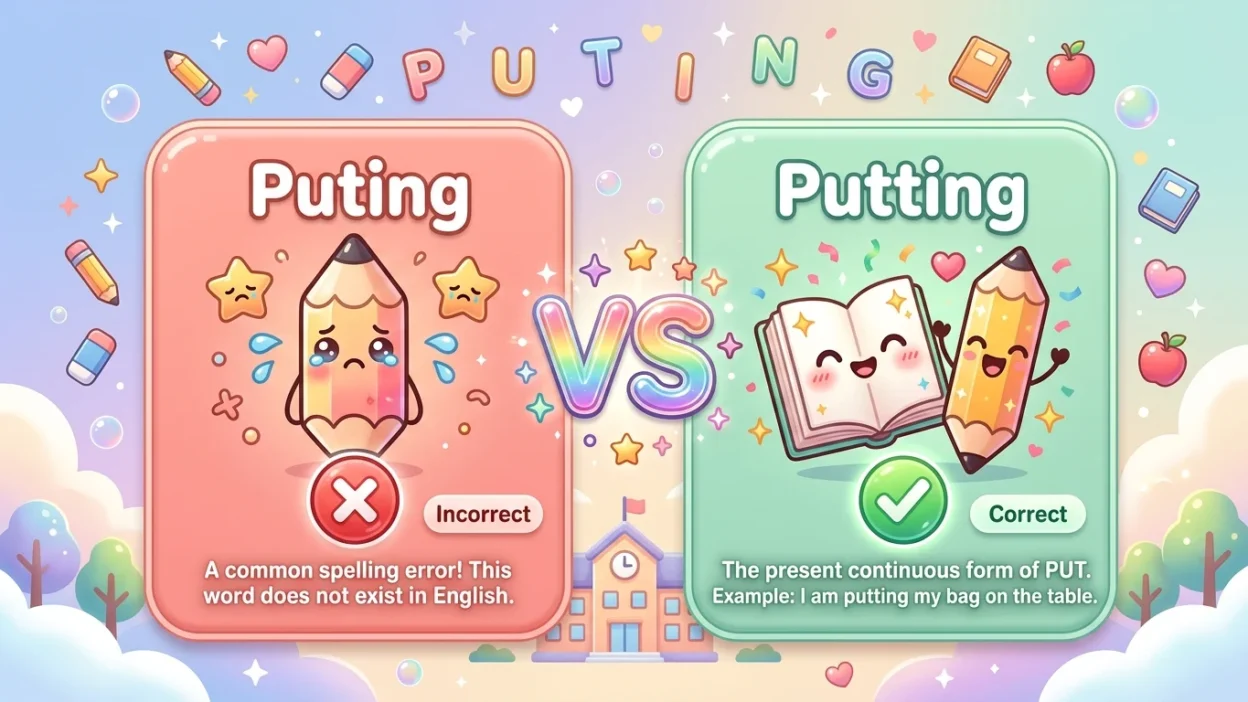
- Putting ✅ is the correct spelling.
- Puting ❌ is a misspelling and is not recognized as a standard English word.
Whenever you mean the present participle or gerund of the verb put, always write putting with two “t”s.
What Does Puting vs Putting Mean?
Although these spellings look similar, only one is correct in modern English.
What Is Putting?
Putting is the present participle and gerund form of the verb put, which means to place, position, move, or set something somewhere.
Examples:
- She is putting the groceries on the table.
- We are putting together a new project.
- He enjoys putting puzzles together.
- They kept putting off the meeting.
The word putting appears frequently in everyday conversations, writing, education, and business English.
What Is Puting?
Puting is simply a misspelling of putting.
It sometimes appears because writers accidentally forget to double the letter t before adding -ing. However, dictionaries and grammar guides do not recognize puting as a correct English word.
Puting vs Putting Comparison Table
| Feature | Puting | Putting |
|---|---|---|
| Correct English Word | ❌ No | ✅ Yes |
| Dictionary Entry | No | Yes |
| Meaning | None | Present participle of put |
| Used in Formal Writing | No | Yes |
| Used in Everyday English | No | Very Common |
Why Is “Putting” Spelled with Two T’s?
Many learners wonder why put becomes putting instead of puting.
The answer lies in an English spelling rule.
When a short, one-syllable verb ends with one vowel followed by one consonant, the final consonant is usually doubled before adding -ing.
Examples:
- put → putting
- sit → sitting
- run → running
- stop → stopping
- swim → swimming
Doubling the final consonant helps preserve the correct pronunciation.
Examples of Putting in Sentences
Here are some examples of the correct spelling:
- I am putting my phone on silent.
- She keeps putting her keys in the same drawer.
- We are putting our ideas into action.
- They spent hours putting the furniture together.
- He is putting more effort into his studies.
- The chef is putting fresh herbs into the soup.
- She avoided putting pressure on the team.
These examples show how naturally putting fits into everyday English.
Common Mistakes People Make
Many writers accidentally spell putting incorrectly.
Common mistakes include:
- Writing puting instead of putting.
- Forgetting to double the final t.
- Assuming every verb simply adds -ing.
- Confusing spelling rules for short verbs.
Proofreading your writing can quickly catch this error.
Simple Memory Trick
A quick trick can help you remember the correct spelling.
Think:
- Put + T + ing = Putting
Or remember this sentence:
“When you put something down, you need two T’s to keep it there.”
This simple reminder makes the spelling easy to recall.
When Should You Use Putting?
Use putting whenever you describe placing, arranging, moving, or positioning something.
Common situations include:
- Putting food on a plate
- Putting clothes away
- Putting together furniture
- Putting ideas into practice
- Putting money into savings
- Putting a plan into action
- Putting your phone on charge
- Putting effort into learning
When Should You Use Puting?
You shouldn’t.
Puting is considered a spelling mistake in standard English. If you see it in writing, it should usually be corrected to putting.
American vs British English
There is no spelling difference between American English and British English.
Both varieties use:
- ✅ Putting
- ❌ Puting
Whether you’re writing for readers in the United States, the United Kingdom, Canada, Australia, or elsewhere, putting is always the correct spelling.
Related Words and LSI Keywords
Related words and phrases include:
- put
- placing
- positioning
- arranging
- setting
- laying
- spelling mistake
- English grammar
- present participle
- gerund
- double consonants
- English spelling rules
- common misspellings
- writing correctly
- grammar guide
- English vocabulary
- verb forms
- proofreading
- language learning
- correct spelling
Tips for Remembering the Difference
Follow these simple tips:
- Always double the t before adding -ing.
- Remember that putting comes from the verb put.
- If your spell checker highlights puting, change it to putting.
- Read your writing aloud during proofreading.
- Practice common -ing verb spellings regularly.
Frequently Asked Questions
What is the difference between puting and putting?
Putting is the correct spelling of the verb put in its -ing form. Puting is a misspelling.
Is puting a real English word?
No. Puting is not recognized as a standard English word.
Why does putting have two T’s?
English spelling rules require doubling the final consonant of many short verbs before adding -ing, so put becomes putting.
Is putting correct in American and British English?
Yes. Both American and British English use putting.
Can I write puting in formal writing?
No. Always use putting in essays, emails, reports, and professional writing.
Is putting a verb?
Yes. Putting is the present participle and gerund form of the verb put.
What are similar words that double the final consonant?
Examples include running, sitting, stopping, swimming, and putting.
Summary
The difference between puting vs putting is easy to remember once you know the spelling rule.
Putting is the only correct spelling and serves as the present participle and gerund of the verb put. In contrast, puting is simply a common spelling mistake caused by forgetting to double the final t before adding -ing.
Whenever you’re writing emails, assignments, blog posts, or social media content, always choose putting. A quick proofread and a basic understanding of English spelling rules will help you avoid this mistake and write with greater confidence and accuracy.

Rowan Blythecroft crafts atmospheric fiction filled with mystery and folklore.
Her stories often blur the line between reality and imagination.
She spends most of her days wandering forests and writing by candlelight.