
Have you ever seen the words vender and vendor and wondered if they mean the same thing? You’re not alone.
Since the two words differ by just one letter, many English learners and even native speakers confuse them. However, only one spelling is commonly accepted in modern English.
In this guide, you’ll learn the difference between vender vs vendor, their meanings, examples, common mistakes, and whether American and British English treat them differently. By the end, you’ll know exactly which word to use in every situation.
Quick Answer
The difference between vender vs vendor is straightforward:
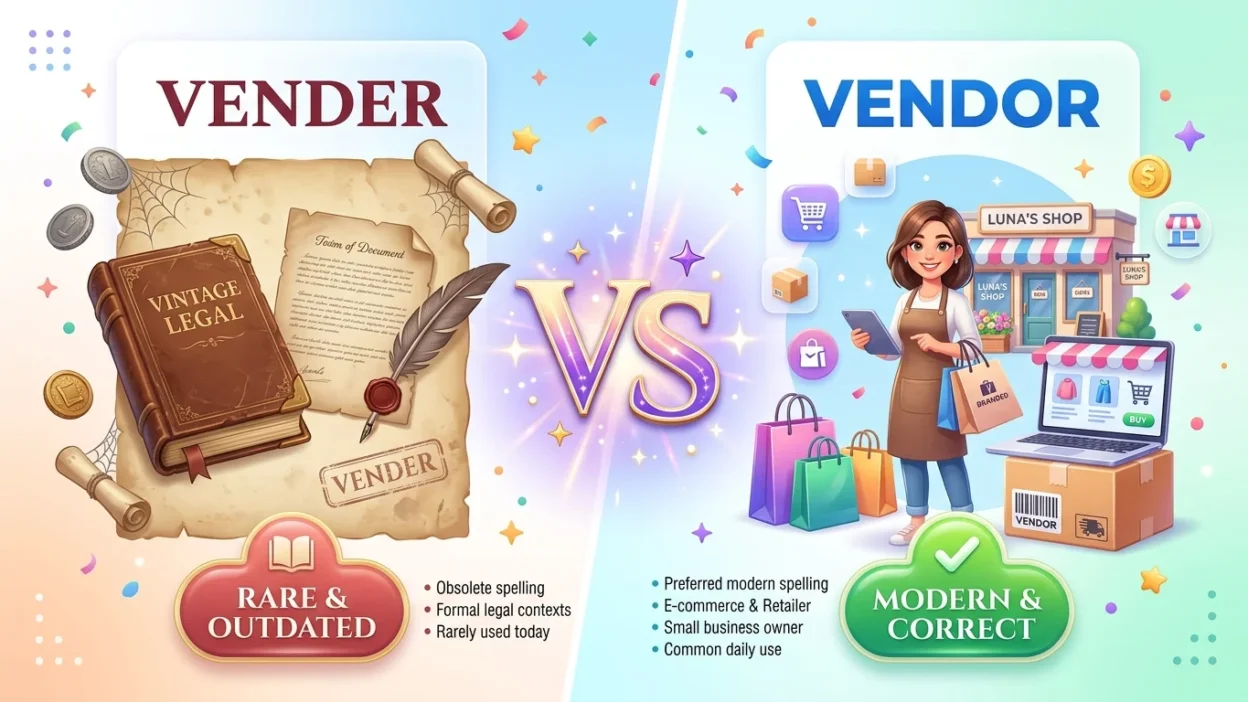
- Vendor is the standard and widely accepted spelling for a person or business that sells goods or services.
- Vender is a rare alternative spelling that appears mainly in legal, historical, or regional contexts and is generally considered outdated in everyday English.
For almost all modern writing, vendor is the correct choice.
What Does Vender vs Vendor Mean?
Although the spellings differ, both words relate to selling something.
What Is a Vendor?
A vendor is a person, company, or organization that sells products or services to customers or businesses.
The term is commonly used in business, retail, real estate, technology, events, and e-commerce.
Examples:
- The software vendor released a security update.
- We selected a local vendor for office supplies.
- Food vendors lined the streets during the festival.
- The property vendor accepted the buyer’s offer.
Today, vendor is the preferred spelling in nearly every industry.
What Is a Vender?
Vender is an uncommon alternative spelling of vendor. Historically, it appeared in some legal documents and older dictionaries, but modern English rarely uses it.
In most situations, replacing vender with vendor is the better choice.
Examples:
- Older legal records may mention the vender of land.
- Historical documents sometimes use the spelling vender instead of vendor.
Outside these limited contexts, the spelling is uncommon.
Vender vs Vendor Comparison Table
| Feature | Vender | Vendor |
|---|---|---|
| Modern Usage | Rare | Very common |
| Meaning | Seller of goods or property | Seller of goods or services |
| Preferred Spelling | No | Yes |
| Business English | Rarely used | Standard |
| Legal or Historical Writing | Occasionally found | Common today |
Examples of Vendor in Everyday English
The word vendor appears in many everyday situations.
Examples:
- The event featured dozens of local vendors.
- Our company changed its software vendor.
- Street vendors sold fresh fruit all afternoon.
- The online vendor offered free shipping.
- The vendor signed a new supply agreement.
These examples show why vendor is the standard spelling in modern communication.
Examples of Vender
Although uncommon, you may occasionally encounter vender.
Examples:
- The legal contract referred to the vender of the property.
- An old dictionary listed vender as an accepted spelling.
- Historical records mentioned the original vender of the estate.
In modern writing, however, vendor is almost always preferred.
Common Mistakes People Make
Many writers accidentally choose the wrong spelling.
Common mistakes include:
- Writing vender in business emails.
- Assuming both spellings are equally common.
- Using vender because it resembles the verb “vend.”
- Believing vendor is only an American spelling.
Choosing vendor will prevent confusion in nearly every context.
Simple Memory Trick
An easy way to remember the correct spelling is:
- Vendor = Modern business spelling
- Vender = Rare historical spelling
If you’re writing about a company, supplier, retailer, marketplace, or service provider, choose vendor.
When Should You Use Vendor?
Use vendor whenever you refer to:
- A business selling products
- A software company
- An online marketplace seller
- A food stall owner
- A retail supplier
- A property seller
- A trade show exhibitor
- A service provider
This is the correct spelling in business, education, journalism, and everyday English.
When Might You See Vender?
You may encounter vender in:
- Historical books
- Older legal documents
- Archived property records
- Some regional or outdated publications
Most modern style guides recommend vendor instead.
American vs British English
There is no meaningful spelling difference between American English and British English for this word.
- Vendor is the standard spelling in both American and British English.
- Vender appears only occasionally in historical or legal materials and is uncommon in both varieties.
Whether you’re writing for a U.S. or U.K. audience, vendor is the preferred choice.
Related Words and LSI Keywords
Related words that help explain this topic include:
- seller
- supplier
- merchant
- retailer
- trader
- provider
- distributor
- wholesaler
- business partner
- service provider
- marketplace seller
- software vendor
- street vendor
- property seller
- business terminology
- English vocabulary
- spelling differences
- word comparison
- business English
- legal terminology
Tips for Remembering the Difference
Keep these tips in mind:
- Use vendor in all modern business writing.
- Think of software vendors, food vendors, and retail vendors—all use vendor.
- If you see vender, check whether the text is historical or legal.
- When unsure, choose vendor because it is the accepted modern spelling.
Frequently Asked Questions
What is the difference between vender and vendor?
Both words refer to someone who sells goods or property, but vendor is the standard modern spelling, while vender is a rare, older variant.
Which spelling is correct: vender or vendor?
For modern English, vendor is the correct and preferred spelling.
Is vender an English word?
Yes. Vender is a recognized but uncommon alternative spelling that mainly appears in historical or legal contexts.
Do American and British English use different spellings?
No. Both American and British English overwhelmingly use vendor.
Can I use vender in business writing?
It’s best not to. Business writing almost always uses vendor.
Why do some legal documents use vender?
Some older legal documents retained the historical spelling vender, especially in property transactions.
Is vendor used for services as well as products?
Yes. A vendor may sell products, software, equipment, or professional services.
Summary
The distinction between vender vs vendor is mainly one of modern usage. While both words historically refer to someone who sells goods or property, vendor has become the accepted spelling in contemporary English. It appears in business, technology, retail, real estate, education, and everyday communication, making it the form most readers expect.
Whenever you write emails, contracts, articles, or reports, choose vendor unless you’re quoting an old legal document or historical source. Using the standard spelling improves clarity, looks more professional, and ensures your writing matches modern English conventions.

Rowan Blythecroft crafts atmospheric fiction filled with mystery and folklore.
Her stories often blur the line between reality and imagination.
She spends most of her days wandering forests and writing by candlelight.