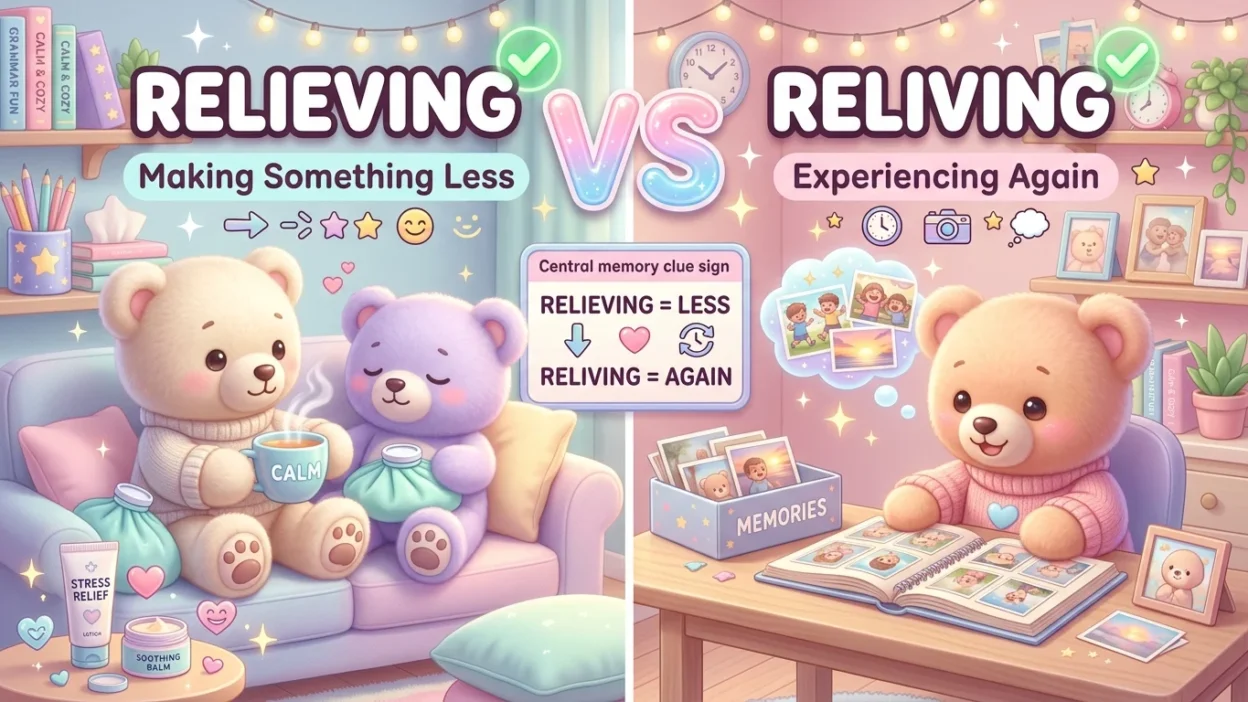
Have you ever confused relieving vs reliving? These two words look and sound similar, but they have completely different meanings. Relieving means reducing pain, stress, discomfort, or responsibility, while reliving means experiencing something from the past again in your mind or memories.
In this guide, you’ll learn the difference between relieving and reliving, their meanings, examples, common mistakes, grammar rules, and an easy memory trick to help you remember which word to use.
Quick Answer
- Relieving ✅ = reducing pain, stress, discomfort, pressure, or someone’s responsibility.
- Reliving ✅ = experiencing or remembering a past event again.
Examples:
- This medicine is relieving my headache. ✅
- She is reliving her childhood memories. ✅
The easiest rule is:
Relieving = making something less difficult
Reliving = living something again
What Does Relieving Mean?
Relieving is the present participle or gerund form of relieve.
The verb relieve means to reduce or remove pain, stress, discomfort, pressure, or responsibility.
Examples:
- The medicine is relieving my pain.
- Exercise is relieving some of my stress.
- The new employee is relieving her of some responsibilities.
- The treatment is relieving the pressure.
- The cold water is relieving the burning sensation.
In each example, something is being made less painful, stressful, difficult, or burdensome.
What Does Reliving Mean?
Reliving is the present participle or gerund form of relive.
The verb relive means to experience, remember, or imagine a past event again.
Examples:
- He is reliving his childhood memories.
- She enjoyed reliving her wedding day through old photographs.
- The movie helped him relive his favorite memories.
- They were reliving the excitement of their first victory.
- I don’t want to keep reliving that painful experience.
The important idea is:
Reliving = living or experiencing something again.
Relieving vs Reliving Comparison Table
| Feature | Relieving | Reliving |
|---|---|---|
| Base word | Relieve | Relive |
| Main meaning | Reducing or removing something unpleasant | Experiencing something again |
| Common objects | Pain, stress, pressure, responsibility | Memories, experiences, moments, events |
| Example | Relieving pain | Reliving a memory |
| Key idea | Making something easier | Experiencing the past again |
| Spelling | Relieving | Reliving |
Why Are Relieving and Reliving Confused?
The words relieving and reliving look very similar because both begin with reli- and end with -ing.
The main spelling difference is the extra e:
- Relieving → from relieve
- Reliving → from relive
Their meanings are also completely different.
Compare:
The medicine is relieving my pain.
This means the medicine is reducing pain.
She is reliving the memory.
This means she is experiencing the memory again.
Examples of Relieving in Sentences
Here are some correct examples of relieving:
- The medication is relieving my headache.
- Stretching is relieving the tension in my muscles.
- The treatment is relieving his discomfort.
- The new system is relieving employees of unnecessary work.
- The cool breeze was relieving the heat.
- She found that walking was relieving her stress.
- The pressure was finally relieving itself.
- The nurse gave him medicine for relieving the pain.
Examples of Reliving in Sentences
Here are some correct examples of reliving:
- She was reliving her childhood memories.
- He kept reliving the moment in his mind.
- They enjoyed reliving their vacation memories.
- The photographs helped us relive the special day.
- He was reliving the excitement of his first performance.
- The story had me reliving my school days.
- She doesn’t want to keep reliving the past.
- The documentary allowed viewers to relive the historic event.
Relieving Pain vs Reliving Memories
This is one of the easiest ways to understand the difference.
Relieving Pain
Relieving often describes something that reduces pain or discomfort.
- The medicine is relieving my pain.
- The ice pack is relieving the swelling.
- Rest is relieving the discomfort.
Reliving Memories
Reliving often describes experiencing a past event again mentally or emotionally.
- She is reliving her childhood.
- He is reliving the happiest moment of his life.
- The photographs helped them relive their vacation.
Remember:
Relieving → pain becomes less
Reliving → the past comes back
Relieve vs Relive
Understanding the base verbs makes the difference much easier.
Relieve
Relieve means to reduce or remove something unpleasant.
Examples:
- relieve pain
- relieve stress
- relieve pressure
- relieve discomfort
- relieve responsibility
Its -ing form is:
relieving
Relive
Relive means to experience something again.
Examples:
- relive a memory
- relive an experience
- relive a moment
- relive an event
- relive the past
Its -ing form is:
reliving
Why Does Relieving Keep the “E”?
The spelling of relieving comes from the verb relieve.
When -ing is added, the final e is removed, but the spelling changes according to the base word:
relieve → relieving
Notice that relieve already contains the letter sequence -ie.
The result is:
relieving
Not:
- ❌ releiving
- ❌ reliving, when you mean reducing something
Why Is Reliving Spelled Without the “E”?
The base verb is:
relive
When -ing is added, the final e is dropped:
relive → reliving
This follows the normal spelling pattern for many verbs ending in silent e.
For example:
- live → living
- give → giving
- love → loving
- relive → reliving
Therefore:
relive → reliving
Common Mistakes People Make
Mistake 1: Using Reliving for Pain
Incorrect:
- ❌ This medicine is reliving my headache.
Correct:
- ✅ This medicine is relieving my headache.
Medicine reduces pain, so use relieving.
Mistake 2: Using Relieving for Memories
Incorrect:
- ❌ She is relieving her childhood memories.
Correct:
- ✅ She is reliving her childhood memories.
She is experiencing the memories again, so use reliving.
Mistake 3: Confusing Relieve and Relive
Remember:
- Relieve = reduce something unpleasant.
- Relive = experience something again.
Their -ing forms follow the same distinction:
- Relieving
- Reliving
Simple Memory Trick
💡 Memory Trick
Spelling Box
Remember:
RELIEVING = RELIEVE → LESS 💆
RELIVING = RELIVE → AGAIN 🔄
Think:
Relieving pain → making pain less.
Reliving memories → experiencing memories again.
A simple clue:
RELIEVING has “IE”
RELIVING has “IV”
Relieve = reduce
Relive = experience again
Relieving Stress vs Reliving Stress
These expressions can mean very different things.
Relieving Stress
This means reducing stress.
- Exercise is relieving my stress.
- Taking a break is relieving some of the stress.
Reliving Stress
This could mean experiencing a stressful event again, usually through memory.
- He was reliving the stressful experience in his mind.
So:
Relieving stress = reducing stress
Reliving a stressful experience = experiencing it again
Relieving Responsibility
Relieving can also mean removing or reducing someone’s responsibility or duty.
Examples:
- The assistant is relieving her of some administrative duties.
- The manager was relieved of his responsibilities.
- The new employee is relieving the team of extra work.
Here, relieving has nothing to do with memories.
Reliving a Moment
Reliving is commonly used with moment.
Examples:
- She was reliving the moment she won the competition.
- He enjoyed reliving that special moment.
- The video allowed them to relive the moment.
Here, the person is mentally experiencing the moment again.
Reliving Memories
Reliving memories means thinking about or experiencing past memories again.
Examples:
- We spent the evening reliving old memories.
- The photographs had us reliving our childhood.
- She enjoyed reliving happy memories with her family.
The word reliving is especially common with:
- memories
- childhood
- experiences
- moments
- events
- the past
Relieving in Everyday English
Relieving is common when discussing:
- Pain
- Stress
- Pressure
- Tension
- Discomfort
- Responsibilities
- Workload
Examples:
- relieving pain
- relieving stress
- relieving pressure
- relieving tension
- relieving discomfort
- relieving someone of responsibility
Reliving in Everyday English
Reliving is common when discussing:
- Memories
- Childhood
- Experiences
- Special moments
- Past events
- Historical events
Examples:
- reliving memories
- reliving childhood
- reliving an experience
- reliving a moment
- reliving the past
American vs British English
There is no major spelling difference between American and British English for relieving and reliving.
Both varieties use:
- relieving = reducing or removing something
- reliving = experiencing something again
For example:
- The treatment is relieving the pain.
- She is reliving the memory.
The distinction is the same in both forms of English.
When Should You Use Relieving?
Use relieving when something is being reduced, removed, or made easier.
Examples:
- Relieving pain
- Relieving stress
- Relieving pressure
- Relieving discomfort
- Relieving tension
- Relieving responsibility
Ask yourself:
“Is something becoming less unpleasant or difficult?”
If yes, use relieving.
When Should You Use Reliving?
Use reliving when someone is experiencing something from the past again.
Examples:
- Reliving memories
- Reliving childhood
- Reliving an experience
- Reliving a special moment
- Reliving an event
Ask yourself:
“Is someone experiencing something again?”
If yes, use reliving.
Related Words and LSI Keywords
- relieving meaning
- reliving meaning
- relieving vs reliving
- reliving vs relieving
- relieve vs relive
- relieving pain
- reliving memories
- relieving stress
- reliving the past
- relieving discomfort
- reliving an experience
- English spelling
- English grammar
- commonly confused words
- common spelling mistakes
- correct English usage
- English vocabulary
- word differences
- grammar guide
- language learning
Tips for Remembering the Difference
- Relieving = reducing something unpleasant.
- Reliving = experiencing something again.
- You relieve pain.
- You relive memories.
- Relieving comes from relieve.
- Reliving comes from relive.
- Think less for relieving.
- Think again for reliving.
- Relieving stress means reducing stress.
- Reliving a stressful event means experiencing it again.
Frequently Asked Questions
What is the difference between relieving and reliving?
Relieving means reducing or removing pain, stress, pressure, discomfort, or responsibility. Reliving means experiencing a past event, memory, or moment again.
Is it relieving or reliving pain?
Relieving pain is correct.
Example:
- This medication is relieving my pain.
Is it relieving or reliving memories?
Reliving memories is correct.
Example:
- She is reliving happy memories from her childhood.
What does relieving mean?
Relieving means reducing or removing something unpleasant, such as pain, stress, pressure, or discomfort.
What does reliving mean?
Reliving means experiencing something from the past again, usually through memory or imagination.
Is relieving the same as reliving?
No. Relieving means making something less difficult or unpleasant, while reliving means experiencing something again.
Why does relieving have an extra e?
Relieving comes from relieve, while reliving comes from relive. The two base verbs have different spellings and meanings.
Is “relieving stress” correct?
Yes. Relieving stress means reducing stress.
Example:
- Exercise can be effective for relieving stress.
Is “reliving stress” correct?
It can be grammatically correct, but it has a different meaning. Reliving stress could refer to experiencing a stressful event again in your memory.
Is “relieving memories” correct?
Generally, no, if you mean experiencing memories again. The correct phrase is reliving memories.
Is “reliving pain” correct?
It can be used if someone is experiencing a past painful event again, especially emotionally or mentally. But if you mean reducing physical pain, use relieving pain.
Is relieving the opposite of reliving?
Not exactly. They have different meanings, but they can create a useful contrast: relieving makes something less painful, while reliving means experiencing something again.
What is an easy way to remember relieving vs reliving?
Remember: RELIEVING = MAKING SOMETHING LESS, while RELIVING = EXPERIENCING SOMETHING AGAIN. You relieve pain but relive memories.
Summary
The difference between relieving vs reliving becomes simple when you remember their base verbs. Relieving comes from relieve, meaning to reduce or remove something unpleasant, such as pain, stress, pressure, or discomfort. Reliving comes from relive, meaning to experience a past memory, event, or moment again.
Use relieving for things like pain, stress, pressure, and discomfort. Use reliving for memories, childhood, experiences, and past events. The easiest memory trick is: relieving = making something less, reliving = experiencing something again.

Alistair Fenwicke is a quiet observer of rural life and forgotten histories.
His novels explore memory, solitude, and the passing of time.
He writes from a small countryside cottage surrounded by fields.