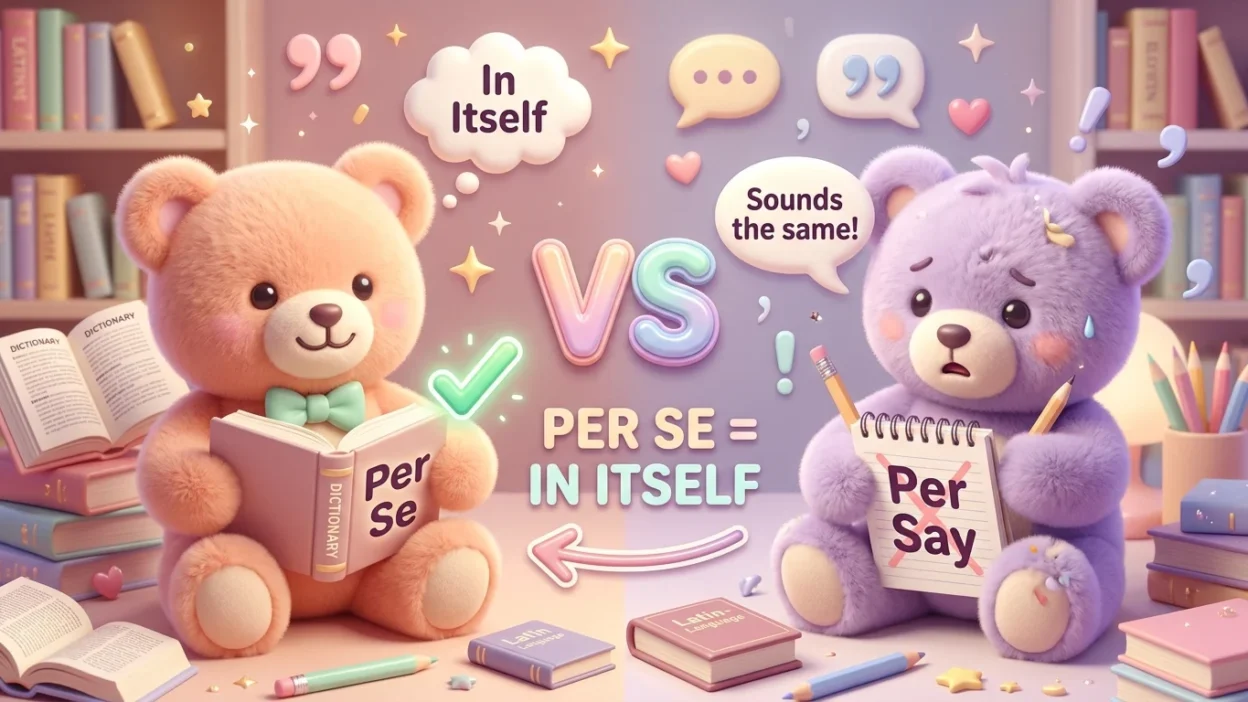
Have you ever wondered about per se vs per say? These expressions sound almost identical, so it’s easy to confuse them. However, only one is the standard expression: per se. It is a Latin phrase meaning “in itself,” “by itself,” or “intrinsically.” Per say is a common misspelling.
In this guide, you’ll learn the difference between per se and per say, their meanings, examples, common mistakes, pronunciation, usage, and an easy memory trick.
Quick Answer
- Per se ✅ = correct expression meaning in itself or by itself.
- Per say ❌ = incorrect spelling when you mean per se.
Example:
- The idea isn’t bad per se, but it needs improvement. ✅
- The idea isn’t bad per say. ❌
The easiest rule is:
Per se = in itself
Per say = incorrect
What Does Per Se Mean?
Per se is a Latin phrase that means in itself, by itself, or intrinsically.
English speakers commonly use it when they want to distinguish something itself from its effects, context, or related circumstances.
Examples:
- The job isn’t difficult per se, but it is time-consuming.
- I don’t dislike the movie per se; I just didn’t enjoy the ending.
- There is nothing wrong with the design per se.
- The rule isn’t unfair per se, but its application can be problematic.
In each example, per se means something like “in itself” or “considered on its own.”
What Does Per Say Mean?
Per say ❌ is not the standard spelling of this expression.
People often write per say because se and say can sound similar when spoken quickly.
Incorrect:
- ❌ The idea isn’t bad per say.
Correct:
- ✅ The idea isn’t bad per se.
If you mean “in itself,” always write per se.
Per Se vs Per Say Comparison Table
| Expression | Correct? | Meaning | Example |
|---|---|---|---|
| Per se | ✅ Yes | In itself; by itself | It isn’t wrong per se. |
| Per say | ❌ No | Misspelling of per se | ❌ It isn’t wrong per say. |
Why Is “Per Se” the Correct Spelling?
Per se comes directly from Latin.
In Latin, per se means by itself or in itself.
The expression entered English while retaining its original spelling.
Therefore, the correct form is:
per se
Not:
per say
The word say has a completely different meaning in English and is not part of this Latin expression.
How Do You Pronounce Per Se?
Per se is commonly pronounced approximately:
“per SAY”
This pronunciation explains why people sometimes mistakenly write per say.
Although it sounds similar to say, the correct spelling remains:
per se
Think of it as a pronunciation trap: it sounds like “per say,” but it is spelled “per se.”
Examples of Per Se in Sentences
Here are some natural examples:
- The plan isn’t bad per se, but it could be improved.
- I don’t object to the idea per se.
- Money isn’t the problem per se.
- The product isn’t expensive per se, but shipping costs are high.
- The decision wasn’t wrong per se.
- There’s nothing unusual about the situation per se.
- The restaurant isn’t terrible per se, but I wouldn’t return.
- Technology isn’t harmful per se; its impact depends on how people use it.
Per Se Meaning “In Itself”
The easiest way to understand per se is to replace it with “in itself.”
For example:
The idea isn’t bad per se.
You could rewrite it as:
The idea isn’t bad in itself.
Another example:
The job isn’t difficult per se.
Means:
The job isn’t difficult in itself.
This substitution is one of the best ways to understand the phrase.
Per Se Meaning “By Itself”
Per se can also mean by itself or considered independently.
Example:
- The rule isn’t harmful per se.
This means the rule itself isn’t necessarily harmful when considered independently.
Another example:
- Fame isn’t a problem per se.
The speaker means that fame itself is not the problem.
Common Mistakes People Make
Mistake 1: Writing Per Say
Incorrect:
- ❌ I don’t dislike it per say.
Correct:
- ✅ I don’t dislike it per se.
Mistake 2: Thinking Per Say Is an Alternative Spelling
Per say isn’t an accepted alternative spelling of per se.
It is simply a common misspelling caused by pronunciation.
Mistake 3: Writing “Persee”
Another incorrect version is:
- ❌ persee
Correct:
- ✅ per se
The expression consists of two separate words.
Mistake 4: Using Per Se When You Mean “For Example”
Per se does not mean for example.
For example:
- ❌ I like many fruits, per se, apples and oranges.
If you mean for example, use:
- for example
- such as
- e.g.
Per se means in itself.
Simple Memory Trick
💡 Memory Trick
Spelling Box
Remember:
PER SE = IN ITSELF ✨
The phrase ends with SE, not SAY.
Think:
“Per se” = “in itself.”
If you’re tempted to write per say, remember that say is a verb meaning to speak words. It has nothing to do with the Latin phrase.
Per Se vs For Example
These expressions have completely different meanings.
Per se
Means in itself.
- The idea isn’t bad per se.
For example
Introduces an example.
- I enjoy outdoor activities, for example, hiking and cycling.
Don’t substitute one for the other.
Per Se vs Specifically
Per se means in itself.
Specifically means exactly or particularly.
Examples:
- I don’t dislike the color per se.
- I don’t mean specifically that color.
They can appear in similar discussions but serve different purposes.
Per Se in Formal Writing
Per se is widely used in formal and academic English.
You may see it in:
- Academic writing
- Legal writing
- Business writing
- Essays
- Journalism
- Professional discussions
- Philosophy
- Research
Examples:
- The policy is not discriminatory per se.
- The technology is not dangerous per se.
- The behavior is not illegal per se.
However, in simple writing, in itself or by itself may sometimes be clearer.
Per Se in Everyday English
Although per se is more formal than some everyday expressions, native speakers also use it in conversation.
Examples:
- I don’t hate it per se.
- It’s not expensive per se.
- He’s not rude per se.
- There’s nothing wrong with it per se.
It often helps speakers express a subtle distinction.
Per Se vs In Itself
These expressions are closely related.
Per se:
- The plan isn’t unreasonable per se.
In itself:
- The plan isn’t unreasonable in itself.
Both communicate essentially the same idea.
The main difference is style. In itself is often simpler and more accessible, while per se can sound more formal or concise.
American vs British English
Per se is used in both American and British English.
Both varieties use:
- ✅ per se
- ❌ per say
There is no American-versus-British spelling difference here.
The expression retains its Latin spelling in both varieties.
When Should You Use Per Se?
Use per se when you mean:
- In itself
- By itself
- Intrinsically
- Considered independently
Examples:
- The idea isn’t bad per se.
- The rule isn’t unfair per se.
- The product isn’t expensive per se.
- I don’t dislike the concept per se.
Ask yourself:
“Can I replace this expression with ‘in itself’?”
If yes, per se may be appropriate.
When Should You Use Per Say?
You generally should not use “per say” when you mean per se.
If you see per say in a sentence such as:
- ❌ It isn’t wrong per say.
Correct it to:
- ✅ It isn’t wrong per se.
Remember that say is a completely separate English word.
Related Words and LSI Keywords
- per se meaning
- per say meaning
- per se vs per say
- per say vs per se
- per se definition
- per se spelling
- per say spelling
- what does per se mean
- how to use per se
- per se in a sentence
- per se pronunciation
- in itself meaning
- by itself meaning
- Latin phrases in English
- commonly confused words
- common spelling mistakes
- English grammar
- English vocabulary
- correct English usage
- formal English expressions
Tips for Remembering the Difference
- Per se is correct.
- Per say is a misspelling.
- Per se means in itself.
- The phrase contains se, not say.
- Per se comes from Latin.
- It is written as two separate words.
- Both American and British English use per se.
- Remember: Per se = in itself.
Frequently Asked Questions
Is it per se or per say?
Per se is correct. Per say is a common misspelling.
What does per se mean?
Per se means in itself, by itself, or intrinsically.
Is per say a word?
No. Per say is not the standard spelling of the expression per se.
Why do people write per say?
People often write per say because per se is pronounced approximately like “per SAY.”
Is per se one word?
No. Per se consists of two separate words.
Is per se Latin?
Yes. Per se is a Latin phrase meaning by itself or in itself.
How do you pronounce per se?
It is commonly pronounced approximately “per SAY.”
Is per se formal?
Per se is often considered somewhat formal and is common in academic, professional, legal, and philosophical writing. It is also used in everyday conversation.
Can per se mean in itself?
Yes. In itself is one of the simplest English equivalents of per se.
What is an example of per se?
A common example is:
- The idea isn’t bad per se, but it needs improvement.
Here, per se means in itself.
Is per se used in American English?
Yes. Per se is commonly used in American English.
Is per se used in British English?
Yes. British English also uses per se with the same meaning and spelling.
What is an easy way to remember per se vs per say?
Remember: PER SE = IN ITSELF. The correct phrase ends with se, even though it sounds like “say.”
Summary
The difference between per se vs per say is simple: per se is the correct expression, while per say is a common misspelling. Per se is a Latin phrase meaning “in itself,” “by itself,” or “intrinsically.” It is useful when you want to distinguish something itself from its context, effects, or related circumstances.
Although per se is pronounced approximately like “per say,” never let the pronunciation trick you into adding ay. Remember the simple rule: PER SE = IN ITSELF. Whether you’re writing in American or British English, per se is the correct form.

Rowan Blythecroft crafts atmospheric fiction filled with mystery and folklore.
Her stories often blur the line between reality and imagination.
She spends most of her days wandering forests and writing by candlelight.