
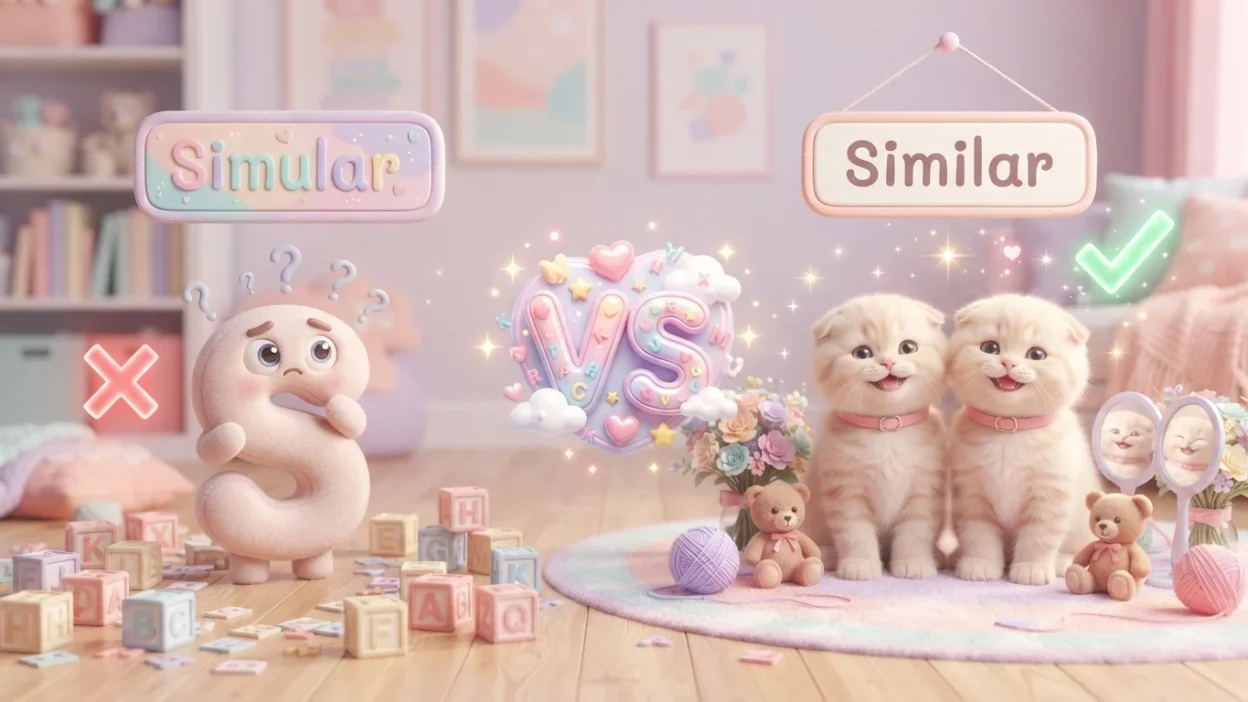
Have you ever typed simular instead of similar? You’re not alone! This is one of the most common English spelling mistakes because the two words sound very similar. However, only one spelling is correct in standard English.
In this guide, you’ll learn the difference between simular vs similar, their meanings, examples, common mistakes, and an easy memory trick to help you spell the word correctly every time.
Quick Answer
- Similar ✅ — Correct spelling.
- Simular ❌ — Incorrect spelling.
Use similar whenever you want to describe two or more things that are alike but not exactly the same.
Examples:
- These two dresses look similar.
- Their writing styles are very similar.
What Do Simular and Similar Mean?
Although these words look almost identical, only one is accepted in standard English.
What Is Similar?
Similar is an adjective that means:
- Nearly the same but not identical.
- Sharing common features or qualities.
- Closely resembling another person or thing.
Examples:
- The twins have similar personalities.
- Our ideas are surprisingly similar.
- These phones offer similar features.
- Their houses have similar designs.
What Is Simular?
Simular is a misspelling of similar.
It is not recognized as a standard English word and should never be used in formal or informal writing.
Simular vs Similar Comparison Table
| Feature | Simular | Similar |
|---|---|---|
| Correct English Word | ❌ No | ✅ Yes |
| Dictionary Entry | No | Yes |
| Meaning | None | Nearly alike or resembling |
| Used in Formal Writing | No | Yes |
| Used in Everyday English | No | Very Common |
Why Is “Similar” Correct?
The correct spelling is:
S-I-M-I-L-A-R
Many writers accidentally replace the second “i” with a “u” because of pronunciation or typing habits. However, the standard English spelling has always been similar.
Therefore:
- Similar ✅ — Correct spelling.
- Simular ❌ — Incorrect spelling.
Examples of Similar in Sentences
- The two paintings have similar colors.
- We share similar interests.
- These software programs perform similar tasks.
- Their voices sound remarkably similar.
- The brothers have similar facial features.
- The recipes use similar ingredients.
- Both companies offer similar services.
Common Mistakes People Make
Many writers accidentally:
- Write simular instead of similar.
- Spell the word based on pronunciation.
- Replace the second “i” with a “u.”
- Miss the typo while proofreading.
Incorrect:
- ❌ These products are simular in quality.
Correct:
- ✅ These products are similar in quality.
Simple Memory Trick
💡 Memory Trick
- Think: “SIMIlar has two I’s because two things are alike.”
- The two “i” letters remind you of two similar items standing side by side.
Rule: If things are alike, remember the double “i” in similar.
When Should You Use Similar?
Use similar when talking about:
- People.
- Objects.
- Ideas.
- Designs.
- Experiences.
- Features and characteristics.
Examples:
- Similar colors.
- Similar opinions.
- Similar products.
- Similar experiences.
- Similar styles.
- Similar results.
When Should You Use Simular?
Never.
Simular is always a spelling mistake and should be corrected to similar.
American vs British English
There is no spelling difference between American and British English.
Both varieties use:
- ✅ Similar
- ❌ Simular
The spelling is identical throughout the English-speaking world.
Related Words and LSI Keywords
- similar meaning
- similar definition
- alike
- comparable
- resembling
- nearly identical
- English spelling rules
- commonly misspelled words
- vocabulary guide
- grammar tips
- language learning
- proofreading tips
- word comparison
- correct English usage
Tips for Remembering the Difference
- Similar always contains two “i” letters.
- Never replace the second “i” with a “u.”
- Think of two similar objects standing together.
- Double-check the spelling while proofreading.
- Use spell check if you’re unsure.
Frequently Asked Questions
Is simular a real word?
No. Simular is not recognized as a standard English word.
Which is correct: simular or similar?
Similar is the correct spelling.
What does similar mean?
It means nearly the same or sharing common characteristics without being identical.
Is similar used in American and British English?
Yes. Both varieties use the same spelling.
Can I use simular in formal writing?
No. Always use similar.
Is similar an adjective?
Yes. Similar is an adjective used to compare people, objects, ideas, or situations.
Summary
The difference between simular vs similar is simple. Similar is the correct English spelling used to describe things that are alike or closely resemble one another. Simular is a common misspelling and should never be used in standard English.
Whenever you’re comparing two or more things, remember that similar always contains two “i” letters.

Alistair Fenwicke is a quiet observer of rural life and forgotten histories.
His novels explore memory, solitude, and the passing of time.
He writes from a small countryside cottage surrounded by fields.