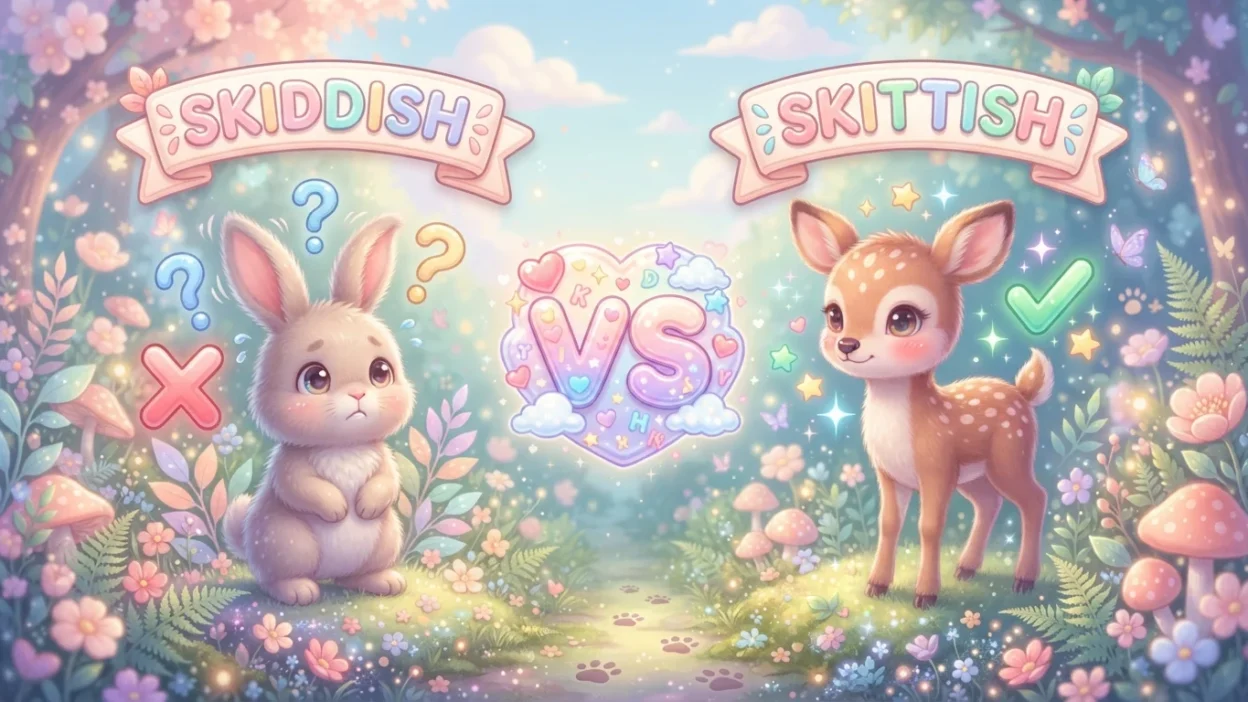
Have you ever written skiddish when you meant skittish? You’re not alone! These two spellings are often confused because they sound similar when spoken aloud. However, only one is considered correct in standard English.
In this guide, you’ll learn the difference between skiddish vs skittish, their meanings, examples, common mistakes, and an easy memory trick to help you remember the correct spelling every time.
Quick Answer
- Skittish ✅ — Correct spelling.
- Skiddish ❌ — Incorrect spelling.
Use skittish whenever you mean nervous, easily frightened, or reluctant to trust or engage.
Examples:
- The horse became skittish during the storm.
- She felt skittish about speaking in front of a large audience.
What Do Skiddish and Skittish Mean?
Although these words look and sound alike, only one is accepted in standard English.
What Is Skittish?
Skittish is an adjective that means:
- Easily frightened or startled.
- Nervous or excitable.
- Reluctant or hesitant.
- Difficult to control because of nervousness or fear.
Examples:
- The puppy was skittish around strangers.
- Investors became skittish after the market news.
- The deer looked skittish when it heard a loud noise.
- He was a little skittish about trying something new.
What Is Skiddish?
Skiddish is a common misspelling of skittish.
Although it occasionally appears in informal online conversations, dictionaries do not recognize it as standard English. It should be avoided in professional, academic, and everyday writing.
Skiddish vs Skittish Comparison Table
| Feature | Skiddish | Skittish |
|---|---|---|
| Correct English Word | ❌ No | ✅ Yes |
| Dictionary Entry | No | Yes |
| Meaning | None | Nervous or easily frightened |
| Used in Formal Writing | No | Yes |
| Used in Everyday English | No | Common |
Why Is “Skittish” Correct?
The correct spelling is:
S-K-I-T-T-I-S-H
Many people mistakenly write skiddish because the pronunciation can make the middle sounds seem similar. However, the word has always been spelled with a double “t.”
Therefore:
- Skittish ✅ — Correct spelling.
- Skiddish ❌ — Incorrect spelling.
If you’re describing someone or something that is nervous or easily startled, always use skittish.
Examples of Skittish in Sentences
- The cat became skittish after hearing fireworks.
- The horse looked skittish before the race began.
- She was skittish about accepting the job offer immediately.
- Financial markets can become skittish during uncertain times.
- The child grew skittish around loud noises.
- He seemed skittish when discussing the topic.
- The rescue dog remained skittish for several weeks.
Common Mistakes People Make
Many writers accidentally:
- Write skiddish instead of skittish.
- Spell the word according to its pronunciation.
- Forget that it contains two “t” letters.
- Miss the typo while proofreading.
Incorrect:
- ❌ The horse was skiddish during the parade.
Correct:
- ✅ The horse was skittish during the parade.
Simple Memory Trick
💡 Memory Trick
- A nervous animal might take two tiny taps before moving.
- Think: “Skittish needs two T’s for two tiny taps!”
Rule: If something is nervous or easily startled, remember the double “t.”
When Should You Use Skittish?
Use skittish when talking about:
- Nervous animals.
- Hesitant people.
- Financial markets.
- Fearful reactions.
- Uncertainty or caution.
- Easily startled behavior.
Examples:
- Skittish horse.
- Skittish puppy.
- Skittish investors.
- Skittish behavior.
- Skittish reaction.
- Skittish attitude.
When Should You Use Skiddish?
Never.
Skiddish is a spelling mistake and should always be corrected to skittish in standard English.
American vs British English
There is no spelling difference between American and British English.
Both varieties use:
- ✅ Skittish
- ❌ Skiddish
The spelling is identical across the English-speaking world.
Related Words and LSI Keywords
- skittish meaning
- skittish definition
- easily frightened
- nervous behavior
- hesitant personality
- timid animal
- English spelling rules
- commonly misspelled words
- vocabulary guide
- language learning
- grammar tips
- proofreading tips
- word comparison
- correct English usage
Tips for Remembering the Difference
- Skittish always contains two “t” letters.
- Think of nervous little footsteps when spelling it.
- Never replace “tt” with “d.”
- Remember that dictionaries recognize only skittish.
- Use spell check if you’re uncertain.
Frequently Asked Questions
Is skiddish a real word?
No. Skiddish is not recognized as a standard English word.
Which is correct: skiddish or skittish?
Skittish is the correct spelling.
What does skittish mean?
It means nervous, easily frightened, hesitant, or excitable.
Is skittish used in American and British English?
Yes. Both varieties use the same spelling.
Can I use skiddish in formal writing?
No. Always use skittish.
Can skittish describe people and animals?
Yes. It commonly describes both people and animals that are nervous or easily startled.
Summary
The difference between skiddish vs skittish is simple. Skittish is the correct English spelling used to describe nervous, hesitant, or easily frightened behavior. Skiddish is merely a common misspelling and should be avoided in all forms of writing.
Whenever you’re talking about a shy horse, a nervous pet, or even cautious investors, remember that skittish always uses two “t” letters.

Rowan Blythecroft crafts atmospheric fiction filled with mystery and folklore.
Her stories often blur the line between reality and imagination.
She spends most of her days wandering forests and writing by candlelight.