
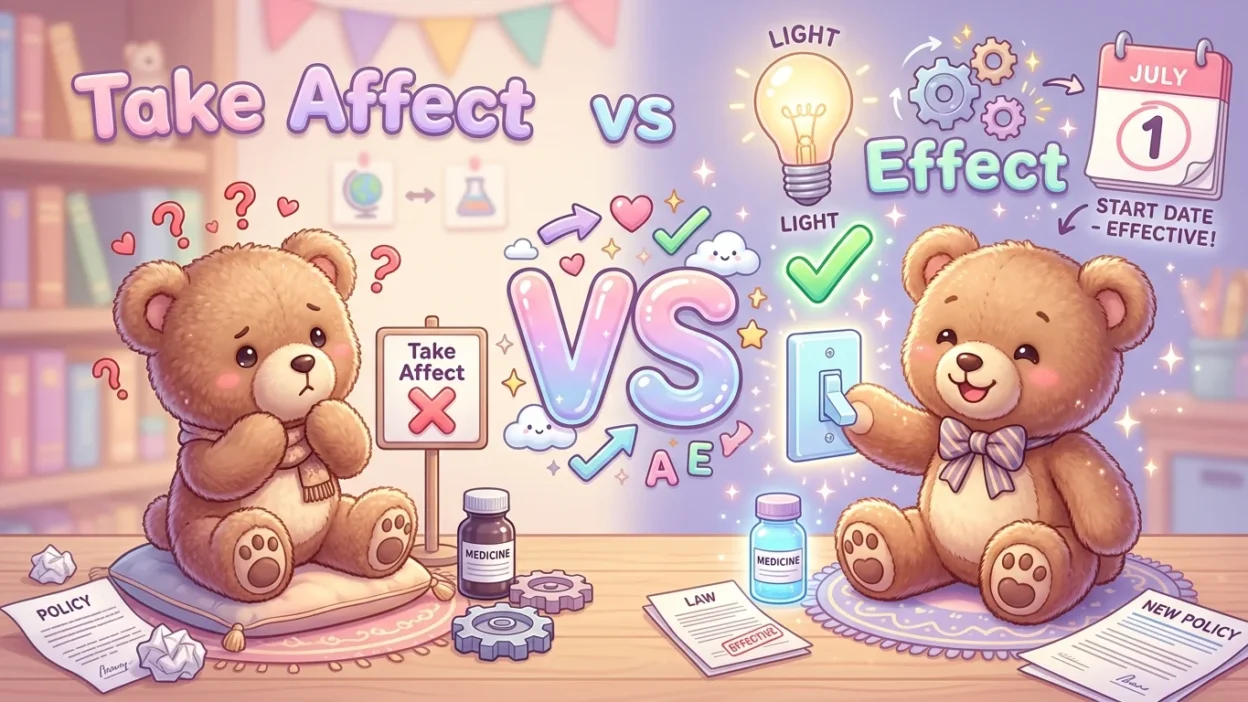
Have you ever wondered whether take effect or take affect is the correct phrase? You’re not alone. Effect and affect are two of the most commonly confused words in English, and their similar pronunciation makes this mistake especially easy. However, the correct phrase is take effect.
In this guide, you’ll learn the difference between take effect vs take affect, what each phrase means, how to use take effect correctly, common mistakes, examples, and a simple memory trick. Once you understand the basic difference between effect and affect, this phrase becomes much easier to remember.
Quick Answer
- Take effect ✅ — Correct standard phrase.
- Take affect ❌ — Incorrect in standard English.
Take effect means to begin producing a result, change, or impact.
Example:
- The new policy will take effect next month.
What Do Take Effect and Take Affect Mean?
What Does Take Effect Mean?
Take effect is a standard English phrase meaning that something begins to work, operate, or produce its intended result.
It is commonly used for:
- Laws.
- Rules.
- Policies.
- Agreements.
- Treatments.
- Changes.
- Decisions.
- Plans.
Examples:
- The new law will take effect on January 1.
- The changes will take effect immediately.
- The medicine began to take effect after an hour.
- The agreement will take effect next week.
In each case, something starts producing an effect or result.
What Does Take Affect Mean?
Take affect is incorrect when you mean that something begins to produce a result or becomes active.
The confusion comes from the fact that affect is also a real English word.
For example:
- Stress can affect your health.
Here, affect is a verb meaning to influence.
But when you mean something begins to operate or produce a result, the correct phrase is:
- ✅ take effect
- ❌ take affect
Take Effect vs Take Affect Comparison Table
| Feature | Take Effect | Take Affect |
|---|---|---|
| Standard Phrase | ✅ Yes | ❌ No |
| Meaning | Begin to work or produce a result | Not standard in this phrase |
| Common Usage | Laws, rules, medicine, changes | Incorrect substitution |
| Professional Writing | Recommended | Avoid |
| Grammar | Fixed verb phrase | Incorrect phrase |
Why Is “Take Effect” Correct?
The word effect commonly functions as a noun meaning a result, consequence, or impact.
The phrase take effect literally connects the idea of something beginning to produce an effect.
For example:
- The new rule will take effect tomorrow.
This means the rule will begin operating or producing its intended impact tomorrow.
By contrast, affect is usually a verb meaning to influence.
For example:
- The new rule may affect employees.
This is why the two words work differently:
- Take effect = begin to produce a result.
- Affect = influence something.
Examples of Take Effect in Sentences
- The new rules will take effect tomorrow.
- The policy will take effect next month.
- The changes will take effect immediately.
- The law officially took effect last year.
- The medicine started to take effect quickly.
- The agreement will take effect after both parties sign it.
- The new schedule will take effect on Monday.
- The safety measures have taken effect.
Common Mistakes People Make
The most common mistake is replacing effect with affect.
Incorrect:
- ❌ The new law will take affect next week.
Correct:
- ✅ The new law will take effect next week.
Another common mistake is confusing take effect with affect because both words can relate to change or influence.
Compare:
- The new policy will take effect tomorrow.
- The new policy may affect employees.
The first sentence describes when the policy begins operating. The second describes how the policy may influence people.
Simple Memory Trick
💡 Memory Trick
Spelling Box
Remember:
TAKE EFFECT = START WORKING
If something begins to operate, work, or produce a result, use effect.
Rule: Take effect = begin to have an effect.
Take Effect vs Affect
The easiest way to understand the difference is to compare complete sentences.
Take Effect
Take effect means begin to work or produce a result.
Example:
- The new law will take effect tomorrow.
Affect
Affect usually means influence or change something.
Example:
- The new law may affect businesses.
The difference is simple:
Take effect = begin working
Affect = influence
Take Effect vs Have an Effect
Take effect and have an effect are related but not identical.
Take effect means something begins to work or produce a result.
- The treatment will take effect soon.
Have an effect means something produces an impact.
- The treatment will have an effect on the symptoms.
A useful connection is:
Take effect → begin producing an effect.
Take Effect in Laws and Policies
Take effect is especially common when discussing laws, rules, policies, and regulations.
Examples:
- The new tax rules will take effect next year.
- The policy will take effect on Monday.
- The regulation took effect immediately.
- The agreement will take effect after approval.
This phrase is common in legal, government, business, and professional writing.
Take Effect in Medicine
The phrase can also describe when medicine or treatment begins producing a noticeable result.
Examples:
- The medication should take effect within an hour.
- The treatment started to take effect after several days.
- The pain relief quickly took effect.
Here, take effect means the treatment begins working.
When Should You Use Take Effect?
Use take effect when something:
- Begins working.
- Becomes active.
- Starts producing results.
- Begins influencing a situation.
- Becomes officially applicable.
Examples:
- A law takes effect.
- A policy takes effect.
- A treatment takes effect.
- A rule takes effect.
- An agreement takes effect.
When Should You Use Affect?
Use affect when you mean influence or have an impact on something.
Examples:
- The change may affect prices.
- The weather can affect travel.
- The decision could affect employees.
- Lack of sleep can affect concentration.
Don’t use take affect as a replacement for take effect.
When Should You Use “Take Affect”?
Don’t use take affect when you mean something begins to operate or produce results.
Use:
Take effect ✅
For example:
- ✅ The new policy will take effect next month.
Not:
- ❌ The new policy will take affect next month.
American vs British English
Take effect is the standard phrase in both American and British English.
There is no regional spelling difference:
- Take effect ✅
- Take affect ❌
Both varieties use the phrase to describe something beginning to operate, work, or produce a result.
Related Words and LSI Keywords
- take effect meaning
- take affect meaning
- take effect definition
- take effect immediately
- take effect date
- take effect next month
- law takes effect
- policy takes effect
- medicine takes effect
- effect vs affect
- affect vs effect
- begin to work
- produce a result
- become effective
- influence
- impact
- result
- consequence
- English grammar
- commonly confused words
- correct English usage
- spelling mistakes
Tips for Remembering the Difference
- Take effect is the correct phrase.
- Remember take effect = start working.
- Affect usually means influence.
- Effect usually means result.
- Think of a law or policy beginning to operate: it takes effect.
- Never replace effect with affect in this fixed phrase.
Frequently Asked Questions
Is it take effect or take affect?
The correct phrase is take effect.
What does take effect mean?
Take effect means to begin working, operating, or producing a result.
Is take affect grammatically correct?
No. Take affect is not the standard phrase when you mean something begins to work or produce an effect.
What is an example of take effect?
An example is: The new policy will take effect next month.
What is the difference between take effect and affect?
Take effect means to begin producing a result, while affect usually means to influence something.
Is take effect used in American and British English?
Yes. Take effect is standard in both American and British English.
Can medicine take effect?
Yes. We commonly say that medicine or treatment takes effect when it begins producing the intended result.
Summary
The difference between take effect vs take affect is straightforward. Take effect is the correct standard English phrase and means that something begins working, operating, or producing a result. It is commonly used with laws, policies, rules, agreements, treatments, and changes.
Take affect is incorrect when used in this sense. Remember that affect usually functions as a verb meaning to influence, while effect usually functions as a noun meaning result. So, when something begins producing a result, it takes effect.

Alistair Fenwicke is a quiet observer of rural life and forgotten histories.
His novels explore memory, solitude, and the passing of time.
He writes from a small countryside cottage surrounded by fields.