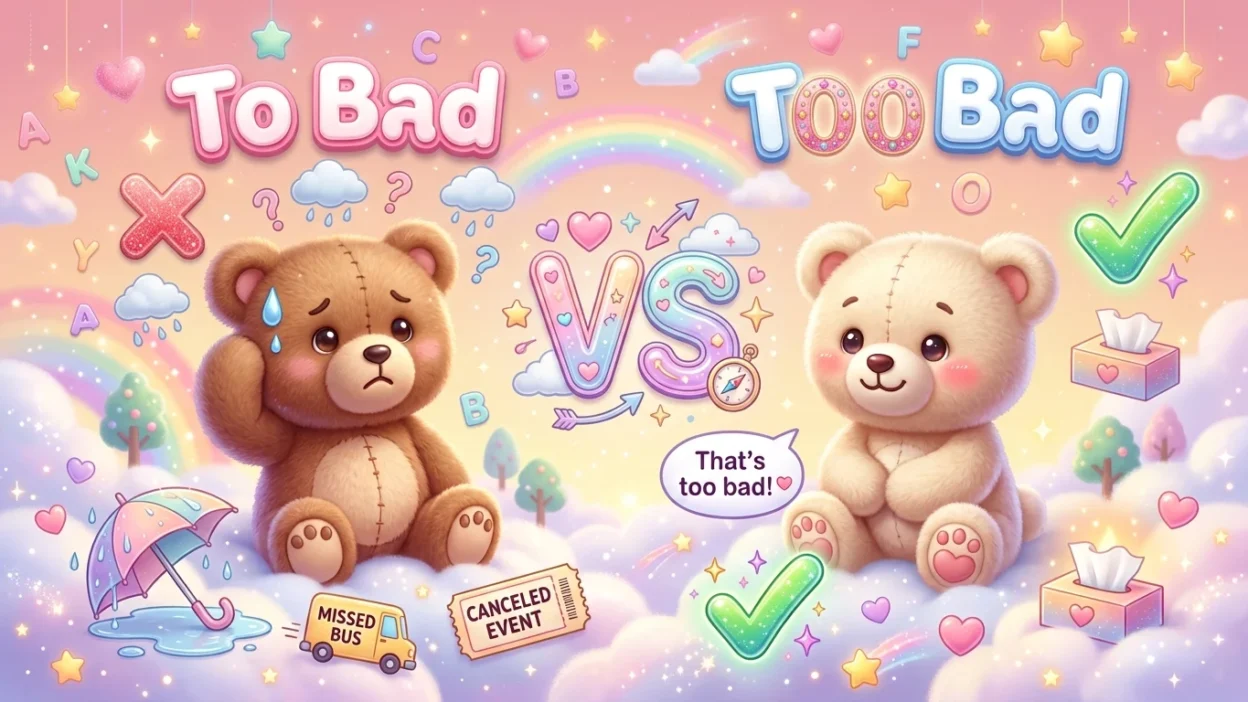
Have you ever wondered whether to bad or too bad is the correct phrase? You’re not alone. These two forms sound almost identical when spoken, so it’s easy to confuse them in writing. However, when you want to express disappointment, sympathy, or something unfortunate, the correct phrase is too bad.
In this guide, you’ll learn the difference between to bad vs too bad, what each word means, how to use the phrase correctly, common mistakes, examples, and an easy memory trick. By the end, you’ll know exactly when to use too and why to bad usually doesn’t work in this expression.
Quick Answer
- Too bad ✅ — Correct phrase when expressing disappointment, regret, or something unfortunate.
- To bad ❌ — Incorrect when you mean the common expression too bad.
Example:
- Too bad you couldn’t come with us.
Here, too bad expresses disappointment about something unfortunate.
What Do To Bad and Too Bad Mean?
What Is Too Bad?
Too bad is a common English expression used to show disappointment, regret, sympathy, or that something is unfortunate.
Examples:
- Too bad you missed the concert.
- Too bad it started raining.
- That’s too bad.
- It’s too bad that she couldn’t attend.
The phrase can also mean that something is excessive or worse than acceptable, depending on the context.
Example:
- The damage wasn’t too bad.
Here, too bad means the damage was not excessively severe.
What Is To Bad?
To bad is not normally correct when you are trying to express the common phrase too bad.
The confusion happens because to and too sound alike in many varieties of English.
Incorrect:
- ❌ To bad you missed the event.
Correct:
- ✅ Too bad you missed the event.
However, to can appear before the word bad when the sentence has a completely different grammatical structure.
For example:
- I don’t want to bad-mouth anyone.
Here, to is part of the infinitive to bad-mouth, not the expression too bad.
To Bad vs Too Bad Comparison Table
| Feature | To Bad | Too Bad |
|---|---|---|
| Common Expression | ❌ No | ✅ Yes |
| Meaning | No standard meaning as this phrase | Unfortunate, disappointing, or excessively bad |
| Part of Speech | Depends on context | Phrase |
| Used to Express Sympathy | No | Yes |
| Used in Casual English | Rarely | Very commonly |
Why Is “Too Bad” Correct?
The word too can mean also, excessively, or more than desirable.
In the expression too bad, it helps form a phrase expressing that something is unfortunate or disappointing.
For example:
- Too bad you can’t stay.
The phrase communicates disappointment about the situation.
By contrast, to is most commonly used as a preposition or as part of an infinitive.
Examples:
- I went to school.
- I want to leave.
- She decided to stay.
Therefore, when you mean the expression showing disappointment, use:
Too bad ✅
Examples of Too Bad in Sentences
- Too bad you couldn’t join us.
- That’s too bad.
- It’s too bad that the store is closed.
- Too bad we missed the last train.
- Too bad she wasn’t available.
- The weather wasn’t too bad after all.
- The injury isn’t too bad.
- It’s too bad that the event was canceled.
Common Mistakes People Make
The most common mistake is confusing to and too because they sound alike.
Incorrect:
- ❌ To bad you missed the party.
Correct:
- ✅ Too bad you missed the party.
Another common mistake is forgetting that too has an extra o.
A simple way to remember it is:
TOO = extra O
The extra O can remind you that too often relates to an additional or excessive idea.
Simple Memory Trick
💡 Memory Trick
Spelling Box
Remember:
TOO BAD = UNFORTUNATE
If you’re expressing disappointment or sympathy, choose TOO.
Rule: Too has an extra O, and too bad is the phrase you need.
Too Bad as an Expression of Disappointment
One of the most common uses of too bad is to express disappointment.
For example:
- Too bad you couldn’t make it.
This can mean:
- I’m sorry you couldn’t come.
- It’s unfortunate that you couldn’t come.
- That’s disappointing.
Another example:
- Too bad the concert was canceled.
The speaker is expressing disappointment about the cancellation.
Too Bad as “Not Very Severe”
Too bad can also describe the degree or severity of something.
For example:
- The damage wasn’t too bad.
Here, too bad means the damage was not extremely serious.
Other examples:
- The weather wasn’t too bad.
- My headache isn’t too bad.
- The traffic wasn’t too bad today.
In these examples, too means excessively or to an undesirable degree.
Too Bad vs So Bad
Too bad and so bad are not always interchangeable.
Too bad can express disappointment:
- Too bad you missed the bus.
So bad can emphasize the degree of something:
- The traffic was so bad that we arrived late.
Another example:
- I felt so bad about what happened.
Here, so bad intensifies the feeling.
When Should You Use Too Bad?
Use too bad when:
- Something is unfortunate.
- You’re expressing disappointment.
- You’re showing sympathy.
- Something is excessively bad.
- Something is worse than desirable.
Examples:
- Too bad you missed the flight.
- That’s too bad.
- The weather wasn’t too bad.
- The situation isn’t too bad.
When Should You Use To?
Use to when it functions as a preposition or introduces an infinitive.
Examples:
- I went to work.
- She wants to leave.
- We decided to wait.
- He gave the book to me.
Remember that these uses are completely different from too bad.
When Should You Use “To Bad”?
Don’t use to bad as a replacement for too bad.
If you’re expressing disappointment, use:
Too bad ✅
For example:
- ✅ Too bad you couldn’t come.
Not:
- ❌ To bad you couldn’t come.
American vs British English
Too bad is used in both American and British English.
There is no spelling difference:
- Too bad ✅
- To bad ❌ when expressing disappointment.
The phrase may vary slightly in tone depending on context, but the spelling remains the same.
Related Words and LSI Keywords
- too bad meaning
- to bad meaning
- too bad definition
- too bad phrase
- too bad meaning in English
- that’s too bad
- too bad you missed
- expressing disappointment
- expressing sympathy
- unfortunate
- disappointing
- excessive
- too vs to
- to vs too
- English grammar
- commonly confused words
- spelling mistakes
- correct English usage
- vocabulary guide
Tips for Remembering the Difference
- Too bad is the correct phrase for disappointment.
- Remember TOO = extra O.
- Use too when something is excessive or when expressing the common phrase too bad.
- Use to for direction, connection, or infinitives.
- Think: Too bad = unfortunate.
Frequently Asked Questions
Is it to bad or too bad?
The correct phrase is too bad when you mean something is unfortunate or disappointing.
What does too bad mean?
Too bad can express disappointment, sympathy, or that something is unfortunate. It can also mean something is excessively bad depending on context.
Is to bad grammatically correct?
Not as the common expression of disappointment. In that context, use too bad.
Why is too bad spelled with two o’s?
Too is a separate word from to and can express excess or addition. In too bad, it is part of an established expression or can describe excessive severity.
Is too bad used in American and British English?
Yes. Too bad is used in both American and British English.
What is an example of too bad?
An example is: Too bad you couldn’t come to the party.
What is the difference between too and to?
To commonly indicates direction or introduces an infinitive, while too can mean also or excessively and appears in expressions such as too bad.
Summary
The difference between to bad vs too bad is easy once you understand the roles of to and too. Too bad is the correct phrase when expressing disappointment, sympathy, or something unfortunate. It can also describe something that is excessively bad, depending on the sentence.
To bad is not the correct form when you mean the common expression. Remember the extra o in too and connect too bad with the idea of something being unfortunate or disappointing.

Cedric Halewood is known for his intricate historical narratives.
His work reflects a deep fascination with lost civilizations.
He lives near the coast, where he finds inspiration in the sea.