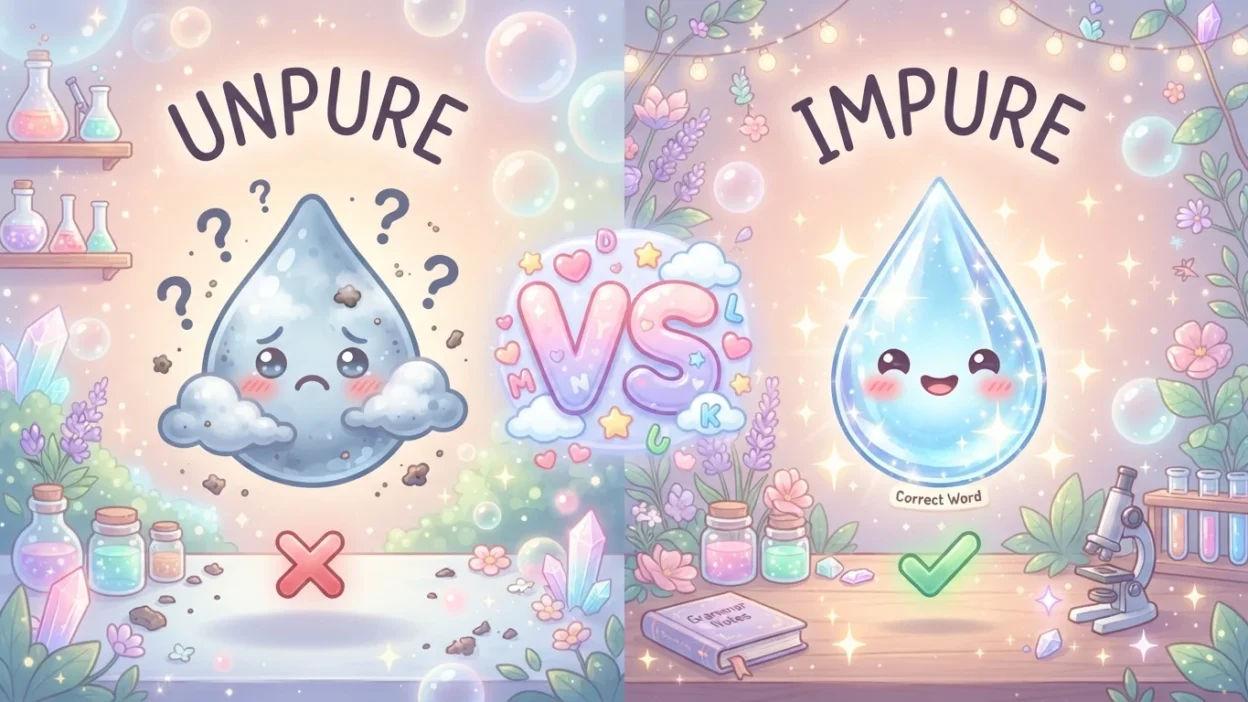
Have you ever wondered whether unpure or impure is the correct word? You’re not alone! Since many English adjectives form opposites by adding the prefix un-, it’s easy to assume unpure is correct. However, standard English uses a different prefix in this case.
In this guide, you’ll learn the difference between unpure vs impure, their meanings, examples, common mistakes, and an easy memory trick to help you choose the correct word.
Quick Answer
- Impure ✅ — Correct and standard English.
- Unpure ❌ — Incorrect or extremely rare.
Use impure whenever you describe something that is not pure, contains contaminants, or is morally or spiritually unclean.
Examples:
- The water became impure after the chemicals leaked into the river.
- Ancient traditions considered certain objects impure.
What Do Unpure and Impure Mean?
Although these words seem similar, only one is standard in modern English.
What Is Impure?
Impure is an adjective that means:
- Not pure or clean.
- Mixed with unwanted substances.
- Morally or spiritually unclean.
- Contaminated or adulterated.
Examples:
- The laboratory rejected the impure sample.
- Impure gold contains other metals.
- The medicine became impure after improper storage.
- Some cultures considered certain foods impure.
What Is Unpure?
Unpure is a nonstandard or extremely rare form of impure.
Although you may occasionally find it in very old texts or unusual contexts, it is not accepted in modern standard English. In almost every situation, impure is the correct choice.
Unpure vs Impure Comparison Table
| Feature | Unpure | Impure |
|---|---|---|
| Standard English Word | ❌ No | ✅ Yes |
| Dictionary Preference | Rare or Nonstandard | Yes |
| Meaning | Not pure | Not pure or contaminated |
| Used in Formal Writing | No | Yes |
| Used in Everyday English | Very Rare | Common |
Why Is “Impure” Correct?
The correct spelling is:
I-M-P-U-R-E
Many English adjectives beginning with p form their opposite by using the prefix im-, not un-.
For example:
- Possible → Impossible
- Polite → Impolite
- Pure → Impure
Therefore:
- Impure ✅ — Correct spelling.
- Unpure ❌ — Nonstandard spelling.
Examples of Impure in Sentences
- Scientists discovered the sample was impure.
- Drinking impure water can be dangerous.
- The jeweler explained that the silver was impure.
- The air became impure because of pollution.
- The mixture remained impure after the experiment.
- Some traditions describe certain actions as impure.
- The factory worked to remove impure materials.
Common Mistakes People Make
Many writers accidentally:
- Write unpure instead of impure.
- Assume every opposite begins with un-.
- Forget that some adjectives take the prefix im-.
- Miss the typo while proofreading.
Incorrect:
- ❌ The water was unpure.
Correct:
- ✅ The water was impure.
Simple Memory Trick
💡 Memory Trick
- Words beginning with P often use IM- to form their opposite.
- Think:
- Possible → Impossible
- Polite → Impolite
- Pure → Impure
Rule: If something is not pure, choose impure, not unpure.
When Should You Use Impure?
Use impure when talking about:
- Water.
- Air.
- Food.
- Metals.
- Chemicals.
- Moral or spiritual purity.
Examples:
- Impure water.
- Impure gold.
- Impure air.
- Impure substance.
- Impure thoughts.
- Impure mixture.
When Should You Use Unpure?
Almost never.
Unpure is considered nonstandard and should be avoided in modern English. For professional, academic, and everyday writing, always use impure.
American vs British English
There is no spelling difference between American and British English.
Both varieties use:
- ✅ Impure
- ❌ Unpure
The standard spelling is the same worldwide.
Related Words and LSI Keywords
- impure meaning
- impure definition
- pure vs impure
- contaminated
- unclean
- adulterated
- polluted
- English spelling rules
- commonly confused words
- vocabulary guide
- grammar tips
- language learning
- proofreading tips
- correct English usage
Tips for Remembering the Difference
- Impure is the standard English word.
- Words beginning with P often take the prefix im-.
- Avoid unpure in formal writing.
- Compare it with impossible and impolite.
- Use spell check if you’re uncertain.
Frequently Asked Questions
Is unpure a real word?
It exists in some historical or very rare uses, but it is not considered standard English today.
Which is correct: unpure or impure?
Impure is the correct and widely accepted word.
What does impure mean?
It means not pure, contaminated, mixed with unwanted substances, or morally unclean.
Is impure used in American and British English?
Yes. Both varieties use the same spelling.
Can I use unpure in formal writing?
No. Always use impure in modern English.
Is impure only used for physical substances?
No. It can describe physical contamination as well as moral, religious, or spiritual impurity.
Summary
The difference between unpure vs impure is straightforward. Impure is the correct and standard English word used to describe something that is not pure, whether physically, chemically, morally, or spiritually. Unpure is a rare, nonstandard form that should generally be avoided.
Whenever you’re describing contamination or a lack of purity, remember that impure is the word trusted by dictionaries and style guides.

Rowan Blythecroft crafts atmospheric fiction filled with mystery and folklore.
Her stories often blur the line between reality and imagination.
She spends most of her days wandering forests and writing by candlelight.