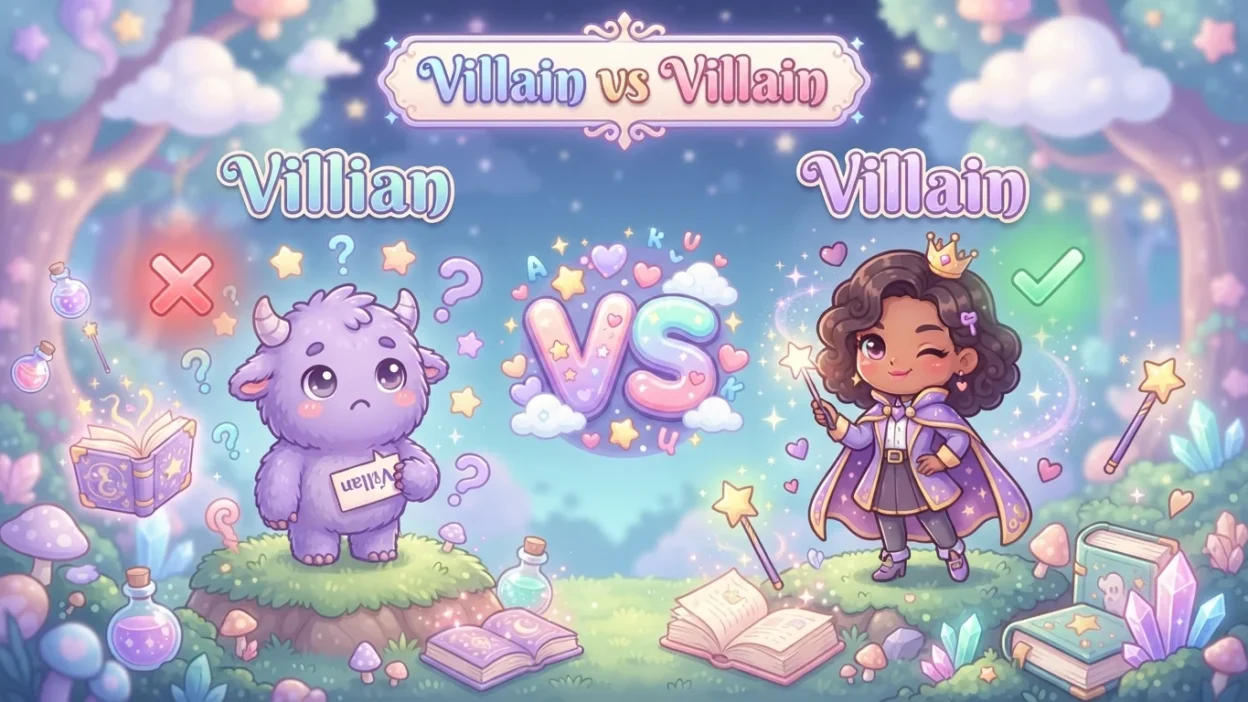
Have you ever written villian when you meant villain? You’re not alone! This is one of the most commonly misspelled words in English because the placement of the letters “a” and “i” can be confusing. Fortunately, there’s an easy way to remember the correct spelling.
In this guide, you’ll learn the difference between villain vs villian, their meanings, examples, common mistakes, and an easy memory trick to help you spell the word correctly every time.
Quick Answer
- Villain ✅ — Correct spelling.
- Villian ❌ — Incorrect spelling.
Use villain whenever you’re referring to an evil character, antagonist, or someone who causes harm or trouble in a story or real-life context.
Examples:
- The movie’s main villain was incredibly clever.
- Every superhero needs a memorable villain.
What Do Villain and Villian Mean?
Although these words look very similar, only one is correct in modern English.
What Is Villain?
Villain is a noun that means:
- An evil or immoral character in a story.
- The main antagonist in a book, movie, or television show.
- Someone who behaves dishonestly or maliciously.
- A person responsible for causing harm or problems.
Examples:
- The comic book villain has extraordinary powers.
- She played the role of the villain in the school play.
- The detective finally caught the villain.
- The audience loved how well-written the movie’s villain was.
What Is Villian?
Villian is a misspelling of villain.
It is not recognized as a standard English word and should never be used in formal or informal writing.
Villain vs Villian Comparison Table
| Feature | Villain | Villian |
|---|---|---|
| Correct English Word | ✅ Yes | ❌ No |
| Dictionary Entry | Yes | No |
| Meaning | Evil character or antagonist | None |
| Used in Formal Writing | Yes | No |
| Used in Everyday English | Very Common | No |
Why Is “Villain” Correct?
The correct spelling is:
V-I-L-L-A-I-N
Many writers accidentally switch the last two vowels and write villian, but the correct sequence is:
- A followed by I → Villain
Therefore:
- Villain ✅ — Correct spelling.
- Villian ❌ — Incorrect spelling.
Remember that English spelling doesn’t always follow pronunciation, which is why this mistake is so common.
Examples of Villain in Sentences
- The superhero defeated the evil villain.
- Disney movies often feature unforgettable villains.
- The story’s villain had a tragic backstory.
- He enjoys playing the villain in theater productions.
- The audience sympathized with the misunderstood villain.
- Every great adventure needs a powerful villain.
- The novelist created one of the most iconic villains in modern fiction.
Common Mistakes People Make
Many writers accidentally:
- Write villian instead of villain.
- Reverse the letters “a” and “i.”
- Spell the word based on pronunciation.
- Miss the typo while proofreading.
Incorrect:
- ❌ The villian escaped at the end of the movie.
Correct:
- ✅ The villain escaped at the end of the movie.
Simple Memory Trick
💡 Memory Trick
- Think: “A villain is an AI in disguise.”
- The correct spelling ends with A-I-N.
Rule: Remember the ending “AIN” in villain whenever you’re talking about an antagonist.
When Should You Use Villain?
Use villain when talking about:
- Movies
- Books
- Television shows
- Video games
- Superheroes and antagonists
- Fictional and real-life wrongdoers
Examples:
- Supervillain
- Movie villain
- Fictional villain
- Story antagonist
- Comic book villain
- Disney villain
When Should You Use Villian?
Never.
Villian is always a spelling mistake and should be corrected to villain.
American vs British English
There is no spelling difference between American and British English.
Both varieties use:
- ✅ Villain
- ❌ Villian
The spelling is identical throughout the English-speaking world.
Related Words and LSI Keywords
- villain meaning
- villain definition
- antagonist
- supervillain
- fictional character
- movie villain
- English spelling rules
- commonly misspelled words
- vocabulary guide
- grammar tips
- language learning
- proofreading
- English usage
- word comparison
Tips for Remembering the Difference
- Remember that villain ends with AIN.
- Never switch the positions of the letters “a” and “i.”
- Think of the phrase “evil villain.”
- Proofread words that contain similar vowel combinations.
- Use spell check whenever you’re unsure.
Frequently Asked Questions
Is villian a real word?
No. Villian is not recognized as a standard English word.
Which is correct: villain or villian?
Villain is the correct spelling.
Why do people misspell villain?
Many people accidentally reverse the positions of the letters “a” and “i” because of the word’s pronunciation.
Is villain used in American and British English?
Yes. Both varieties of English use the same spelling.
Can I use villian in formal writing?
No. Always use villain.
What does villain mean?
It refers to an evil or antagonistic character or someone who causes harm or trouble.
Summary
The difference between villain vs villian is simple. Villain is the correct English spelling and is used for antagonists, evil characters, and wrongdoers in both fiction and real life. Villian is merely a common spelling mistake.
Whenever you’re writing about the bad guy in a story, remember that the correct word ends with AIN—making villain the right choice every time.

Cedric Halewood is known for his intricate historical narratives.
His work reflects a deep fascination with lost civilizations.
He lives near the coast, where he finds inspiration in the sea.