Have you ever written insue when you meant ensue? You’re not alone! Since this word isn’t used as frequently as many common English verbs, it is often misspelled. The two spellings look similar, but only one is correct in modern English.
In this guide, you’ll learn the difference between insue vs ensue, their meanings, examples, common mistakes, and an easy memory trick to help you remember the correct spelling.
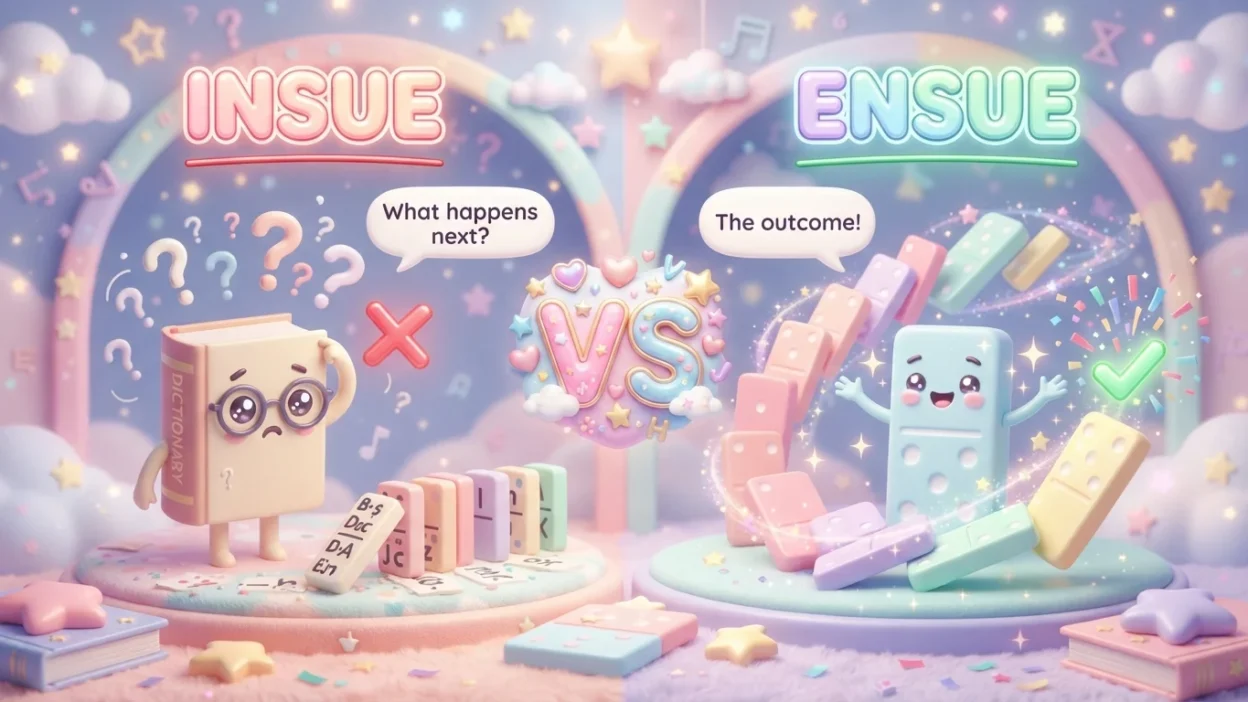
Quick Answer
- Ensue ✅ — Correct spelling.
- Insue ❌ — Incorrect spelling.
Use ensue whenever you mean that something happens afterward or follows as a result of something else.
Examples:
- Chaos may ensue if the instructions are ignored.
- A lengthy discussion will likely ensue after the announcement.
What Do Insue and Ensue Mean?
Although these words look similar, only one is accepted in standard English.
What Is Ensue?
Ensue is a verb that means:
- To happen afterward.
- To follow as a consequence or result.
- To occur naturally after another event.
Examples:
- Laughter immediately ensued after the joke.
- Confusion may ensue if the directions are unclear.
- Several changes will ensue following the policy update.
- A heated debate could ensue during the meeting.
What Is Insue?
Insue is a misspelling of ensue.
It is not recognized as a standard English word and should never be used in formal or informal writing.
Insue vs Ensue Comparison Table
| Feature | Insue | Ensue |
|---|---|---|
| Correct English Word | ❌ No | ✅ Yes |
| Dictionary Entry | No | Yes |
| Meaning | None | To happen afterward or as a result |
| Used in Formal Writing | No | Yes |
| Used in Everyday English | No | Common |
Why Is “Ensue” Correct?
The correct spelling is:
E-N-S-U-E
The word comes from Latin and entered English through French. It has always been spelled with an initial “e” in standard modern English.
Therefore:
- Ensue ✅ — Correct spelling.
- Insue ❌ — Incorrect spelling.
Many people mistakenly write “insue” because it sounds similar when spoken quickly, but dictionaries and style guides recognize only ensue.
Examples of Ensue in Sentences
- Panic may ensue during an emergency.
- Silence ensued after the announcement.
- Several problems could ensue if the deadline is missed.
- Negotiations are expected to ensue next week.
- Excitement immediately ensued when the winner was announced.
- Legal proceedings may ensue if the agreement is violated.
- Confusion will likely ensue without proper communication.
Common Mistakes People Make
Many writers accidentally:
- Write insue instead of ensue.
- Spell the word based on pronunciation.
- Confuse it with similar-looking English words.
- Miss the typo during proofreading.
Incorrect:
- ❌ Confusion may insue if the instructions are incomplete.
Correct:
- ✅ Confusion may ensue if the instructions are incomplete.
Simple Memory Trick
💡 Memory Trick
- Think: “Events ENSUE.”
- Both words begin with the letter E.
Rule: When one event follows another, remember that ensue starts with “E” for “event.”
When Should You Use Ensue?
Use ensue when discussing:
- Consequences
- Results
- Future events
- Formal writing
- News reports
- Professional communication
Examples:
- Problems may ensue.
- Chaos may ensue.
- Discussions will ensue.
- Legal action may ensue.
- Silence ensued.
- Celebrations ensued.
When Should You Use Insue?
Never.
Insue is always a spelling mistake and should be corrected to ensue.
American vs British English
There is no spelling difference between American and British English.
Both varieties use:
- ✅ Ensue
- ❌ Insue
The spelling is identical throughout the English-speaking world.
Related Words and LSI Keywords
- ensue meaning
- ensue definition
- what does ensue mean
- consequences
- happen afterward
- follow as a result
- English spelling rules
- commonly misspelled words
- vocabulary guide
- grammar tips
- language learning
- proofreading
- English usage
- word comparison
Tips for Remembering the Difference
- Remember that ensue begins with the letter “E.”
- Associate it with the phrase “events ensue.”
- Never spell it with an “i.”
- Think of consequences that follow an event.
- Use spell check whenever you’re unsure.
Frequently Asked Questions
Is insue a real word?
No. Insue is not recognized as a standard English word.
Which is correct: insue or ensue?
Ensue is the correct spelling.
What does ensue mean?
It means to happen afterward or to follow as a consequence of something else.
Is ensue used in American and British English?
Yes. Both varieties use the same spelling.
Can I use insue in formal writing?
No. Always use ensue.
Is ensue a formal word?
Yes. It is commonly used in formal, academic, journalistic, and professional writing.
Summary
The difference between insue vs ensue is straightforward. Ensue is the correct English word used to describe something that follows as a result of an earlier event. Insue is simply a common misspelling and should be avoided in all forms of writing.
Whenever you’re describing consequences or events that happen next, remember that events ensue. This simple memory trick will help you spell the word correctly every time.

Alistair Fenwicke is a quiet observer of rural life and forgotten histories.
His novels explore memory, solitude, and the passing of time.
He writes from a small countryside cottage surrounded by fields.