
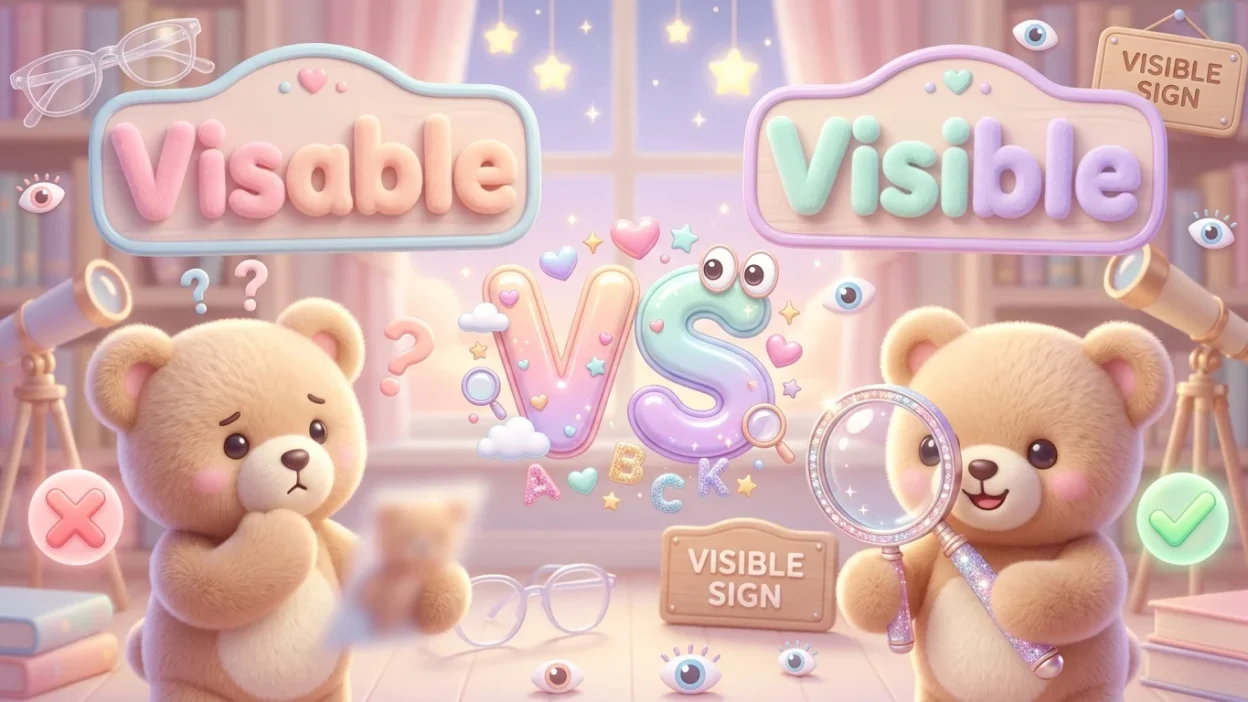
Have you ever wondered whether visable or visible is the correct spelling? You’re not alone. This is a common spelling mistake because the pronunciation can make the middle of the word confusing. However, visible is the correct standard English spelling.
In this guide, you’ll learn the difference between visable vs visible, their meanings, examples, common mistakes, pronunciation, and an easy memory trick. By the end, you’ll know which spelling to use in everyday, academic, and professional writing.
Quick Answer
- Visible ✅ — Correct spelling.
- Visable ❌ — Incorrect spelling.
Visible means something that can be seen, noticed, or perceived.
Example:
- The moon was clearly visible in the night sky.
What Do Visable and Visible Mean?
What Is Visible?
Visible is an adjective that means something can be seen or noticed.
It can describe something that is physically within sight or something that can be clearly recognized or observed.
Examples:
- The mountains were visible from the window.
- There was a visible mark on the wall.
- Her excitement was visible on her face.
- The stars were clearly visible tonight.
Visible can also describe something that is noticeable rather than physically seen.
For example:
- There has been a visible improvement in his writing.
What Is Visable?
Visable is an incorrect spelling of visible in standard English.
The mistake commonly occurs because people hear the word and assume that the middle vowel should be a.
Incorrect:
- ❌ The sign was not visable from the road.
Correct:
- ✅ The sign was not visible from the road.
Visable vs Visible Comparison Table
| Feature | Visable | Visible |
|---|---|---|
| Correct Spelling | ❌ No | ✅ Yes |
| Standard English | No | Yes |
| Part of Speech | — | Adjective |
| Meaning | No standard meaning | Able to be seen or noticed |
| Professional Writing | Avoid | Recommended |
Why Is “Visible” Correct?
The correct spelling is:
V-I-S-I-B-L-E
The important part to remember is the i after vis:
VIS-I-BLE
A common mistake changes that i to a, creating visable.
However, the standard form is:
Visible
not:
Visable
Therefore:
- Visible ✅
- Visable ❌
Examples of Visible in Sentences
- The stars were clearly visible from the garden.
- The damage was immediately visible.
- Her smile was visible from across the room.
- The sign was barely visible in the fog.
- The results showed a visible improvement.
- The building is visible from the highway.
- His nervousness was visible to everyone.
- Make sure the text is clearly visible on the screen.
Common Mistakes People Make
The most common mistake is replacing the i in visible with an a.
People may write:
- ❌ visable
- ❌ visibel
- ❌ visibile
The correct spelling is:
- ✅ visible
This mistake can happen because English pronunciation doesn’t always clearly reveal the spelling of every vowel.
Incorrect:
- ❌ The text is not visable on my screen.
Correct:
- ✅ The text is not visible on my screen.
Simple Memory Trick
💡 Memory Trick
Spelling Box
Remember:
VISIBLE = VIS + I + BLE
Keep the I:
VIS-I-BLE
Rule: Think I can see it → visible.
Visible vs Invisible
Visible and invisible are opposites.
- Visible = able to be seen.
- Invisible = unable to be seen.
Examples:
- The writing is visible.
- The writing is invisible.
The prefix in- changes the meaning to its opposite.
Physical and Figurative Uses of Visible
Visible can describe something you can physically see.
Example:
- The bird was visible through the window.
It can also describe something that is noticeable or obvious.
Example:
- There was a visible change in her attitude.
Another example:
- The company has made visible progress.
So, visible does not always refer only to physical sight.
When Should You Use Visible?
Use visible when something:
- Can be seen.
- Can be noticed.
- Is easy to observe.
- Is apparent.
- Is clearly displayed.
Examples:
- Visible damage.
- Visible signs.
- Visible improvement.
- Visible change.
- Visible results.
- Clearly visible text.
When Should You Use Visable?
Don’t use visable in standard English.
If you mean something that can be seen or noticed, always use:
Visible ✅
American vs British English
There is no spelling difference between American and British English.
Both varieties use:
- Visible ✅
- Visable ❌
The standard spelling remains visible in both forms of English.
Related Words and LSI Keywords
- visible meaning
- visible definition
- visable meaning
- visible spelling
- can be seen
- noticeable
- observable
- apparent
- clearly seen
- visible signs
- visible change
- visible improvement
- invisible
- English spelling
- commonly misspelled words
- grammar guide
- vocabulary tips
- correct English usage
Tips for Remembering the Difference
- Remember V-I-S-I-B-L-E.
- Keep the i after vis.
- Think I can see it → visible.
- Don’t replace the i with a.
- Remember visible and invisible as opposite words.
Frequently Asked Questions
Is visable a correct spelling?
No. Visable is an incorrect spelling. The correct form is visible.
Which is correct: visable or visible?
Visible is correct.
What does visible mean?
Visible means something can be seen, noticed, or observed.
Why do people spell visible as visable?
The mistake often happens because the pronunciation can make the middle vowel sound unclear, leading people to use a instead of i.
Is visible used in American and British English?
Yes. Visible is standard in both American and British English.
What is the opposite of visible?
The opposite of visible is invisible, meaning something cannot be seen.
What is an example of visible?
An example is: The mountains were clearly visible from the window.
Summary
The difference between visable vs visible is straightforward. Visible is the correct standard English spelling, while visable is a common spelling mistake. The word visible describes something that can be seen, noticed, or observed.
The easiest way to remember the spelling is V-I-S-I-B-L-E. Focus on the i in the middle and connect the word with the idea of seeing something. This will help you avoid the common visable mistake.

Alistair Fenwicke is a quiet observer of rural life and forgotten histories.
His novels explore memory, solitude, and the passing of time.
He writes from a small countryside cottage surrounded by fields.