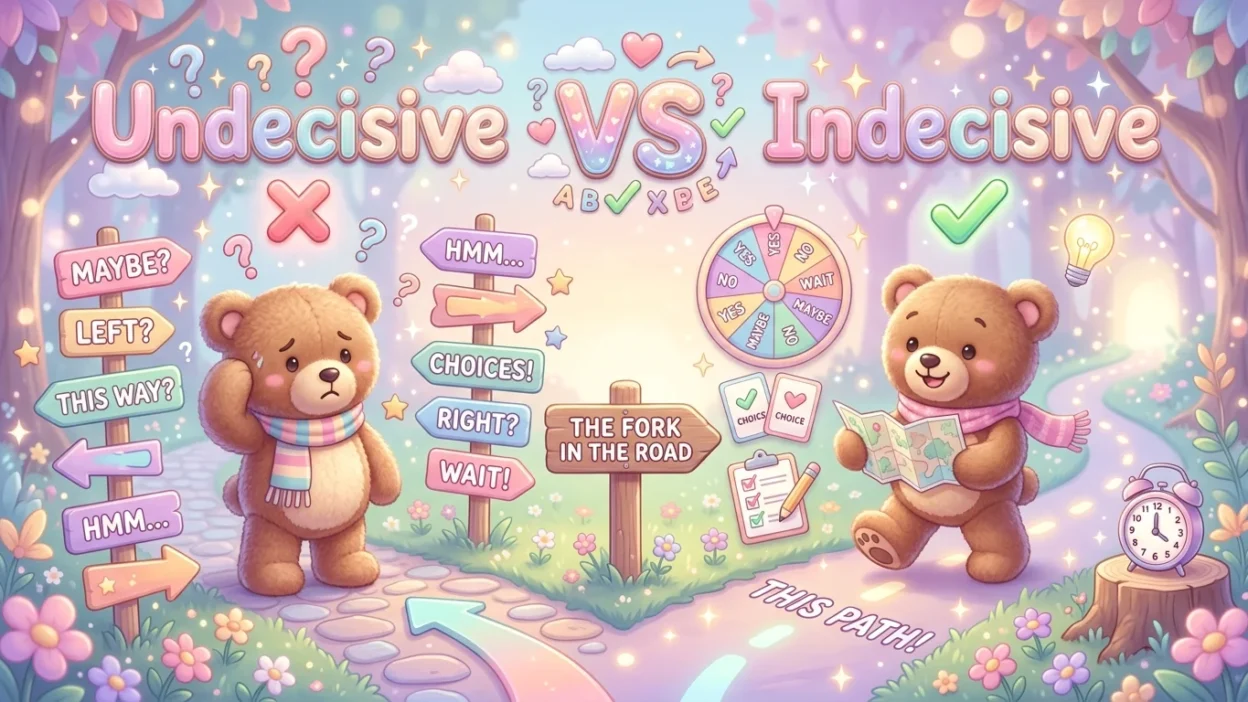
Have you ever wondered whether undecisive or indecisive is the correct word? You’re not alone. These words look similar, and because decisive means being able to make decisions, it can seem logical to add either un- or in-. However, indecisive is the standard and widely accepted word in modern English.
In this guide, you’ll learn the difference between undecisive vs indecisive, their meanings, examples, common mistakes, and an easy memory trick. You’ll also see how indecisive works in everyday, academic, and professional English.
Quick Answer
- Indecisive ✅ — Correct and standard.
- Undecisive ⚠️ — Rare and generally not the preferred word.
Indecisive describes someone who has difficulty making decisions or something that does not produce a definite result.
Example:
- I can be indecisive when choosing what to eat.
What Do Undecisive and Indecisive Mean?
What Is Indecisive?
Indecisive is an adjective used to describe a person who struggles to make decisions or a situation that does not lead to a clear decision or result.
For a person, it means they may have difficulty choosing between different options.
Examples:
- She is indecisive about which career to choose.
- He can be very indecisive when shopping.
- I’m indecisive because both options look good.
The word can also describe something uncertain or inconclusive.
Example:
- The election produced an indecisive result.
What Is Undecisive?
Undecisive does appear occasionally, but it is uncommon and generally not the preferred standard term when describing difficulty making decisions.
In most situations, indecisive is the natural and established choice.
Instead of:
- ⚠️ He is undecisive about his future.
Prefer:
- ✅ He is indecisive about his future.
Undecisive vs Indecisive Comparison Table
| Feature | Undecisive | Indecisive |
|---|---|---|
| Common Standard Usage | ⚠️ Rare | ✅ Yes |
| Meaning | Uncommon form related to lacking decisiveness | Unable or reluctant to make decisions |
| Common in Modern English | No | Yes |
| Professional Writing | Usually avoid | Recommended |
| Everyday Usage | Uncommon | Very common |
Why Is “Indecisive” Usually Preferred?
The standard word is indecisive.
It comes from:
In- + decisive = indecisive
The prefix in- can express a negative meaning, such as the absence of a quality.
Compare:
- Decisive → able to make decisions.
- Indecisive → unable or reluctant to make decisions.
The word indecisive is well established in dictionaries and everyday English.
Therefore:
- Indecisive ✅
- Undecisive ⚠️ Less common and generally not preferred.
Examples of Indecisive in Sentences
- She was indecisive about which dress to buy.
- He became indecisive when faced with two equally good options.
- I tend to be indecisive when ordering at restaurants.
- His indecisive behavior frustrated the team.
- The manager seemed indecisive during the meeting.
- Don’t be indecisive; choose the option that feels right.
- The committee reached an indecisive result.
Common Mistakes People Make
One common mistake is assuming that undecisive must be correct because undecided is a common word.
For example:
- Undecided ✅
- Indecisive ✅
However, these words are not formed in exactly the same way.
Another mistake is creating undecisive by simply adding un- to decisive.
Incorrect or less preferred:
- ⚠️ She is undecisive about the offer.
Preferred:
- ✅ She is indecisive about the offer.
Simple Memory Trick
💡 Memory Trick
Spelling Box
Remember:
DECISIVE → INDECISIVE
Think:
Decisive = makes decisions
Indecisive = struggles with decisions
Rule: If someone cannot easily decide, use INDECISIVE.
Indecisive vs Undecided
Although indecisive and undecided are related, they are not always interchangeable.
Indecisive usually describes a person’s tendency or difficulty in making decisions.
Example:
- She is indecisive.
Undecided usually means that a decision has not yet been made.
Example:
- She is still undecided about which university to attend.
A person can be indecisive because they remain undecided, but the words emphasize slightly different ideas.
When Should You Use Indecisive?
Use indecisive when describing:
- Difficulty making choices.
- Uncertainty about decisions.
- Hesitation between options.
- A lack of decisiveness.
- An inconclusive result.
Examples:
- Indecisive person.
- Indecisive behavior.
- Indecisive attitude.
- Indecisive decision-making.
- Indecisive response.
- Indecisive result.
When Should You Use Undecisive?
In most modern English writing, avoid undecisive when you mean someone who struggles to make decisions.
Choose:
Indecisive ✅
If you mean that a decision has not been made, undecided may also be appropriate.
American vs British English
Indecisive is the standard spelling in both American and British English.
There is no major regional difference:
- Indecisive ✅
- Undecisive ⚠️ Rare and generally not preferred.
Both varieties commonly use indecisive for someone who has difficulty making decisions.
Related Words and LSI Keywords
- indecisive meaning
- indecisive definition
- undecisive meaning
- indecisive person
- indecisive behavior
- indecision
- decision making
- difficult decisions
- uncertainty
- hesitation
- uncertain
- undecided
- decisive
- decision
- choice
- English spelling
- commonly confused words
- grammar guide
- vocabulary tips
- correct English usage
Tips for Remembering the Difference
- Remember decisive → indecisive.
- Use indecisive for someone who struggles to choose.
- Don’t automatically add un- to every adjective.
- Remember that undecided is a different but related word.
- Use indecisive in professional and academic writing.
Frequently Asked Questions
Is undecisive a correct word?
Undecisive appears occasionally, but it is uncommon and generally not the preferred standard word. Indecisive is the usual choice.
Which is correct: undecisive or indecisive?
Indecisive is the standard and widely accepted word.
What does indecisive mean?
Indecisive means having difficulty making decisions or choosing between options.
Is indecisive the opposite of decisive?
Yes. Decisive describes someone who can make decisions confidently, while indecisive describes someone who struggles to decide.
What is the difference between indecisive and undecided?
Indecisive usually describes a person’s difficulty making decisions, while undecided means a decision has not yet been made.
Is indecisive used in American and British English?
Yes. Indecisive is standard in both American and British English.
What is an example of indecisive?
An example is: He was indecisive about which job offer to accept.
Summary
The difference between undecisive vs indecisive is mainly about standard usage. Indecisive is the established and widely preferred word for someone who has difficulty making decisions or for something that produces no definite result.
Although undecisive may occasionally appear, it is uncommon and usually not the best choice for general, professional, or academic writing. If you want your English to sound natural and standard, choose indecisive.