Have you ever wondered whether any time or anytime is the correct form? You’re not alone. Both forms are correct, but they are not always used in the same way. The main difference depends on how the word functions in a sentence.
Any time is normally used as a noun phrase meaning “any amount of time” or “at any time,” while anytime is usually an adverb meaning “whenever” or “at any time.”
In this guide, you’ll learn the difference between any time vs anytime, their meanings, examples, grammar rules, common mistakes, American and British English usage, and an easy memory trick.
Quick Answer
- Any time ✅ — Usually used as a noun phrase, especially after words such as at, of, or any.
- Anytime ✅ — Usually used as an adverb meaning whenever or at any time.
Examples:
- Call me anytime. ✅
- You can call me at any time. ✅
- Do you have any time to help me? ✅
- Anytime is not normally used as a noun phrase.
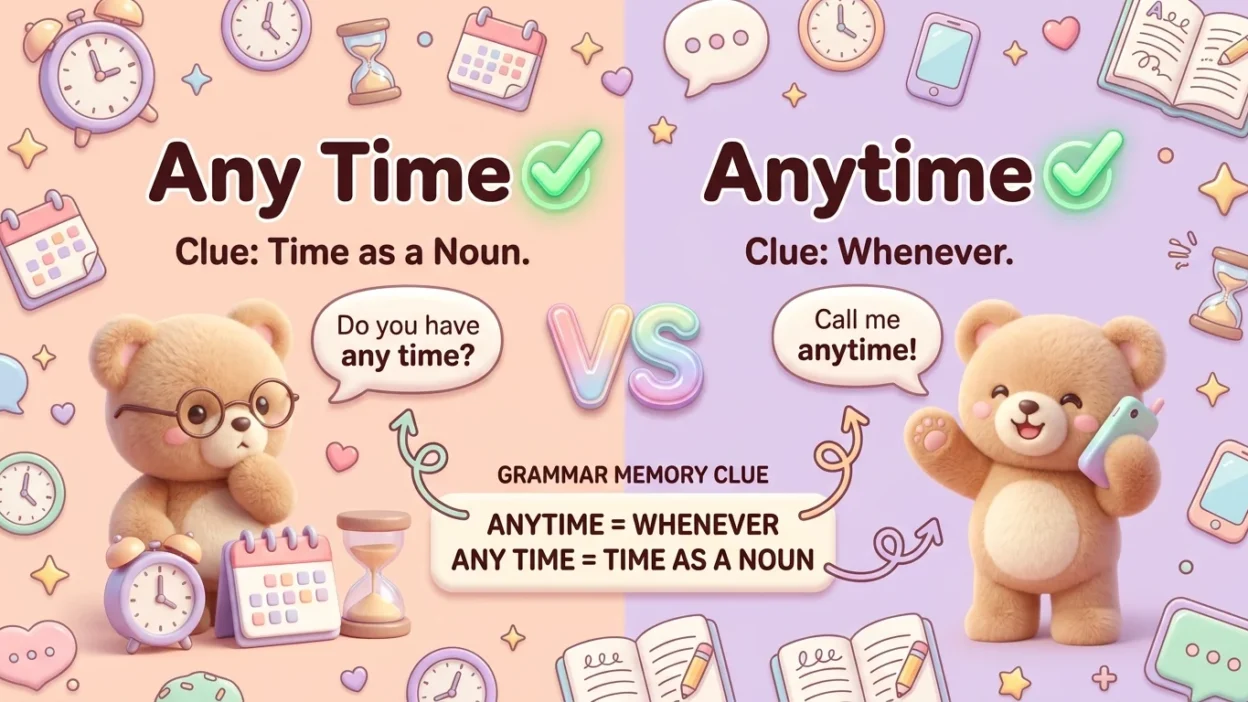
The simplest rule is:
Anytime = whenever
Any time = any amount of time / at any time
What Does Any Time Mean?
Any time is the two-word form. It can refer to any amount or period of time, and it commonly appears after a preposition such as at.
Examples:
- Do you have any time available?
- I don’t have any time today.
- You can contact me at any time.
- We don’t have any time to waste.
- Have you spent any time studying?
Here, time functions as a noun.
What Does Anytime Mean?
Anytime is a one-word adverb. It generally means whenever or at any time.
Examples:
- Call me anytime.
- You can visit anytime.
- Come over anytime you want.
- Feel free to ask anytime.
- We can talk anytime.
A useful test is to replace anytime with whenever.
For example:
Call me anytime.
→ Call me whenever you want.
Because the substitution works naturally, anytime is appropriate.
Any Time vs Anytime Comparison Table
| Feature | Any Time | Anytime |
|---|---|---|
| Number of words | Two | One |
| Main function | Noun phrase | Adverb |
| Meaning | Any amount/period of time | Whenever / at any time |
| Example | Do you have any time? | Call me anytime. |
| With “at” | At any time ✅ | At anytime ❌ |
| Can mean “whenever” | Sometimes as a phrase | ✅ Yes |
Why Are Any Time and Anytime Confused?
The two forms have almost identical pronunciation and very similar meanings.
For example:
- Call me anytime.
- Call me at any time.
Both sentences communicate almost the same idea.
The difference becomes clearer when time is being treated as a noun.
Compare:
- Do you have any time?
- Do you have anytime? ❌
The first sentence asks whether someone has any available time. Therefore, any time must remain two words.
Examples of Any Time in Sentences
Use any time when time functions as a noun.
- Do you have any time this afternoon?
- I don’t have any time to relax.
- We don’t have any time to waste.
- Did you spend any time studying?
- She doesn’t have any time available.
- I haven’t had any time to finish the project.
- We need any time that is available.
- You can visit us at any time.
Examples of Anytime in Sentences
Use anytime when it means whenever or at any time.
- Call me anytime.
- Come by anytime.
- You can ask me anytime.
- Feel free to contact us anytime.
- We can meet anytime this week.
- Stop by anytime you are nearby.
- You can leave anytime you want.
- Message me anytime.
Any Time After “At”
One of the easiest rules is this:
After at, use any time as two words.
Correct:
- at any time ✅
- at any time during the day ✅
- at any time you need help ✅
Incorrect:
- at anytime ❌
Why?
Because anytime already functions as an adverb, while at needs the noun phrase any time in this construction.
So remember:
At + any time = correct
Any Time as a Noun Phrase
When you’re talking about an amount or period of time, use any time.
Examples:
- I don’t have any time.
- Do you have any time tomorrow?
- We need any time you can spare.
- She hasn’t had any time to rest.
A useful test is to ask:
“Am I talking about time as a thing or amount?”
If yes, use any time.
Anytime as an Adverb
When anytime means whenever, use the one-word form.
Examples:
- You can call anytime.
- I’ll help anytime.
- Come over anytime.
- You can leave anytime.
Try replacing anytime with whenever:
Come anytime.
→ Come whenever you want.
The meaning remains clear.
Any Time vs Anytime With “You Want”
Both forms can sometimes appear in constructions such as:
- Call me any time you want.
- Call me anytime you want.
The one-word form is common when the meaning is whenever.
However, any time is also widely used when followed by a clause, particularly when the phrase has a more literal time-related meaning.
For example:
- You can visit any time you want.
This is completely natural.
“At Any Time” vs “Anytime”
These expressions can have nearly the same meaning.
At Any Time
This is the two-word form and is often more formal.
- You may contact us at any time.
Anytime
This is shorter and often more conversational.
- You may contact us anytime.
Both mean approximately:
Whenever you want / whenever necessary.
Common Mistakes People Make
Mistake 1: Writing “At Anytime”
Incorrect:
- ❌ You can contact me at anytime.
Correct:
- ✅ You can contact me at any time.
Mistake 2: Using Anytime as a Noun
Incorrect:
- ❌ I don’t have anytime today.
Correct:
- ✅ I don’t have any time today.
Here, you’re talking about an amount of available time.
Mistake 3: Assuming One Form Is Always Correct
It’s incorrect to think that anytime is always right or that any time is always right.
Both forms are correct, but their grammatical roles differ.
Mistake 4: Confusing “Anytime” With “Any Time”
Remember:
- Anytime = whenever.
- Any time = any amount or period of time.
Simple Memory Trick
💡 Memory Trick
Spelling Box
Remember:
ANYTIME = WHENEVER
ANY TIME = TIME AS A NOUN
Try this:
Call me anytime.
→ Call me whenever.
Do you have any time?
→ Do you have any time available?
Also remember:
AT ANY TIME ✅
AT ANYTIME ❌
Any Time in Formal Writing
Any time is especially useful when discussing a quantity or period of time.
Examples:
- We did not have any time to complete the task.
- The researchers spent any time available analyzing the results.
- Do you have any time available for a meeting?
For formal expressions meaning whenever, at any time is often a clear choice.
Example:
- Please contact the office at any time if you have questions.
Anytime in Informal Writing
Anytime is very common in everyday communication.
Examples:
- Call me anytime.
- Come over anytime.
- Text me anytime.
- You can ask me anytime.
It sounds natural and conversational.
Any Time in Questions
Use any time when you’re asking about available time.
Examples:
- Do you have any time tomorrow?
- Do you have any time this week?
- Did you spend any time studying?
- Do you have any time to talk?
Here, time is clearly a noun.
Anytime in Invitations
Anytime is common when giving someone an open invitation.
Examples:
- Come visit anytime.
- Stop by anytime.
- Call me anytime.
- You’re welcome here anytime.
The meaning is:
Whenever you want.
Any Time vs Anytime in Business English
Both forms can appear in professional communication.
Formal
- Please contact us at any time if you need assistance.
More conversational
- Please contact us anytime if you need assistance.
For formal business writing, at any time can sound slightly more polished and explicit.
Any Time vs Anytime in Academic Writing
In academic writing, any time is used when time functions as a noun.
Examples:
- The participants did not have any time to prepare.
- The researchers spent any time available collecting data.
When expressing the meaning whenever, the phrase at any time is often preferable in formal academic writing.
Example:
- Participants could withdraw at any time.
American vs British English
Both American and British English use any time and anytime.
However, usage preferences can vary somewhat by style and context.
In both varieties:
- any time = noun phrase
- anytime = adverb meaning whenever
- at any time = standard phrase
In formal writing, at any time remains a particularly safe choice.
Any Time vs Anytime in Everyday English
In everyday conversation, anytime is extremely common when it means whenever.
For example:
“When can I call you?”
“Anytime.”
But if someone asks:
“Do you have any time this weekend?”
they are asking about your available time.
That distinction is important.
When Should You Use Any Time?
Use any time when:
- Time functions as a noun.
- You’re referring to an amount of available time.
- You’re using the phrase at any time.
- You can replace the phrase with any amount of time.
Examples:
- Do you have any time?
- I don’t have any time.
- You can contact me at any time.
- We don’t have any time to waste.
When Should You Use Anytime?
Use anytime when:
- It means whenever.
- It functions as an adverb.
- You’re giving an open invitation.
- You’re saying something can happen whenever someone wants.
Examples:
- Call me anytime.
- Come over anytime.
- You can ask anytime.
- I’ll help you anytime.
Related Words and LSI Keywords
- any time meaning
- anytime meaning
- any time vs anytime
- anytime vs any time
- any time definition
- anytime definition
- anytime spelling
- at any time
- anytime examples
- any time examples
- English grammar
- English spelling
- commonly confused words
- common grammar mistakes
- correct English usage
- time expressions
- English language learning
- grammar rules
- formal English
- informal English
Tips for Remembering the Difference
- Anytime = whenever.
- Any time = any amount or period of time.
- Use at any time, not at anytime.
- If time is acting as a noun, keep it separate.
- If you can replace anytime with whenever, the one-word form usually works.
- Call me anytime = Call me whenever.
- Do you have any time? = Do you have any time available?
Frequently Asked Questions
Is it any time or anytime?
Both are correct, but they have different grammatical uses. Anytime is usually an adverb meaning whenever, while any time is a noun phrase.
Is anytime one word?
Yes. Anytime is a standard one-word adverb meaning whenever or at any time.
Is any time two words?
Yes. Any time is written as two words when time functions as a noun or in the phrase at any time.
Is “at anytime” correct?
No. The standard phrase is at any time.
Correct: You can call me at any time.
Incorrect: You can call me at anytime.
Is “call me anytime” correct?
Yes. Call me anytime is correct and means call me whenever you want.
Is “do you have any time” correct?
Yes. Do you have any time? is correct because time functions as a noun and refers to available time.
Which is more formal: any time or anytime?
At any time is generally more formal and explicit when it means whenever. Anytime is very common in everyday and informal writing.
Can anytime be used at the beginning of a sentence?
Yes.
Example:
- Anytime, you can contact us for help.
However, depending on the sentence, any time may be the appropriate form if time functions as a noun.
Can I say “anytime soon”?
Yes.
Example:
- I don’t think he’ll arrive anytime soon.
Here, anytime functions as an adverb.
What is an easy way to remember any time vs anytime?
Remember: ANYTIME = WHENEVER, while ANY TIME = TIME AS A NOUN. Also remember the fixed phrase AT ANY TIME.
Summary
The difference between any time vs anytime depends mainly on grammar and meaning. Anytime is usually a one-word adverb meaning whenever, as in “Call me anytime.” Any time is written as two words when time functions as a noun, as in “Do you have any time?” or in the standard phrase “at any time.”
The easiest way to remember the difference is to replace anytime with whenever. If the sentence still makes sense, anytime is usually appropriate. When you’re talking about an amount or period of time, use any time. And always remember: at any time is correct, while at anytime is not.

Rowan Blythecroft crafts atmospheric fiction filled with mystery and folklore.
Her stories often blur the line between reality and imagination.
She spends most of her days wandering forests and writing by candlelight.