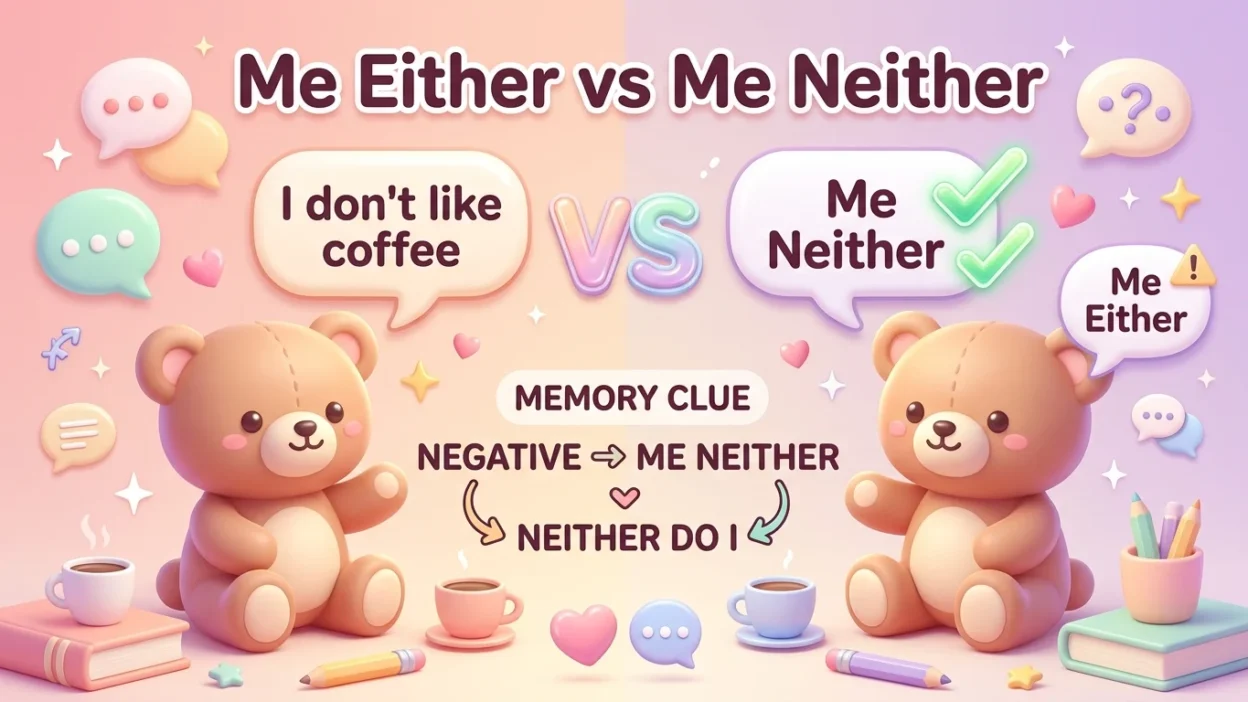
Have you ever wondered whether to say me either or me neither? Both expressions can be used in English, but they do not work in exactly the same way. The key is the sentence that comes before them.
“Me neither” is commonly used to agree with a negative statement, while “me either” is usually used after a negative sentence in informal American English, especially at the end of a sentence.
In this guide, you’ll learn the difference between me either vs me neither, when to use each expression, correct examples, common mistakes, formal alternatives, American vs British English usage, and an easy memory trick.
Quick Answer
- Me neither ✅ — Used to agree with a negative statement.
- Me either ✅ — Informal, especially in American English, and commonly appears with a negative sentence.
- Neither do I ✅ — More grammatically formal and widely accepted.
- Either do I ❌ — Not standard English.
Examples:
- “I don’t like coffee.”
“Me neither.” ✅ - “I don’t like coffee either.”
“Me either.” ✅ Informal, especially American English
A simple rule:
Negative statement + agreement → Me neither / Me either
However, me neither is generally the safer and more widely accepted choice.
What Does Me Neither Mean?
Me neither is an informal expression used to agree with a negative statement.
It means:
“I don’t either.”
For example:
“I don’t like spicy food.”
“Me neither.”
The second speaker means:
“I don’t like spicy food either.”
More formal alternatives include:
- Neither do I.
- I don’t either.
What Does Me Either Mean?
Me either is an informal expression used by some speakers, particularly in American English, to agree with a negative statement.
Example:
“I don’t want to go.”
“Me either.”
The meaning is:
“I don’t want to go either.”
However, me either is less formal and is not preferred by all English speakers.
In careful or formal writing, use:
- Me neither.
- Neither do I.
- I don’t either.
Me Either vs Me Neither Comparison Table
| Expression | Meaning | Usage |
|---|---|---|
| Me neither | I don’t either | Informal and widely understood |
| Me either | I don’t either | Informal, especially American English |
| Neither do I | I also don’t | Standard and more formal |
| I don’t either | I also don’t | Standard and natural |
| Either do I | — | ❌ Incorrect |
Why Are Me Either and Me Neither Confused?
The confusion happens because either and neither can both be connected with negative ideas.
Compare:
- I don’t like it either.
- Neither do I.
- Me neither.
- Me either.
All of these can communicate agreement with a negative statement in certain contexts.
However, their grammatical structures differ.
The safest conversational response is:
“I don’t like it.”
“Me neither.”
Examples of Me Neither
Here are natural examples of me neither:
- “I don’t like coffee.” — “Me neither.”
- “I can’t swim.” — “Me neither.”
- “I don’t want pizza.” — “Me neither.”
- “I haven’t seen that movie.” — “Me neither.”
- “I don’t understand this.” — “Me neither.”
- “I won’t be going.” — “Me neither.”
- “I didn’t enjoy the movie.” — “Me neither.”
- “I don’t have enough money.” — “Me neither.”
In each case, the first speaker makes a negative statement, and the second speaker agrees.
Examples of Me Either
Me either can occur in informal conversation, especially in American English.
Examples:
- “I don’t like that song.” — “Me either.”
- “I don’t want to go.” — “Me either.”
- “I can’t understand it.” — “Me either.”
- “I haven’t been there.” — “Me either.”
- “I don’t know the answer.” — “Me either.”
However, if you’re writing an article, essay, formal email, academic paper, or professional document, me neither or neither do I is a better choice.
Me Either vs Me Neither in a Conversation
Consider this conversation:
Person A: I don’t like horror movies.
Person B: Me neither.
This is completely natural.
You could also hear:
Person A: I don’t like horror movies either.
Person B: Me either.
This informal pattern occurs in conversational English, particularly in American English.
Still, me neither is the more broadly accepted expression.
Me Neither vs Neither Do I
Both can express agreement with a negative statement.
Me Neither
This is informal and conversational.
“I don’t like tea.”
“Me neither.”
Neither Do I
This is more grammatically structured and works well in both conversation and writing.
“I don’t like tea.”
“Neither do I.”
If you’re unsure which one to choose, neither do I is an excellent option.
Me Neither vs I Don’t Either
These two expressions have essentially the same meaning.
Me Neither
“I don’t like seafood.”
“Me neither.”
I Don’t Either
“I don’t like seafood.”
“I don’t either.”
Both mean:
I also don’t like seafood.
The difference is mainly in sentence structure and style.
Either in Negative Sentences
Either commonly appears at the end of a negative sentence.
Examples:
- I don’t like coffee either.
- She doesn’t know either.
- I can’t swim either.
- He hasn’t been there either.
Here, either means also in a negative context.
Compare:
I don’t like coffee.
I don’t like tea either.
The second sentence means that the speaker also doesn’t like tea.
Neither in Negative Agreement
Neither can express the same idea without repeating the negative verb.
Example:
“I don’t like coffee.”
“Neither do I.”
Instead of:
“I don’t like coffee.”
“I don’t like coffee either.”
you can say:
“Me neither.”
or:
“Neither do I.”
Common Mistakes People Make
Mistake 1: Saying “Either Do I”
Incorrect:
- ❌ Either do I.
Correct:
- ✅ Neither do I.
- ✅ Me neither.
- ✅ I don’t either.
Mistake 2: Using Me Neither After a Positive Statement
Suppose someone says:
“I love chocolate.”
You should not normally respond:
- ❌ Me neither.
Instead, use:
- ✅ Me too.
- ✅ I do too.
Why?
Because me neither agrees with a negative statement.
Mistake 3: Using “Me Either” in Formal Writing
Although me either occurs in informal speech, it is best avoided in formal writing.
Instead, use:
- Neither do I.
- I don’t either.
Mistake 4: Double Negatives
Avoid constructions such as:
- ❌ I don’t like neither.
Better:
- ✅ I don’t like either.
- ✅ I like neither.
Simple Memory Trick
💡 Memory Trick
Spelling Box
Think:
Positive statement → Me too
Negative statement → Me neither
Example:
“I love music.”
→ Me too. ❤️
“I don’t like jazz.”
→ Me neither. 💙
Remember:
Negative → NEITHER
Me Too vs Me Neither
This is one of the easiest ways to understand the difference.
Positive Statement
“I love pizza.”
“Me too.”
Negative Statement
“I don’t like mushrooms.”
“Me neither.”
So:
Positive → Me too
Negative → Me neither
This simple rule works in most everyday conversations.
Me Either vs Me Neither With “Don’t”
When the original sentence contains don’t, me neither is a natural response.
Example:
“I don’t watch television.”
“Me neither.”
You could also say:
“I don’t either.”
And in informal American conversation, you may hear:
“Me either.”
Me Either vs Me Neither With “Can’t”
The same principle applies with can’t.
Example:
“I can’t drive.”
Natural responses:
- Me neither.
- Neither can I.
- I can’t either.
Informally:
- Me either.
Avoid:
- ❌ Either can I.
Me Either vs Me Neither With “Didn’t”
Example:
“I didn’t enjoy the concert.”
You can respond:
- Me neither.
- Neither did I.
- I didn’t either.
Informally, some speakers also use:
- Me either.
Me Either vs Me Neither With “Haven’t”
Example:
“I haven’t visited London.”
Possible responses:
- Me neither.
- Neither have I.
- I haven’t either.
Informally:
- Me either.
Me Either vs Me Neither With “Won’t”
Example:
“I won’t attend the meeting.”
Possible responses:
- Me neither.
- Neither will I.
- I won’t either.
The auxiliary verb in neither + auxiliary + subject changes according to the original sentence.
Neither Do I, Neither Am I, Neither Can I
The structure after neither depends on the verb in the original statement.
Examples:
“I don’t like it.”
→ Neither do I.
“I’m not tired.”
→ Neither am I.
“I can’t swim.”
→ Neither can I.
“I haven’t finished.”
→ Neither have I.
“I won’t go.”
→ Neither will I.
This is why neither do I isn’t always the correct form. The auxiliary verb must match the original sentence.
Is Me Either Grammatically Correct?
Me either is used in informal speech, especially in American English, as a response to a negative statement. However, it is not the safest choice for standard or formal English.
For formal writing, prefer:
- Neither do I.
- I don’t either.
For casual conversation, me neither is widely accepted and natural.
American vs British English
Me neither is widely understood in both American and British English.
Me either is particularly associated with informal American English, although it can be heard elsewhere too.
For example:
American informal:
“I don’t like it.”
“Me either.”
More broadly accepted:
“Me neither.”
British English also commonly uses:
“Me neither.”
Therefore, if you want an expression that works comfortably across varieties of English, me neither is the safer choice.
Is “Me Either” or “Me Neither” More Correct?
If you’re choosing between the two for standard English, me neither is generally the better choice.
For example:
“I don’t like horror movies.”
Me neither. ✅
If you want an even more grammatically explicit form:
Neither do I. ✅
Me either is used informally, but it is less universally accepted.
When Should You Use Me Neither?
Use me neither when someone makes a negative statement and you want to say that the same negative statement applies to you.
Examples:
- “I don’t like tea.” → Me neither.
- “I can’t swim.” → Me neither.
- “I haven’t seen it.” → Me neither.
- “I don’t want to go.” → Me neither.
When Should You Use Me Either?
You may hear me either in informal conversation, particularly in American English, after a negative statement.
Example:
- “I don’t want dessert.”
- “Me either.”
However, for formal or careful English, choose:
- Me neither.
- Neither do I.
- I don’t either.
Related Words and LSI Keywords
- me either meaning
- me neither meaning
- me either vs me neither
- me neither vs me either
- neither do I
- I don’t either
- either meaning
- neither meaning
- negative agreement
- English conversation
- English grammar
- common grammar mistakes
- informal English
- American English
- British English
- commonly confused expressions
- correct English usage
- English language learning
- grammar rules
Tips for Remembering the Difference
- Positive statement → Me too.
- Negative statement → Me neither.
- Neither do I is a standard alternative to me neither.
- I don’t either is also standard.
- Me either is informal and especially common in American English.
- Never say “Either do I.”
- Match neither with the appropriate auxiliary: neither do I, neither am I, neither can I, neither have I, etc.
- When in doubt, me neither is the safer choice.
Frequently Asked Questions
Is it me either or me neither?
Me neither is generally the safer and more widely accepted expression for agreeing with a negative statement. Me either is also used informally, particularly in American English.
Can I say me either?
Yes, me either occurs in informal English, especially American English. However, it is better to use me neither, neither do I, or I don’t either in formal or careful writing.
Is me neither grammatically correct?
Yes. Me neither is a common informal conversational expression used to agree with a negative statement.
What does me neither mean?
Me neither means “I don’t either” or “Neither do I.”
Example:
“I don’t like coffee.”
“Me neither.”
What is the difference between me either and me neither?
Both can be used informally to agree with a negative statement, but me neither is more widely accepted. Me either is particularly associated with informal American English.
Is “me either” grammatically wrong?
It is commonly used in informal speech, but many style guides and speakers prefer me neither or I don’t either. For formal writing, avoid me either.
Can I say neither do I?
Yes. Neither do I is a standard way to agree with a negative statement.
Example:
“I don’t like seafood.”
“Neither do I.”
Is “either do I” correct?
No. Either do I is not the standard expression for negative agreement.
Use:
- Neither do I.
- I don’t either.
Is me neither the same as me too?
No. Me too normally agrees with a positive statement, while me neither agrees with a negative statement.
- “I love coffee.” → Me too.
- “I don’t like coffee.” → Me neither.
Which is better: me either or me neither?
Me neither is the better choice if you want a widely accepted informal expression. For formal English, neither do I or I don’t either is preferable.
Is me either American or British?
Me either is particularly common in informal American English. Me neither is more broadly accepted across English varieties.
Summary
The difference between me either vs me neither can be understood by looking at the negative statement that comes before the response. Me neither means “I don’t either” and is a natural way to agree with a negative statement. Me either is also heard in informal conversation, particularly in American English, but it is less universally accepted.
For example, if someone says, “I don’t like coffee,” you can reply, “Me neither,” “Neither do I,” or “I don’t either.” In formal writing, avoid me either and choose one of these standard alternatives. Remember: positive → me too; negative → me neither.

Rowan Blythecroft crafts atmospheric fiction filled with mystery and folklore.
Her stories often blur the line between reality and imagination.
She spends most of her days wandering forests and writing by candlelight.