
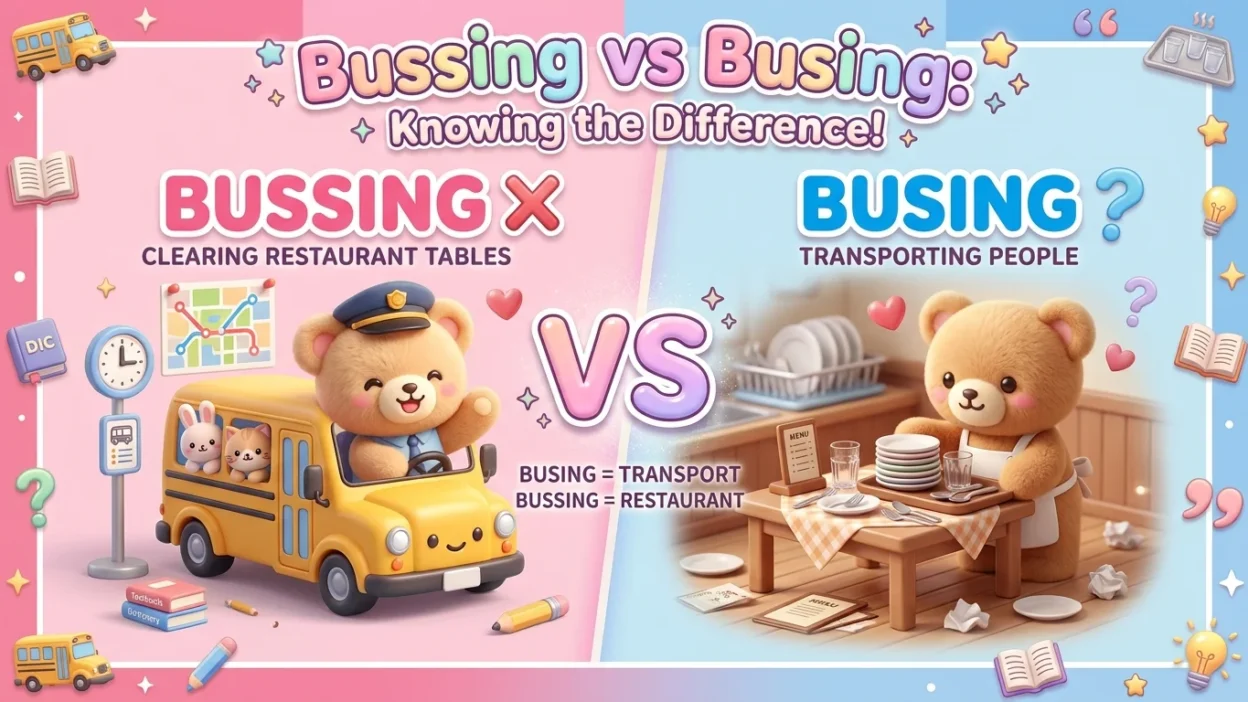
Have you ever confused bussing vs busing? Both spellings can be correct, but they can have different meanings and uses. Busing is commonly used for transporting people by bus, while bussing can be the correct spelling when referring to clearing dishes or, in some varieties of English, transporting people by bus.
In this guide, you’ll learn the difference between bussing and busing, their meanings, examples, spelling rules, common mistakes, American and British English usage, FAQs, and an easy memory trick.
Quick Answer
- Busing ✅ = transporting people by bus; also commonly used as the spelling of the verb bus in American English.
- Bussing ✅ = serving or clearing tables in a restaurant; also a variant spelling for transporting people by bus.
- Bus can have different meanings, so the correct spelling depends on the context.
Examples:
- The school is busing students to another campus. ✅
- The restaurant employee is bussing the tables. ✅
The easiest rule is:
Busing = transportation by bus
Bussing = clearing or serving tables
However, bussing can also be used for the transportation meaning, especially under a spelling rule that doubles the final consonant.
What Does Busing Mean?
Busing is commonly used as the present participle of bus when bus means to transport people by bus.
Examples:
- The school is busing students to the museum.
- The company is busing employees to the event.
- The district began busing children to different schools.
- They are busing passengers from the airport to the hotel.
In American English, busing is a very common spelling for this meaning.
What Does Bussing Mean?
Bussing can have several uses.
One common use is as the present participle of bus when someone clears dishes and cleans tables in a restaurant.
Examples:
- She is bussing tables at the restaurant.
- He spent the evening bussing tables.
- The server asked the employee to start bussing the tables.
- They were bussing tables after the dinner rush.
Here, bussing is clearly about restaurant work, not transportation.
Bussing as Transportation
Bussing can also be used to mean transporting people by bus.
This spelling occurs because some writers apply the consonant-doubling pattern used with short words ending in a consonant.
Examples:
- The district is bussing students to another school.
- The company is bussing employees to the conference.
- They are bussing guests between the hotels and venue.
However, busing is also standard and is particularly common in American English for this meaning.
Therefore, if you’re writing about transportation, busing is usually the safest choice.
Bussing vs Busing Comparison Table
| Word | Common Meaning | Example |
|---|---|---|
| Busing | Transporting people by bus | The school is busing students to the museum. |
| Bussing | Clearing or serving restaurant tables | She is bussing tables. |
| Bussing | Also a variant spelling for transporting people by bus | The district is bussing students. |
Why Are Bussing and Busing Confused?
The confusion comes from the word bus and the spelling rule for adding -ing.
Some English words double their final consonant before adding -ing:
- run → running
- sit → sitting
- stop → stopping
That can lead people to assume:
- bus → bussing
And bussing is indeed a legitimate spelling in some contexts.
However, busing is also an established spelling, particularly when bus means transporting people by bus.
This makes the situation more complicated than simply saying one spelling is always correct.
Busing vs Bussing in Restaurant English
When you’re talking about restaurant employees clearing tables, bussing is commonly preferred.
Examples:
- He is bussing tables.
- She got a job bussing tables.
- The restaurant needs someone for bussing duties.
- The staff finished bussing the dining room.
The phrase bus tables means to clear used dishes, glasses, and other items from tables.
Therefore:
bus tables → bussing tables
is a common spelling.
Busing in School Transportation
When talking about school transportation, busing is especially common.
Examples:
- The district is busing students to the new school.
- Busing children to school can take considerable time.
- The school introduced a new busing system.
- Parents discussed changes to student busing.
The noun busing can also refer to the practice or system of transporting students by bus.
Common Mistakes People Make
Mistake 1: Thinking Busing Is Always Wrong
Incorrect assumption:
- ❌ Busing is always a misspelling.
This is not true.
Busing is a standard spelling, especially for transporting people by bus.
Example:
- The school is busing students to the event. ✅
Mistake 2: Thinking Bussing Is Always Wrong
This is also incorrect.
Bussing is commonly used for clearing tables.
Example:
- She is bussing tables. ✅
Mistake 3: Using Bussing for Every Context
Although bussing can refer to transportation, it may create ambiguity.
For example:
- The school is bussing students.
A reader may understand it, but busing is a cleaner and more common choice for transportation in American English.
Mistake 4: Confusing Bussing With Bussing Someone
Be careful with context.
Bussing tables = clearing restaurant tables.
Busing students = transporting students by bus.
The meanings are completely different.
Simple Memory Trick
💡 Memory Trick
Spelling Box
🚌 BUSING = BUS TRANSPORTATION
Think: Busing people on a bus.
🍽️ BUSSING = RESTAURANT TABLES
Think: Bussing tables and clearing dishes.
Remember:
Busing → buses
Bussing → tables
Both spellings can be correct, but the context matters.
Busing as a Noun
Busing can function as a noun when referring to the practice or system of transporting people by bus.
Examples:
- School busing became an important issue.
- The city expanded public busing services.
- Student busing requires careful planning.
- The new busing program began in September.
In these examples, busing refers to transportation by bus rather than the action of driving a particular bus.
Bussing as a Noun
Bussing can refer to the work of clearing and resetting tables in a restaurant.
Examples:
- Bussing is part of the employee’s responsibilities.
- She has experience in serving and bussing.
- The restaurant hired someone for bussing duties.
In this context, bussing is related to restaurant service.
Busing vs Busking
Don’t confuse busing with busking.
Busing = transporting people by bus.
Busking = performing in a public place, usually for voluntary donations.
Examples:
- The school is busing students to the museum.
- The musician was busking on the street.
These words have completely different meanings.
Busing vs Bussing vs Busking
| Word | Meaning | Example |
|---|---|---|
| Busing | Transporting by bus | They are busing students. |
| Bussing | Clearing restaurant tables | She is bussing tables. |
| Busking | Performing publicly for money | He makes money by busking. |
American vs British English
Usage can vary between American and British English.
In American English, busing is very common for transporting people by bus, while bussing is common for clearing restaurant tables.
In British English, spelling and usage can vary, and bussing may appear more often when forming the present participle of bus.
Because of these differences, context matters more than simply labeling one spelling “correct” and the other “incorrect.”
When Should You Use Busing?
Use busing when you mean:
- Transporting people by bus
- School transportation
- Employee transportation
- Moving passengers by bus
- A transportation system involving buses
Examples:
- The school is busing students to the competition.
- The company is busing workers to the event.
- The city is busing passengers between terminals.
If you’re writing for an American audience, busing is usually the safest choice for this meaning.
When Should You Use Bussing?
Use bussing when you mean:
- Clearing restaurant tables
- Removing dishes
- Resetting tables
- Restaurant support work
Examples:
- She is bussing tables.
- He worked as a server and bussed tables.
- The restaurant needs help with bussing.
Bussing can also be used for transporting people by bus, but busing is often clearer for that meaning.
Related Words and LSI Keywords
- busing meaning
- bussing meaning
- busing vs bussing
- bussing vs busing
- busing tables
- bussing tables
- school busing
- bus transportation
- bus tables
- restaurant bussing
- bused vs bussed
- bussing tables meaning
- busing students
- bus driver
- restaurant terminology
- English spelling
- English grammar
- commonly confused words
- spelling differences
- correct English usage
- American English
- British English
- English vocabulary
Tips for Remembering the Difference
- Busing commonly means transporting people by bus.
- Bussing commonly means clearing restaurant tables.
- Both spellings can be correct depending on the meaning and dialect.
- Busing students → transportation.
- Bussing tables → restaurant work.
- In American English, busing is especially common for transportation.
- Remember busing → bus transportation.
- Remember bussing → bussing tables.
Frequently Asked Questions
What is the difference between busing and bussing?
Busing commonly means transporting people by bus, while bussing commonly refers to clearing tables in a restaurant. Bussing can also be used as a variant spelling for transporting people by bus.
Is busing correct?
Yes. Busing is a standard spelling, especially when referring to transportation by bus.
Example:
- The school is busing students to the museum.
Is bussing correct?
Yes. Bussing is correct when referring to clearing tables in a restaurant.
Example:
- She is bussing tables.
It can also be used for transportation by bus in some varieties and styles of English.
Is it busing tables or bussing tables?
Bussing tables is the commonly preferred spelling for the restaurant meaning.
Example:
- She got a job bussing tables.
Is it busing students or bussing students?
Both spellings can occur, but busing students is especially common in American English.
Why does bussing have two S’s?
Bussing uses a doubled s because some English spelling patterns double a final consonant before adding -ing. The spelling is also commonly used for the restaurant verb bus.
Is busing an American spelling?
Busing is especially common in American English, particularly for transporting people by bus.
Is bussing a British spelling?
Bussing can be found in British English, but spelling preferences depend on the context and variety of English. It is also commonly used in American English for restaurant table service.
What does bussing tables mean?
Bussing tables means clearing used dishes, glasses, utensils, and other items from restaurant tables and often preparing the tables for the next customers.
What does busing students mean?
Busing students means transporting students by bus, often between their homes and schools or between different locations.
Are busing and bussing pronounced the same?
They are generally pronounced the same or very similarly because both are formed from bus.
Which spelling should I use for transportation?
For transportation by bus, busing is generally the clearest and safest choice, particularly in American English.
Which spelling should I use for restaurant tables?
Use bussing for clearing or servicing restaurant tables.
How do you remember busing vs bussing?
Remember BUSING = BUS TRANSPORTATION and BUSSING = RESTAURANT TABLES. When you’re talking about students or passengers being transported, busing is usually the best choice. When you’re talking about clearing dishes, use bussing.
Summary
The difference between bussing vs busing depends largely on context. Busing is commonly used for transporting people by bus, especially in American English. Bussing is commonly used for clearing and servicing restaurant tables. However, bussing can also be used as a variant spelling for transporting people by bus, so it is not simply an incorrect spelling.
Remember the easiest distinction: busing = bus transportation, while bussing = restaurant table service. For example, a school may be busing students to another campus, while a restaurant employee may be bussing tables after dinner. Context will help you choose the clearest spelling.

Rowan Blythecroft crafts atmospheric fiction filled with mystery and folklore.
Her stories often blur the line between reality and imagination.
She spends most of her days wandering forests and writing by candlelight.