Have you ever confused sew vs sow? These two words sound very similar, but they have completely different meanings. Sew means to join fabric using a needle and thread, while sow means to plant seeds in the ground. They are easy to confuse because they are pronounced differently in some accents but can sound very similar in others.
In this guide, you’ll learn the difference between sew and sow, their meanings, examples, common mistakes, spelling rules, American and British English usage, FAQs, and an easy memory trick.
Quick Answer
- Sew ✅ = to join or repair fabric with a needle and thread.
- Sow ✅ = to plant seeds or spread seeds for growing.
- Sow can also mean to spread or introduce something, especially an idea or feeling.
Examples:
- She learned to sew her own clothes. ✅
- Farmers sow seeds in the spring. ✅
The easiest rule is:
Sew = fabric and thread
Sow = seeds and planting
What Does Sew Mean?
Sew is a verb that means to join, repair, or decorate fabric using a needle and thread.
Examples:
- My grandmother taught me how to sew.
- She can sew a beautiful dress.
- I need to sew a button onto my shirt.
- He learned to sew by hand.
- She sewed the torn fabric together.
You can use sew for both hand stitching and machine stitching.
Sew in Everyday English
You may use sew when talking about:
- Clothes
- Fabric
- Buttons
- Curtains
- Repairs
- Quilts
- Embroidery
- Needlework
Examples:
- I need to sew a button back onto my jacket.
- She sewed a hole in her jeans.
- They sew clothes for children.
- My aunt enjoys sewing quilts.
What Does Sow Mean?
Sow is a verb that means to plant seeds in the ground.
Examples:
- Farmers sow seeds in early spring.
- We need to sow the garden before the rain.
- The farmer sowed wheat across the field.
- They sowed the seeds carefully.
The basic idea is:
Sow = put seeds into the soil so they can grow.
Sow in a Figurative Sense
Sow can also have a figurative meaning: to spread or introduce something that may develop or produce a result later.
Examples:
- The rumor sowed confusion among the employees.
- His speech sowed doubt in their minds.
- The campaign sowed fear among the public.
- Education can sow the seeds of change.
This meaning comes from the farming idea of planting something that will grow later.
Sew vs Sow Comparison Table
| Word | Meaning | Common Uses | Example |
|---|---|---|---|
| Sew | Join or repair fabric with needle and thread | Clothes, fabric, buttons, quilts | She can sew a dress. |
| Sow | Plant or scatter seeds | Farming, gardening, agriculture | Farmers sow seeds in spring. |
| Sow | Spread something figuratively | Ideas, doubt, fear, confusion | The rumor sowed doubt. |
Why Are Sew and Sow Confused?
The main reason is their pronunciation.
In standard English, sew is pronounced like “so”, while sow has two pronunciations depending on its meaning.
When sow means “plant seeds,” it is pronounced like “so.”
For example:
- sew → sounds like “so”
- sow (plant seeds) → sounds like “so”
This makes sew and sow homophones when sow means planting.
However, sow has another pronunciation when it refers to an adult female pig.
So context is very important.
Sew vs Sow in Sentences
Compare these sentences:
- I know how to sew a button.
- Farmers sow seeds in the field.
The first involves fabric and thread.
The second involves seeds and soil.
Another example:
- She sewed the torn shirt.
- He sowed the garden with flowers.
The spellings are different because the meanings are different.
Common Mistakes People Make
Mistake 1: Using Sow for Sewing
Incorrect:
- ❌ She knows how to sow clothes.
Correct:
- ✅ She knows how to sew clothes.
Clothes are made or repaired with sewing, so use sew.
Mistake 2: Using Sew for Planting
Incorrect:
- ❌ Farmers sew seeds in the spring.
Correct:
- ✅ Farmers sow seeds in the spring.
Seeds are sown, not sewn.
Mistake 3: Confusing Sewed and Sowed
Both sewed and sowed are correct words, but they have different meanings.
- Sewed = stitched fabric.
- Sowed = planted seeds.
Examples:
- She sewed the dress.
- He sowed the seeds.
Simple Memory Trick
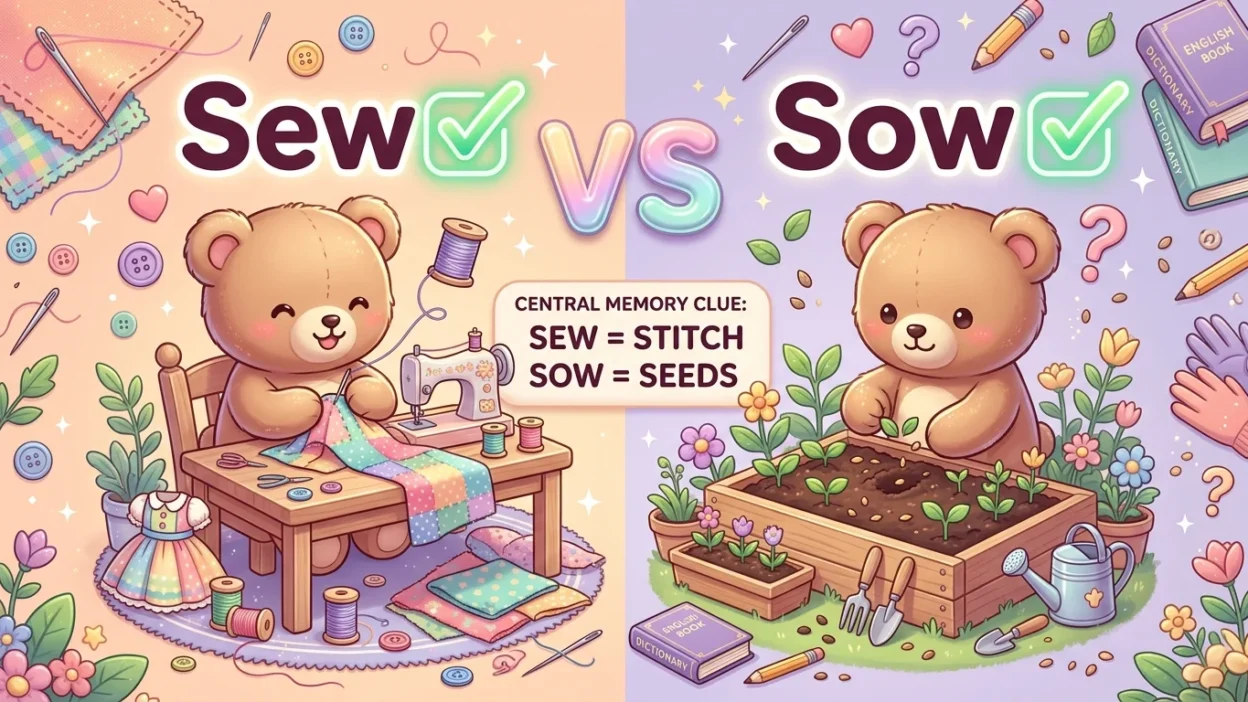
💡 Memory Trick
Spelling Box
🧵 SEW = STITCH
Think: SEW → needle and thread.
🌱 SOW = SEEDS
Think: SOW → seeds go into soil.
Remember:
SEW = fabric
SOW = seeds
If you’re using a needle, choose sew.
If you’re planting seeds, choose sow.
Sew, Sewing, Sewed, and Sewn
The verb sew has several forms.
| Form | Example |
|---|---|
| Sew | I sew clothes. |
| Sewing | She is sewing a dress. |
| Sewed | She sewed the button on. |
| Sewn | The fabric has been sewn together. |
Examples:
- I sew by hand.
- She is sewing a shirt.
- He sewed the torn pocket.
- The pieces have been sewn together.
Sow, Sowing, Sowed, and Sown
The verb sow also has several forms.
| Form | Example |
|---|---|
| Sow | Farmers sow seeds. |
| Sowing | They are sowing wheat. |
| Sowed | He sowed the seeds yesterday. |
| Sown | The seeds have been sown. |
Examples:
- Farmers sow seeds in the spring.
- They are sowing corn.
- She sowed the garden with flowers.
- The seeds have been sown.
Sew vs Sow vs So
These three words are worth keeping separate.
Sew
Sew = stitch fabric.
- I can sew a button.
Sow
Sow = plant seeds.
- Farmers sow seeds.
So
So = therefore, very, or to a certain degree.
Examples:
- I was tired, so I went home.
- She is so happy.
- It was so cold outside.
Although sew, sow, and so can sound alike in some contexts, they have completely different meanings.
Sow as a Farming Term
In agriculture, sow is a common and important word.
Examples:
- Farmers sow seeds before the rainy season.
- The field is ready to sow.
- Workers are sowing wheat.
- The farmer sowed the field with corn.
- The seeds were sown evenly.
The opposite process is often associated with harvesting.
A simple agricultural sequence is:
Sow → grow → harvest
“You Reap What You Sow”
You may have heard the expression:
“You reap what you sow.”
It means that your actions often produce corresponding results.
For example:
- If you treat people kindly, you may receive kindness in return.
- If you work hard, your efforts may produce good results.
Here, sow is being used metaphorically.
The idea comes from farming:
Sow seeds → grow crops → reap the harvest.
Sow the Seeds
The phrase sow the seeds can be literal or figurative.
Literal:
- Farmers sow the seeds in the field.
Figurative:
- Education can sow the seeds of success.
- Her actions sowed the seeds of distrust.
The figurative meaning suggests starting something that may develop later.
American vs British English
There is no significant spelling difference between sew and sow in American and British English.
Both varieties use:
- sew = stitch fabric
- sow = plant seeds
The pronunciation of sew is generally like “so.”
When sow means “plant seeds,” it is also pronounced like “so.”
When sow refers to an adult female pig, it has a different pronunciation.
When Should You Use Sew?
Use sew when talking about:
- Fabric
- Clothing
- Needles
- Thread
- Buttons
- Stitching
- Quilting
- Repairs
Examples:
- Sew a button.
- Sew a dress.
- Sew the fabric together.
- Sew a torn pocket.
- Sew a quilt.
Ask yourself:
“Am I using a needle and thread?”
If yes, use sew.
When Should You Use Sow?
Use sow when talking about:
- Seeds
- Farming
- Gardening
- Planting
- Growing crops
- Spreading something figuratively
Examples:
- Sow seeds.
- Sow wheat.
- Sow flowers.
- Sow crops.
- Sow doubt.
- Sow confusion.
Ask yourself:
“Am I planting seeds or spreading something that may grow?”
If yes, use sow.
Related Words and LSI Keywords
- sew meaning
- sow meaning
- sew vs sow
- sow vs sew
- sew definition
- sow definition
- sewing meaning
- sowing meaning
- sewed vs sowed
- sewn vs sown
- sew a button
- sow seeds
- sow the seeds
- reap what you sow
- sow doubt
- sow confusion
- sewing clothes
- planting seeds
- farming vocabulary
- gardening vocabulary
- homophones
- commonly confused words
- English spelling
- English grammar
- common spelling mistakes
- correct English usage
- vocabulary guide
- English learning
Tips for Remembering the Difference
- Sew = use a needle and thread.
- Sow = plant seeds.
- Sewed = stitched.
- Sowed = planted.
- Sewn = stitched together.
- Sown = planted.
- Think SEW = STITCH.
- Think SOW = SEEDS.
- Sow can also mean spreading ideas, feelings, doubt, or confusion.
- Remember: You sew fabric, but you sow seeds.
Frequently Asked Questions
What is the difference between sew and sow?
Sew means to join or repair fabric with a needle and thread. Sow means to plant or scatter seeds. Sow can also mean to spread something figuratively.
Is it sew seeds or sow seeds?
The correct phrase is sow seeds.
Example:
- Farmers sow seeds in the spring.
Is it sow clothes or sew clothes?
The correct phrase is sew clothes.
Example:
- She knows how to sew clothes.
Is it sewed or sowed?
Both are correct, but they have different meanings.
- Sewed = stitched fabric.
- Sowed = planted seeds.
What is the past tense of sew?
The past tense of sew is sewed.
Example:
- She sewed the button onto her shirt.
Its past participle can be sewn or, in some uses, sewed.
What is the past tense of sow?
The past tense of sow is sowed.
Example:
- The farmer sowed the seeds.
The past participle is usually sown.
Is sew pronounced like so?
Yes. Sew is pronounced like “so.”
Is sow pronounced like sew?
When sow means to plant seeds, yes. It is pronounced like “so.”
What does “you reap what you sow” mean?
It means that your actions often produce corresponding results. The expression comes from farming: what you sow as seeds eventually produces a harvest.
Can sow have another pronunciation?
Yes. When sow refers to an adult female pig, it has a different pronunciation from the verb sow meaning to plant seeds.
Is sew used in American and British English?
Yes. Sew is standard in both American and British English.
Is sow used in American and British English?
Yes. Sow is standard in both varieties of English.
How do you remember sew vs sow?
Remember SEW = STITCH and SOW = SEEDS. If you’re working with fabric, use sew. If you’re planting seeds, use sow.
Summary
The difference between sew vs sow is easy once you connect each word with its meaning. Sew means to join, repair, or decorate fabric using a needle and thread, while sow means to plant or scatter seeds. Sow can also describe spreading something figuratively, such as doubt, fear, or confusion.
Remember the simple rule: you sew fabric, but you sow seeds. For example, you sew a button onto a shirt, but a farmer sows seeds in a field. When you remember SEW = STITCH and SOW = SEEDS, you’ll have an easy way to avoid confusing these commonly confused words.