
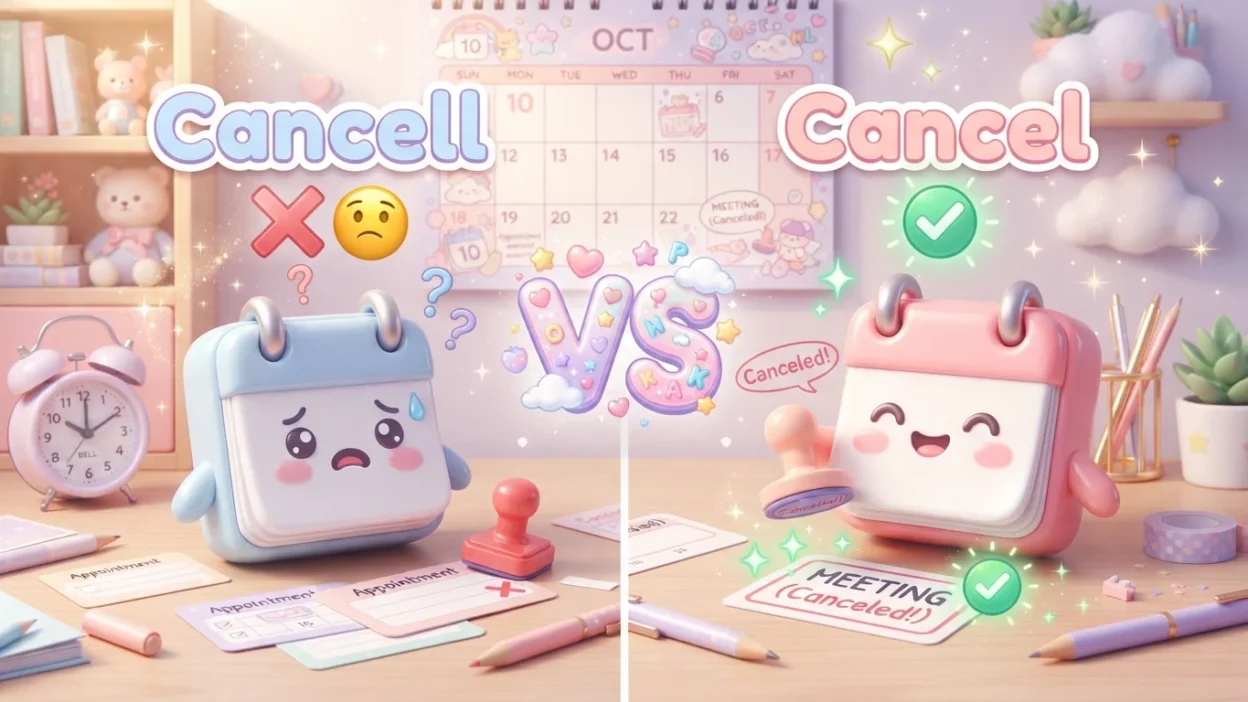
Have you ever written cancell and wondered if it was correct? You’re not alone! Many English learners accidentally add an extra “l” because English spelling rules can be confusing. However, only one spelling is correct in modern English.
In this guide, you’ll learn the difference between cancell vs cancel, their meanings, examples, common mistakes, and an easy memory trick to help you remember the correct spelling.
Quick Answer
- Cancel ✅ — Correct spelling.
- Cancell ❌ — Incorrect spelling.
Use cancel whenever you mean to stop, call off, or end something.
Examples:
- We decided to cancel the meeting.
- She had to cancel her subscription.
What Do Cancell and Cancel Mean?
Although these words look similar, only one is accepted in standard English.
What Is Cancel?
Cancel is a verb that means:
- To call something off.
- To stop or terminate an arrangement.
- To invalidate or revoke something.
- To decide that an event or action will not happen.
Examples:
- Please cancel my order.
- They had to cancel the flight because of bad weather.
- You can cancel your membership anytime.
- The school may cancel classes during severe storms.
What Is Cancell?
Cancell is a misspelling of cancel.
It is not recognized as a standard English word and should never be used in formal or informal writing.
Cancell vs Cancel Comparison Table
| Feature | Cancell | Cancel |
|---|---|---|
| Correct English Word | ❌ No | ✅ Yes |
| Dictionary Entry | No | Yes |
| Meaning | None | To stop or call off something |
| Used in Formal Writing | No | Yes |
| Used in Everyday English | No | Very Common |
Why Is “Cancel” Correct?
The correct spelling is:
C-A-N-C-E-L
Many people mistakenly add an extra “l” and write cancell, but modern English uses only one “l” in the base form of the word.
Therefore:
- Cancel ✅ — Correct spelling.
- Cancell ❌ — Incorrect spelling.
Keep in mind that some forms of the word may contain two “l” letters, such as:
- Cancelled (British English)
- Cancelling (British English)
However, the base verb always remains cancel.
Examples of Cancel in Sentences
- Please cancel my appointment.
- We may need to cancel the reservation.
- The airline refused to cancel the ticket without notice.
- She forgot to cancel her free trial subscription.
- The organizers decided to cancel the concert.
- He plans to cancel his gym membership.
- The company had to cancel the product launch.
Common Mistakes People Make
Many writers accidentally:
- Write cancell instead of cancel.
- Confuse the base word with “cancelled.”
- Assume all forms of the word use two “l” letters.
- Miss the typo while proofreading.
Incorrect:
- ❌ We need to cancell the booking.
Correct:
- ✅ We need to cancel the booking.
Simple Memory Trick
💡 Memory Trick
- Cancel has one mission and one “L.”
- Think: “Cancel uses a single L to keep things simple.”
Rule: The base word always ends with one “l.”
When Should You Use Cancel?
Use cancel when talking about:
- Flights
- Appointments
- Events
- Memberships
- Reservations
- Orders and subscriptions
Examples:
- Cancel an appointment
- Cancel a flight
- Cancel an order
- Cancel a reservation
- Cancel a subscription
- Cancel a meeting
When Should You Use Cancell?
Never.
Cancell is always a spelling mistake and should be corrected to cancel.
American vs British English
The base verb is the same in both American and British English:
- ✅ Cancel
- ❌ Cancell
However, there are differences when adding suffixes:
| Word Form | American English | British English |
|---|---|---|
| Base Verb | Cancel | Cancel |
| Past Tense | Canceled | Cancelled |
| Present Participle | Canceling | Cancelling |
No matter which variety of English you use, the original word is always cancel.
Related Words and LSI Keywords
- cancel meaning
- cancel spelling
- canceled vs cancelled
- canceling vs cancelling
- English spelling rules
- commonly misspelled words
- grammar guide
- vocabulary tips
- professional writing
- correct English usage
- proofreading tips
- word comparison
- language learning
- English grammar
Tips for Remembering the Difference
- The base word always uses one “l.”
- Never add an extra “l” to cancel.
- Don’t confuse the verb with British spellings like cancelled.
- Think: cancel = one word, one L.
- Use spell check if you’re unsure.
Frequently Asked Questions
Is cancell a real word?
No. Cancell is not recognized as a standard English word.
Which is correct: cancell or cancel?
Cancel is the correct spelling.
Why do people spell cancel as cancell?
Many writers confuse the base word with forms like cancelled or cancelling, which contain two “l” letters in British English.
Is cancel used in both American and British English?
Yes. Both varieties use cancel as the base verb.
Can I use cancell in formal writing?
No. Always use cancel.
Is canceled or cancelled correct?
Both are correct. American English prefers canceled, while British English prefers cancelled.
Summary
The difference between cancell vs cancel is simple. Cancel is the correct spelling and is used worldwide as the base form of the verb. Cancell is a common spelling mistake that should never be used.
If you’re ever unsure, remember that the base word always ends with a single “l.” Whether you’re canceling a meeting or canceling a subscription, cancel is the correct choice.

Cedric Halewood is known for his intricate historical narratives.
His work reflects a deep fascination with lost civilizations.
He lives near the coast, where he finds inspiration in the sea.