Have you ever confused cue vs que? These two words look and sound similar, but they have very different meanings and uses. Cue is a standard English word that can mean a signal, prompt, or a stick used in billiards. Que, however, is generally not the correct spelling when you mean cue.
In this guide, you’ll learn the difference between cue and que, their meanings, examples, common mistakes, grammar rules, American and British English usage, FAQs, and an easy memory trick.
Quick Answer
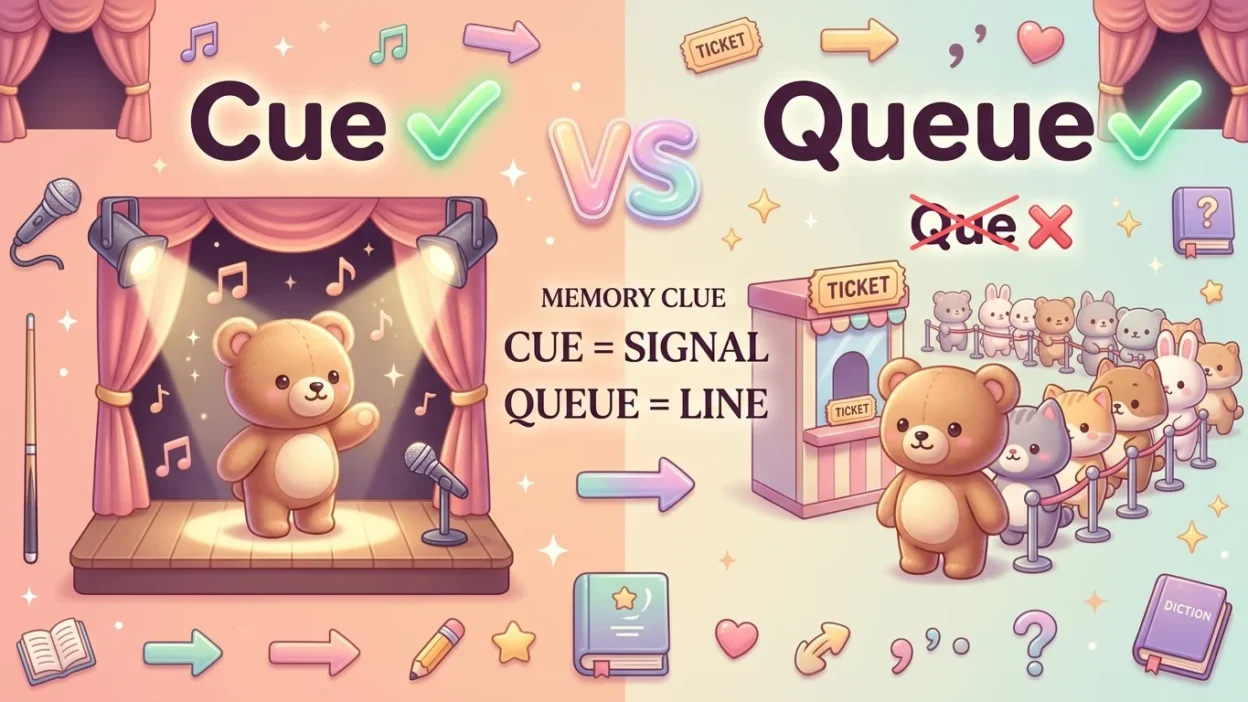
- Cue ✅ = a signal, prompt, or billiards stick.
- Que ❌ = usually a misspelling of cue in English.
- Queue ✅ = a line or sequence of people or things.
Examples:
- That was my cue to start speaking. ✅
- Please wait in the queue. ✅
- That was my que to leave. ❌
The easiest rule is:
Cue = signal or prompt
Queue = line
Que = usually incorrect in standard English
What Does Cue Mean?
Cue is a noun and verb with several related meanings.
As a noun, a cue is a signal, sign, or prompt that tells someone what to do or what should happen next.
Examples:
- The actor missed his cue.
- The music was my cue to begin.
- She gave me a cue to leave.
- When the lights turned green, that was our cue to move.
As a verb, cue means to give someone a signal or prepare something to happen.
Examples:
- The director cued the actor.
- The technician cued the music.
- She cued him to enter the room.
Cue in Theater and Performance
One of the most common meanings of cue appears in theater, television, film, and public speaking.
A cue tells a performer when to speak, move, enter, exit, or begin an action.
Examples:
- The actor waited for his cue.
- The lights provided a cue for the dancers.
- She missed her cue and entered late.
- The director gave the performers their cue.
You may also hear:
“Cue the music!”
This means to start the music at the appropriate moment.
Cue as a Signal
A cue does not have to come from a stage performance.
It can be any signal that tells someone what to do.
Examples:
- His smile was my cue to continue.
- The alarm was a cue to leave the building.
- Her gesture gave me the cue I needed.
- The teacher’s nod was my cue to begin.
In these examples, cue means a signal or indication.
Cue in Billiards and Pool
Cue also refers to the long stick used to hit balls in games such as pool and billiards.
Examples:
- He picked up his cue.
- She bought a new pool cue.
- The player held the cue carefully.
- He used the cue to strike the ball.
This meaning is completely different from the “signal” meaning, but the spelling remains the same.
What Does Que Mean?
In standard English, que is generally not the correct spelling when you mean cue.
For example:
Incorrect:
- ❌ That was my que to leave.
Correct:
- ✅ That was my cue to leave.
However, que can appear in other languages or as part of names and specialized terms. In ordinary English writing, though, you should not use que as a substitute for cue.
Cue vs Que Comparison Table
| Word | Correct in Standard English? | Meaning | Example |
|---|---|---|---|
| Cue | ✅ Yes | Signal, prompt, or billiards stick | That was my cue to speak. |
| Que | ❌ Usually no | Usually a misspelling of cue | ❌ That was my que. |
| Queue | ✅ Yes | A line or sequence | We waited in the queue. |
Cue vs Queue
This is an especially important distinction because cue and queue are pronounced the same in standard English.
They are homophones.
Cue
Cue = signal, prompt, or billiards stick.
Example:
- The actor received his cue.
Queue
Queue = a line of people or things waiting for something.
Example:
- We stood in the queue for tickets.
Compare:
- The director gave me a cue. → signal
- I waited in the queue. → line
Why Are Cue and Queue Confused?
The confusion comes mainly from pronunciation.
Cue and queue sound the same, even though they have different spellings and meanings.
The spelling queue contains several letters that are not pronounced separately.
Think:
Cue → signal
Queue → line
The word que can appear when someone tries to spell the sound of cue without knowing the correct spelling.
Common Mistakes People Make
Mistake 1: Writing Que Instead of Cue
Incorrect:
- ❌ That was my que to speak.
Correct:
- ✅ That was my cue to speak.
Mistake 2: Using Queue for a Signal
Incorrect:
- ❌ That was my queue to leave.
Correct:
- ✅ That was my cue to leave.
A queue is a line, not a signal.
Mistake 3: Using Cue for a Line
Incorrect:
- ❌ We waited in the cue for an hour.
Correct:
- ✅ We waited in the queue for an hour.
Mistake 4: Confusing Cue and Queue in Professional Writing
Because both words sound identical, spelling mistakes can easily appear in emails, articles, and messages.
Compare:
- Cue the presentation.
- Join the queue.
The meanings are completely different.
Simple Memory Trick
💡 Memory Trick
Spelling Box
🎭 CUE = SIGNAL
Think: CUE → Come Up / signal to start.
👥 QUEUE = LINE
Think: QUEUE → people waiting in a line.
❌ QUE = NOT THE STANDARD ENGLISH SPELLING
Remember:
Cue = signal
Queue = line
Que = usually a spelling mistake
Cue as a Verb
Cue can also function as a verb.
It means to give someone a signal or prepare something to happen.
Examples:
- The director cued the actor.
- She cued the music.
- He cued me to start.
- The producer cued the next scene.
Common forms include:
- cue
- cued
- cueing
Example:
- The technician was cueing the audio.
“Cue Up” Meaning
The phrasal verb cue up means to prepare something so it is ready to start.
Examples:
- Cue up the next song.
- She cued up the video.
- The DJ cued up the track.
Do not confuse cue up with queue up.
Cue up = prepare something to play or happen.
Queue up = form or join a line.
Examples:
- Cue up the music. 🎵
- Queue up for tickets. 👥
Queue Up Meaning
Queue up means to form a line or wait in a sequence.
Examples:
- Customers queued up outside the store.
- We queued up for tickets.
- People were queuing up to enter.
This expression is especially common in British English.
In American English, line up is often more common.
Cue vs Queue in American and British English
Both cue and queue are standard in both American and British English.
However, there is a difference in how commonly queue is used.
American English
Americans often say:
- wait in line
- line up
British English
British speakers commonly say:
- queue
- queue up
Examples:
- American: We waited in line.
- British: We waited in the queue.
The word cue has the same spelling and basic meanings in both varieties.
Cue in Everyday English
You may encounter cue in many everyday expressions.
Examples:
- on cue
- take your cue from someone
- cue the music
- cue someone in
- miss your cue
On Cue
On cue means exactly at the expected or appropriate moment.
Example:
- On cue, the lights went out.
Take Your Cue From Someone
This means to use someone’s behavior as a signal for what you should do.
Example:
- I took my cue from the manager and left.
Cue Someone In
Cue someone in means to give someone the information they need or bring them into a conversation or situation.
Example:
- Can you cue me in on what happened?
Cue vs Hint
A cue and a hint can sometimes be similar, but they are not identical.
A cue is often a signal that prompts an action.
A hint usually gives indirect information about something.
Examples:
- The director gave the actor a cue to enter.
- She gave me a hint about the answer.
Related Words and LSI Keywords
- cue meaning
- que meaning
- cue vs que
- cue vs queue
- queue meaning
- cue definition
- cue in a sentence
- cue someone in
- cue up
- queue up
- on cue
- take your cue
- miss your cue
- signal meaning
- prompt meaning
- line meaning
- homophones
- commonly confused words
- English spelling
- English grammar
- common spelling mistakes
- correct English usage
- vocabulary guide
- English learning
Tips for Remembering the Difference
- Cue = a signal or prompt.
- Cue = a stick used in pool or billiards.
- Queue = a line of people or things.
- Que is generally not the standard English spelling for either meaning.
- Cue up = prepare something to start.
- Queue up = form a line.
- Think cue = cue someone to act.
- Think queue = people waiting in a line.
Frequently Asked Questions
What is the difference between cue and que?
Cue is a standard English word meaning a signal, prompt, or billiards stick. Que is generally not the correct English spelling when you mean cue.
Is que a word?
Que can appear in other languages, names, or specialized contexts, but it is generally not the standard English spelling for cue.
Is it cue or que?
Use cue when you mean a signal, prompt, or billiards stick.
Example:
- That was my cue to leave.
Is it cue or queue?
It depends on the meaning.
- Cue = signal or prompt.
- Queue = line.
Is “queue” pronounced like “cue”?
Yes. In standard English, queue and cue are pronounced the same.
What does cue mean?
Cue can mean a signal or prompt that tells someone what to do. It can also mean a stick used in billiards or pool.
What does queue mean?
A queue is a line or sequence of people or things waiting for something.
Is “cue up” correct?
Yes. Cue up means to prepare something so it is ready to start.
Example:
- Cue up the next song.
Is “queue up” correct?
Yes. Queue up means to form or join a line.
Example:
- Customers queued up outside the store.
What does “on cue” mean?
On cue means at exactly the expected or appropriate time.
Example:
- On cue, the music began.
What does “cue someone in” mean?
Cue someone in means to give someone the information they need about a situation.
Example:
- Please cue me in on the latest updates.
Is cue used in American and British English?
Yes. Cue is standard in both American and British English.
Is queue used in American and British English?
Yes. Queue is standard in both, although British English uses queue and queue up more frequently than American English, where line and line up are often preferred.
How do you remember cue vs que?
Remember CUE = SIGNAL and QUEUE = LINE. If something tells you when to act, use cue. If people are waiting one after another, use queue. Que is generally not the standard English spelling.
Summary
The difference between cue vs que is simple: cue is the correct standard English word when you mean a signal, prompt, or billiards stick. Que is generally a misspelling in ordinary English. If you’re talking about a line of people or things waiting, however, the correct word is queue.
Remember the easy rule: cue = signal, while queue = line. For example, an actor waits for a cue, while customers wait in a queue. Once you connect each spelling with its meaning, these commonly confused words become much easier to remember.

Rowan Blythecroft crafts atmospheric fiction filled with mystery and folklore.
Her stories often blur the line between reality and imagination.
She spends most of her days wandering forests and writing by candlelight.