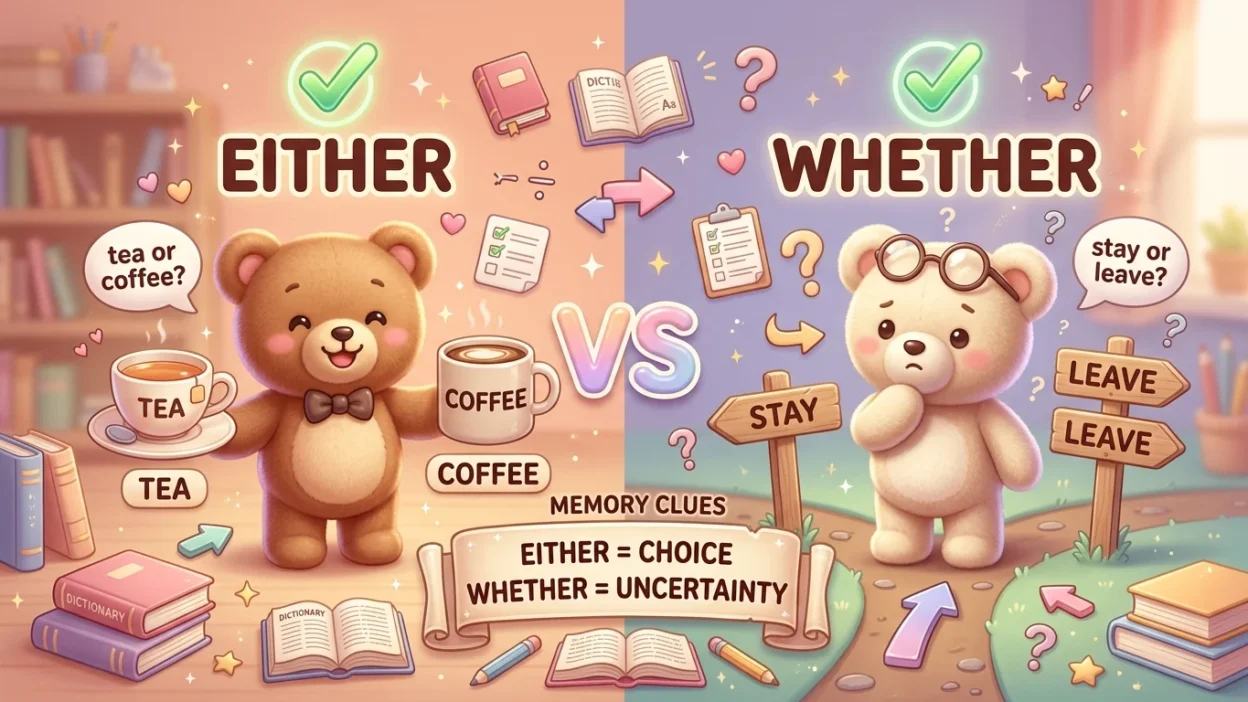
Have you ever confused either vs whether? These two words often appear in sentences about choices, possibilities, and alternatives, so it is easy to mix them up. However, either and whether serve different grammatical purposes. Either usually presents one of two options, while whether introduces a choice, uncertainty, or an alternative situation.
In this guide, you’ll learn the difference between either and whether, their meanings, examples, common mistakes, grammar rules, American and British English usage, FAQs, and an easy memory trick.
Quick Answer
- Either ✅ = one of two choices, or sometimes each of two.
- Whether ✅ = introduces alternatives or expresses uncertainty about a possibility.
Examples:
- You can choose either tea or coffee. ✅
- I don’t know whether she will come. ✅
The easiest rule is:
Either = one of two choices
Whether = if / which possibility
What Does Either Mean?
Either is commonly used when talking about two choices or alternatives.
It can mean one or the other of two possibilities.
Examples:
- You can choose either option.
- Either answer could be correct.
- You can have either tea or coffee.
- Either road will take you to the city.
The common structure is:
either A or B
Examples:
- Either call me or send me an email.
- We can go either today or tomorrow.
- You can choose either the red dress or the blue dress.
What Does Whether Mean?
Whether is used to introduce two or more possibilities, especially when the outcome is uncertain.
It often means something similar to if, particularly when discussing whether something will happen or whether a condition is true.
Examples:
- I don’t know whether she is coming.
- We need to decide whether to stay.
- I’m not sure whether this is the right answer.
- He asked whether I needed help.
A very common structure is:
whether A or B
Examples:
- I don’t know whether to stay or leave.
- We need to decide whether we should go or wait.
- Tell me whether you agree or disagree.
Either vs Whether Comparison Table
| Word | Main Meaning | Common Structure | Example |
|---|---|---|---|
| Either | One of two choices | Either A or B | You can choose either tea or coffee. |
| Whether | Expresses alternatives or uncertainty | Whether A or B | I don’t know whether she will come. |
Why Are Either and Whether Confused?
The confusion often happens because both words can appear with or.
Compare:
- Either tea or coffee.
- Whether to drink tea or coffee.
Although both sentences involve alternatives, the grammatical roles differ.
Either helps identify one choice from two.
Whether introduces a question or uncertainty about which possibility is true or what choice should be made.
Think:
- Either → choosing
- Whether → wondering or deciding
Either … Or
One of the most common uses of either is the structure:
either … or
It presents two alternatives.
Examples:
- Either we leave now or we miss the train.
- You can either call me or text me.
- She will either study medicine or engineering.
- We can either eat at home or go to a restaurant.
Here, either highlights the two available choices.
Whether … Or
Whether … or also presents alternatives, but it usually introduces uncertainty, a decision, or two possible conditions.
Examples:
- I don’t know whether to call him or wait.
- She asked whether we wanted tea or coffee.
- We need to decide whether to stay or leave.
- I’m unsure whether he is joking or serious.
Here, whether introduces the issue that needs to be considered or decided.
Either vs Whether With “Or”
This is an important distinction.
Either or
Use either … or to directly present two choices.
Example:
- You can choose either the red one or the blue one.
The speaker is presenting the available options.
Whether or
Use whether … or when discussing uncertainty, a question, or a decision.
Example:
- I don’t know whether to choose the red one or the blue one.
The speaker is uncertain about the choice.
Compare:
- Choose either the red one or the blue one.
- I don’t know whether to choose the red one or the blue one.
The difference becomes much clearer when you look at the purpose of the sentence.
Either Meaning One of Two
Either can mean one or the other of two people or things.
Examples:
- Either answer is acceptable.
- You can sit on either side.
- Either option would work.
- Take either route.
In these examples, either means one of two possible choices.
Whether Meaning If
In many sentences, whether can be similar to if when expressing uncertainty.
Examples:
- I don’t know whether he is coming.
- I don’t know if he is coming.
Both are commonly used.
Another example:
- She asked whether we were ready.
- She asked if we were ready.
However, whether is often preferred when explicitly presenting alternatives.
Example:
- I don’t know whether to stay or leave.
Whether or Not
The phrase whether or not is used when something is true regardless of the outcome.
Examples:
- I will go whether or not you come.
- We need to finish the work whether or not they help.
- She will attend whether or not he is there.
- I’ll support you whether or not you agree with me.
Here, the meaning is essentially:
No matter if this happens or not.
Either One
Either one means one of two choices.
Examples:
- You can take either one.
- Either one would be fine.
- I don’t mind; either one works.
Compare:
- Either one is acceptable. → one of the two is acceptable.
- I don’t know whether either one is available. → uncertainty about availability.
Either Way vs Whether
These expressions are not interchangeable.
Either Way
Either way means that the result will be the same regardless of which of two possibilities happens.
Example:
- We can drive or take the train. Either way, we’ll arrive by noon.
Whether
Whether introduces the alternatives themselves.
Example:
- I don’t know whether we should drive or take the train.
Compare:
- Whether we drive or take the train, we’ll arrive by noon.
- Either way, we’ll arrive by noon.
Common Mistakes People Make
Mistake 1: Using Either When You Mean Whether
Incorrect:
- ❌ I don’t know either she will come or not.
Correct:
- ✅ I don’t know whether she will come or not.
Whether introduces the uncertainty.
Mistake 2: Using Whether for a Direct Choice
Incorrect:
- ❌ You can choose whether tea or coffee.
Correct:
- ✅ You can choose either tea or coffee.
Here, either presents the two choices.
Mistake 3: Confusing Either With Whether
Compare:
- Either option is acceptable.
- I don’t know whether either option is acceptable.
The first sentence selects one of two possibilities.
The second expresses uncertainty.
Mistake 4: Using Either Instead of Whether After “I Don’t Know”
Incorrect:
- ❌ I don’t know either to stay or leave.
Correct:
- ✅ I don’t know whether to stay or leave.
Simple Memory Trick
💡 Memory Trick
Spelling Box
🔀 EITHER = CHOICE
Think: either A or B → choose one.
❓ WHETHER = UNCERTAINTY
Think: whether A or B → wondering or deciding.
Remember:
Either = choosing
Whether = wondering
Either and Whether in Questions
Either can appear in questions when asking someone to choose between two options.
Examples:
- Would you like either tea or coffee?
- Can I choose either option?
- Can we use either method?
Whether is used when asking about possibilities or uncertainty.
Examples:
- Do you know whether she is coming?
- Have you decided whether to stay?
- Can you tell me whether this is correct?
Either vs Whether in Formal Writing
Both words are standard and appropriate in formal English.
Use either when presenting alternatives or indicating one of two possibilities.
Example:
- The applicant may select either option.
Use whether when introducing uncertainty or alternatives within a clause.
Example:
- The committee must determine whether the proposal meets the requirements.
Whether can sometimes sound more formal than if, especially in professional or academic writing.
American vs British English
There is no major difference between American and British English in the basic use of either and whether.
Both varieties use:
- either for one of two choices
- whether for alternatives or uncertainty
Pronunciation can vary between American and British English, particularly for either, but the spelling and core grammar remain the same.
When Should You Use Either?
Use either when you mean:
- One of two choices
- One or the other
- Both alternatives are possible
- A direct choice between two options
Examples:
- Either answer is acceptable.
- Choose either option.
- You can either stay or leave.
- Either road will work.
Ask yourself:
“Am I offering or identifying a choice?”
If yes, either is probably the right word.
When Should You Use Whether?
Use whether when you mean:
- If something is true
- Uncertainty
- A decision between alternatives
- Two possible situations
- “Whether or not”
Examples:
- I don’t know whether she is coming.
- We need to decide whether to stay.
- Tell me whether you agree.
- I wonder whether this will work.
Ask yourself:
“Am I wondering, deciding, or expressing uncertainty?”
If yes, use whether.
Related Words and LSI Keywords
- either meaning
- whether meaning
- either vs whether
- whether vs either
- either or
- whether or
- whether or not
- either one
- either way
- if vs whether
- either definition
- whether definition
- choice and alternatives
- English grammar
- commonly confused words
- common grammar mistakes
- English vocabulary
- correct English usage
- grammar guide
- English learning
Tips for Remembering the Difference
- Either usually presents a choice.
- Whether usually introduces uncertainty or alternatives.
- Either A or B → choose one.
- Whether A or B → wondering or deciding.
- Either can mean one of two.
- Whether can often mean if.
- Whether or not means regardless of the outcome.
- Think either = choosing.
- Think whether = wondering.
Frequently Asked Questions
What is the difference between either and whether?
Either usually means one of two choices, while whether introduces alternatives, uncertainty, or a decision.
Is it either or whether?
Both words are correct, but they have different uses.
- Either = one of two choices.
- Whether = uncertainty or alternatives.
Can either and whether be used with “or”?
Yes.
Examples:
- Either tea or coffee.
- I don’t know whether to choose tea or coffee.
Is “either or” correct?
Yes. Either … or is a standard construction used to present two alternatives.
Example:
- You can either stay or leave.
Is “whether or” correct?
Yes. Whether … or is also standard when discussing alternatives or uncertainty.
Example:
- I don’t know whether to stay or leave.
Can whether mean if?
Yes. In many contexts, whether can mean if, especially when expressing uncertainty.
Example:
- I don’t know whether he is coming.
- I don’t know if he is coming.
Is “I don’t know either she will come” correct?
No. The correct sentence is:
- I don’t know whether she will come.
Is “choose whether tea or coffee” correct?
Usually, choose either tea or coffee is the natural construction when directly presenting two choices.
What does whether or not mean?
Whether or not means that something will happen or remain true regardless of which possibility occurs.
Example:
- I’ll go whether or not you come.
What does either way mean?
Either way means the result will be the same regardless of which of two options happens.
Is whether more formal than if?
Often, yes. Whether is frequently preferred in formal writing when discussing alternatives or uncertainty, although if is also correct in many contexts.
How do you remember either vs whether?
Remember EITHER = CHOICE and WHETHER = UNCERTAINTY. Use either A or B when presenting a choice and whether A or B when wondering or deciding between possibilities.
Summary
The difference between either vs whether becomes easy when you focus on their roles. Either usually presents one of two choices, while whether introduces uncertainty, alternatives, or a decision. For example, “You can choose either tea or coffee” gives someone a choice, while “I don’t know whether to choose tea or coffee” expresses uncertainty about that choice.
Remember the simple trick: either = choosing, while whether = wondering. Use either A or B when presenting alternatives, and use whether A or B when discussing uncertainty or a decision. Also remember whether or not for situations where the outcome does not change your decision.

Rowan Blythecroft crafts atmospheric fiction filled with mystery and folklore.
Her stories often blur the line between reality and imagination.
She spends most of her days wandering forests and writing by candlelight.