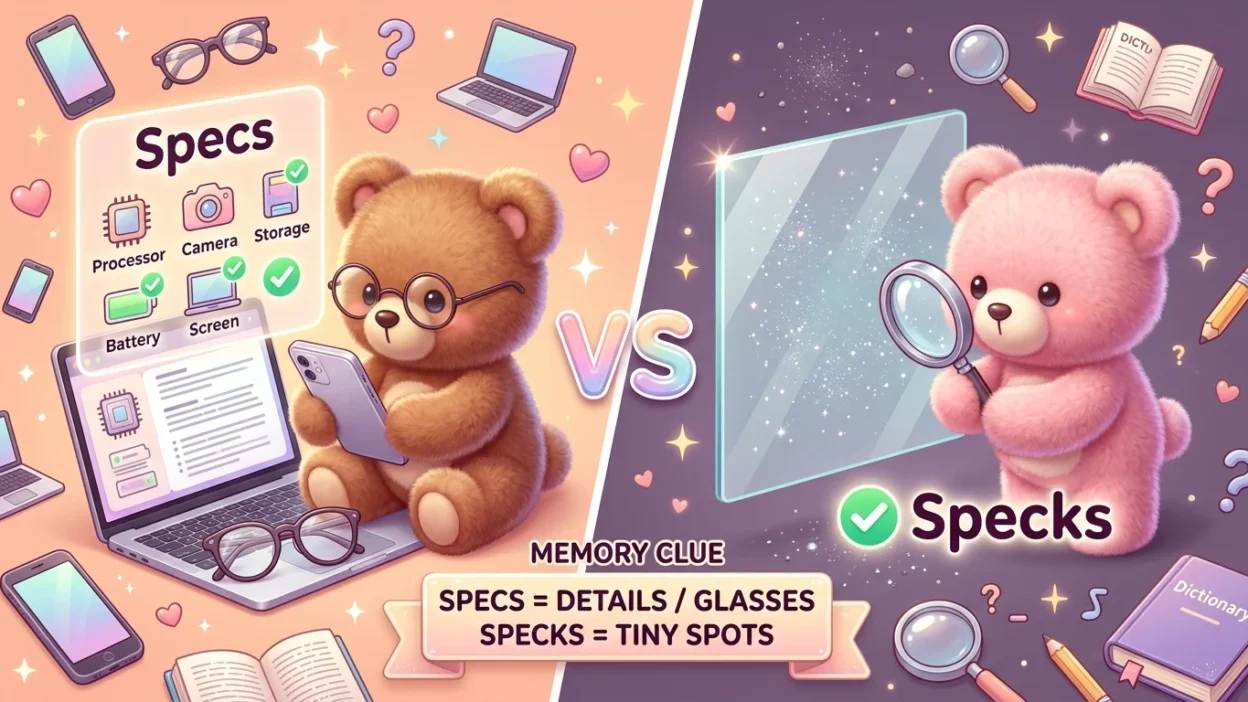
Have you ever confused specs vs specks? These two words sound exactly alike in many varieties of English, but they have completely different meanings. Specs is usually a shortened form of specifications or spectacles, while specks means tiny spots, pieces, or particles.
In this guide, you’ll learn the difference between specs and specks, their meanings, examples, common mistakes, grammar rules, American and British English usage, FAQs, and an easy memory trick.
Quick Answer
- Specs ✅ = specifications or, informally, eyeglasses.
- Specks ✅ = tiny spots, particles, or small pieces.
Examples:
- Check the phone’s specs before buying it. ✅
- There were tiny specks of dust on the table. ✅
The easiest rule is:
Specs = specifications or glasses
Specks = tiny spots or particles
What Does Specs Mean?
Specs has two common meanings.
Specs as Specifications
Specs is an informal abbreviation of specifications.
Specifications are detailed information about the features, size, performance, or requirements of something.
Examples:
- What are the laptop’s specs?
- I checked the car’s specs before buying it.
- These are the technical specs for the new phone.
- The computer has impressive specs.
- Make sure the product meets the required specs.
In this sense, specs is common in technology, engineering, automobiles, electronics, construction, and product descriptions.
Specs as Spectacles
Specs can also be an informal word for spectacles, meaning eyeglasses.
Examples:
- I can’t see without my specs.
- She left her specs at home.
- He bought a new pair of specs.
- Where did I put my specs?
This use is especially associated with informal British English, although it can be understood elsewhere.
What Does Specks Mean?
Specks is the plural of speck.
A speck is a very small spot, particle, mark, or piece of something.
Examples:
- There were specks of dust in the air.
- I noticed specks of paint on the floor.
- The sky was filled with tiny specks of light.
- There were black specks on the paper.
- She removed the specks of dirt from her shirt.
The word emphasizes something very small.
Specs vs Specks Comparison Table
| Word | Meaning | Common Uses | Example |
|---|---|---|---|
| Specs | Short for specifications or spectacles | Technology, products, eyeglasses | Check the phone’s specs. |
| Specks | Tiny spots, particles, or pieces | Dust, dirt, paint, marks | I found specks of dust on the screen. |
Why Are Specs and Specks Confused?
The main reason is pronunciation.
In many varieties of English, specs and specks are pronounced the same or nearly the same.
However, the spelling gives you an important clue:
- Specs → related to specifications or spectacles
- Specks → related to speck
The extra k in specks is part of the plural spelling of speck.
Specs Meaning Specifications
When specs means specifications, it usually refers to technical details.
For example, a smartphone’s specs might include:
- Screen size
- Storage
- Processor
- Camera resolution
- Battery capacity
- Memory
- Operating system
Example:
I compared the two phones based on their specs.
Here, specs does not mean tiny spots. It means specifications.
Specs Meaning Glasses
In informal English, specs can mean spectacles, or eyeglasses.
Example:
- I need my specs to read this.
This meaning is easy to identify from context.
Compare:
- The laptop has excellent specs. → specifications
- I forgot my specs. → glasses
Specks of Dust
One of the most common uses of specks is to describe tiny particles of dust.
Examples:
- The sunlight revealed specks of dust in the room.
- I cleaned the table to remove the specks of dust.
- Tiny specks of dust floated through the air.
Here, specks means tiny particles.
Specks of Dirt
Specks can also describe tiny pieces or marks of dirt.
Examples:
- There were specks of dirt on my shoes.
- Wipe away the specks from the window.
- The white shirt had several specks of dirt on it.
Specks of Paint
The word is also common when describing tiny amounts of paint.
Examples:
- There were specks of paint on the floor.
- His shirt was covered with specks of paint.
- I noticed a few blue specks on the wall.
Specs in Technology
Specs is extremely common when discussing technology.
Examples:
- Check the laptop specs before purchasing it.
- The phone’s specs are impressive.
- What are the camera specs?
- The computer has high-end specs.
- I compared the gaming PC’s specs with another model.
Here, specs means specifications.
Specs in Cars
You can also use specs to discuss the technical characteristics of a vehicle.
Examples:
- I looked up the car’s specs online.
- The two vehicles have similar specs.
- The engine specs are impressive.
- Compare the fuel-efficiency specs before making a decision.
Common Mistakes People Make
Mistake 1: Using Specks for Specifications
Incorrect:
- ❌ What are the laptop’s specks?
Correct:
- ✅ What are the laptop’s specs?
Mistake 2: Using Specs for Tiny Spots
Incorrect:
- ❌ There are specs of dust on the table.
Correct:
- ✅ There are specks of dust on the table.
Mistake 3: Confusing Specs With Glasses
Remember that specs can have two meanings.
- Specs = specifications
- Specs = spectacles
The surrounding sentence tells you which meaning applies.
Simple Memory Trick
💡 Memory Trick
Spelling Box
⚙️ SPECS = SPECIFICATIONS
Think: SPECifications → SPECS👓 SPECS = SPECTACLES
Think: SPECTACLES → SPECS✨ SPECKS = TINY SPOTS
Think: a speck is something very small.Remember:
Specs = details or glasses
Specks = tiny things
Specs vs Specifications
Specs is an informal shortened form of specifications.
For casual conversation, websites, product discussions, and everyday writing, specs is very common.
Examples:
- What are the product specs?
- I need the technical specs.
- The phone has excellent specs.
In highly formal writing, you may prefer the complete word specifications.
Specs vs Spectacles
Specs can also be short for spectacles.
Examples:
- He wears specs.
- I left my specs on the desk.
- She needs new specs.
This use is informal.
Speck vs Specks
Speck is singular.
Specks is plural.
Examples:
- There is one speck of dust.
- There are several specks of dust.
Other examples:
- a speck of paint
- several specks of paint
- a speck of dirt
- tiny specks of dirt
Specs vs Specks in Sentences
Compare these sentences:
- The phone has excellent specs.
- There are specks of dust on the phone.
The first sentence discusses technical features.
The second sentence describes tiny particles.
Another pair:
- I need to check the computer specs.
- I noticed several specks on the computer screen.
The spelling changes because the meanings change.
American vs British English
There is no major spelling difference between American and British English for specs and specks.
However, specs meaning eyeglasses is particularly common in British English and is informal.
Examples:
- Specs = specifications
- Specs = spectacles
- Specks = tiny spots or particles
The spelling remains the same in both varieties.
When Should You Use Specs?
Use specs when you mean:
- Specifications
- Technical details
- Product characteristics
- Spectacles or eyeglasses
Examples:
- phone specs
- laptop specs
- car specs
- camera specs
- technical specs
- a new pair of specs
Ask yourself:
“Do I mean specifications or glasses?”
If yes, use specs.
When Should You Use Specks?
Use specks when you mean:
- Tiny spots
- Small particles
- Tiny pieces
- Small marks
- Very small amounts of something
Examples:
- specks of dust
- specks of dirt
- specks of paint
- specks of light
- specks on the screen
Ask yourself:
“Am I talking about something tiny?”
If yes, use specks.
Related Words and LSI Keywords
- specs meaning
- specks meaning
- specs vs specks
- specks vs specs
- specs definition
- specks definition
- technical specs
- phone specs
- laptop specs
- car specs
- specs meaning glasses
- spectacles
- specks of dust
- specks of dirt
- specks of paint
- tiny spots
- tiny particles
- commonly confused words
- common spelling mistakes
- English grammar
- English vocabulary
- correct English usage
Tips for Remembering the Difference
- Specs can mean specifications.
- Specs can also mean spectacles.
- Specks means tiny spots or particles.
- Think specs = specs/details.
- Think specks = small spots.
- Use phone specs, not phone specks.
- Use specks of dust, not specs of dust.
- Context determines whether specs means specifications or glasses.
Frequently Asked Questions
What is the difference between specs and specks?
Specs usually means specifications or, informally, eyeglasses. Specks means tiny spots, particles, or small pieces.
Is it specs or specks of dust?
The correct phrase is specks of dust.
Is it phone specs or phone specks?
The correct phrase is phone specs, because it means the phone’s specifications.
What does specs mean?
Specs is an informal abbreviation of specifications. It can also mean spectacles, or eyeglasses.
What does specks mean?
Specks is the plural of speck, meaning tiny spots, particles, marks, or pieces.
Are specs and specks pronounced the same?
They are pronounced the same or very similarly in many varieties of English, which is why they are easy to confuse.
Can specs mean glasses?
Yes. Specs is an informal term for spectacles, meaning eyeglasses.
Is specs short for specifications?
Yes. Specs is a common informal abbreviation for specifications.
Is specks the plural of speck?
Yes. One speck becomes multiple specks.
Is “specks” a technical term?
Not usually. Specks generally describes very small spots, particles, or pieces rather than technical specifications.
Is specs used in American English?
Yes. Specs is commonly used in American English to mean specifications, and it can also refer informally to eyeglasses.
Is specs used in British English?
Yes. Specs is used in British English for both specifications and, informally, spectacles.
How do you remember specs vs specks?
Remember SPECS = SPECIFICATIONS or SPECTACLES, while SPECKS = TINY SPOTS.
Summary
The difference between specs vs specks is simple once you connect each spelling to its meaning. Specs is usually an informal abbreviation for specifications, and it can also mean spectacles or eyeglasses. Specks, meanwhile, is the plural of speck and refers to tiny spots, particles, or pieces.
Remember the easy rule: specs = details or glasses, while specks = tiny things. You can check a phone’s specs, wear your specs, or notice specks of dust on a screen. Once you connect the extra k with a tiny speck, you’ll have an easy way to remember the difference.

Cedric Halewood is known for his intricate historical narratives.
His work reflects a deep fascination with lost civilizations.
He lives near the coast, where he finds inspiration in the sea.