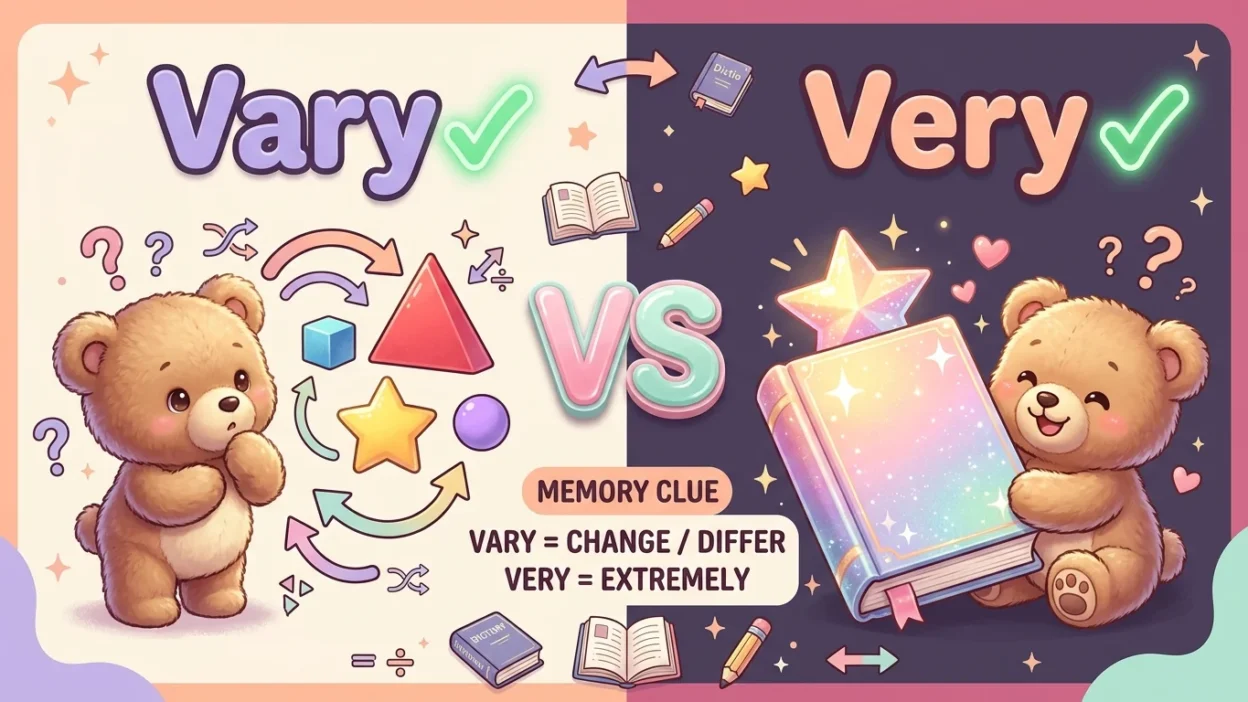
Have you ever confused vary vs very? These two words look and sound similar, but they have completely different meanings and grammatical uses. Vary is a verb meaning to differ, change, or make something different, while very is an adverb used to emphasize an adjective or adverb.
In this guide, you’ll learn the difference between vary and very, their meanings, examples, common mistakes, grammar rules, American and British English usage, FAQs, and an easy memory trick.
Quick Answer
- Vary ✅ = to differ, change, or make something different.
- Very ✅ = extremely or to a high degree.
Examples:
- Prices vary from store to store. ✅
- The movie was very interesting. ✅
The easiest rule is:
Vary = change or differ
Very = extremely
What Does Vary Mean?
Vary is a verb. It means to change, differ, or be different depending on the situation.
It can describe something that is not always the same.
Examples:
- Prices vary depending on the season.
- People’s opinions vary greatly.
- Results may vary from person to person.
- The weather can vary throughout the year.
- The size of the rooms varies considerably.
The word vary often appears when discussing differences, changes, ranges, or conditions.
What Does Very Mean?
Very is usually an adverb used to emphasize an adjective or another adverb.
It often means extremely, really, or to a high degree.
Examples:
- She is very happy.
- The test was very difficult.
- He runs very quickly.
- This book is very useful.
- The weather is very cold today.
In these sentences, very strengthens another word.
Vary vs Very Comparison Table
| Word | Part of Speech | Meaning | Example |
|---|---|---|---|
| Vary | Verb | To change or differ | Prices vary by location. |
| Very | Adverb | Extremely or to a high degree | The price is very high. |
Why Are Vary and Very Confused?
The main reason is their similar spelling and pronunciation.
Both words begin with “var/ver” sounds, and when spoken quickly, they can be easy to confuse.
However, their meanings are completely different.
- Vary → difference or change
- Very → emphasis
A useful way to remember them is:
Vary = various
Very = extremely
Vary Meaning Change
When something varies, it changes instead of remaining the same.
Examples:
- Temperatures vary throughout the day.
- The cost varies depending on the size.
- The results vary between different groups.
- Her mood varies from day to day.
Here, vary describes differences or changes.
Vary Meaning Differ
Vary can also mean to differ.
Examples:
- The two products vary in quality.
- Opinions vary among experts.
- Cooking times vary depending on the recipe.
- The answers vary from student to student.
In these examples, things are different from one another.
Very as an Intensifier
Very is commonly called an intensifier because it increases the strength of an adjective or adverb.
Examples:
- very good
- very difficult
- very cold
- very quickly
- very carefully
- very important
Compare:
- The movie was good.
- The movie was very good.
The word very makes the adjective good stronger.
Common Mistakes People Make
Mistake 1: Using Very Instead of Vary
Incorrect:
- ❌ Prices very from store to store.
Correct:
- ✅ Prices vary from store to store.
Here, the sentence describes differences in prices, so vary is required.
Mistake 2: Using Vary Instead of Very
Incorrect:
- ❌ She is vary happy.
Correct:
- ✅ She is very happy.
Here, the word emphasizes happy, so very is correct.
Mistake 3: Confusing Vary With Various
The words are related.
- Vary = to differ or change.
- Various = several different kinds or types.
Examples:
- Prices vary by location.
- We offer various options.
Mistake 4: Writing “Very” When You Mean “Change”
Incorrect:
- ❌ Results very depending on the method.
Correct:
- ✅ Results vary depending on the method.
Remember that vary is an action or state of difference.
Simple Memory Trick
💡 Memory Trick
Spelling Box
🔄 VARY = CHANGE / DIFFER
Think: VARY → VARIOUS → DIFFERENT
⭐ VERY = EXTREMELY
Think: VERY = REALLY
Remember:
Vary changes.
Very emphasizes.
Vary in Different Forms
Because vary is a verb, it can take different forms.
Vary
- Prices vary by location.
Varies
- The price varies depending on the size.
Varied
- The study produced varied results.
Varying
- The company offers varying levels of service.
Examples:
- Results vary between individuals.
- The cost varies by location.
- We received varied responses.
- The quality is varying across different products.
Very in Different Expressions
Very commonly appears before adjectives and adverbs.
Examples:
- very important
- very small
- very large
- very quickly
- very carefully
- very difficult
- very beautiful
- very slowly
Examples in sentences:
- This is very important.
- She speaks very clearly.
- The room is very small.
- He completed the task very quickly.
Vary vs Very in Sentences
Compare these sentences carefully:
- Prices vary from one store to another.
- The prices are very high.
The first sentence means prices differ.
The second sentence says prices are extremely high.
Another example:
- The results vary depending on the method.
- The results are very different.
Both sentences are grammatically correct, but they communicate different ideas.
Vary From vs Vary Between
Vary from and vary between are common structures.
Vary From
Use vary from when describing differences across a range.
Examples:
- Prices vary from $10 to $50.
- Temperatures vary from 15°C to 30°C.
- The sizes vary from small to large.
Vary Between
Use vary between when describing two limits or alternatives.
Examples:
- Prices vary between $20 and $50.
- Results vary between the two groups.
- The colors vary between light and dark shades.
Very vs Really
Very and really can both emphasize adjectives and adverbs.
Examples:
- She is very happy.
- She is really happy.
However, they are not always interchangeable in every grammatical structure.
For basic writing, remember:
Very = to a high degree
Vary vs Change
Vary and change can sometimes have similar meanings, but they are not identical.
Change is broader.
Examples:
- The weather changed suddenly.
- Prices vary depending on location.
Vary often emphasizes differences between things, people, situations, or conditions.
Vary in Formal Writing
Vary is completely standard in formal English.
It commonly appears in:
- Academic writing
- Scientific writing
- Business reports
- Research papers
- Technical documents
- Articles
Examples:
- Results may vary depending on environmental conditions.
- Costs vary according to the size of the project.
- Individual responses may vary.
Very in Formal Writing
Very is also standard English, but writers sometimes avoid using it too frequently in formal or academic writing because it can be less precise.
For example:
- very important
- very large
- very difficult
In formal writing, a more precise adjective may sometimes be stronger.
However, very itself is not grammatically incorrect or informal.
American vs British English
There is no significant spelling difference between American and British English.
Both varieties use:
- vary = change or differ
- very = extremely or to a high degree
The spelling and basic meanings remain the same.
When Should You Use Vary?
Use vary when you mean:
- Change
- Differ
- Be different
- Have different values
- Range across different amounts
Examples:
- Prices vary by location.
- Results vary from person to person.
- The colors vary depending on the material.
- Costs vary considerably.
Ask yourself:
“Am I talking about something changing or being different?”
If yes, use vary.
When Should You Use Very?
Use very when you want to:
- Emphasize an adjective
- Emphasize an adverb
- Express a high degree
Examples:
- very good
- very important
- very slowly
- very carefully
- very difficult
Ask yourself:
“Am I making another word stronger?”
If yes, use very.
Related Words and LSI Keywords
- vary meaning
- very meaning
- vary vs very
- very vs vary
- vary definition
- very definition
- vary meaning in English
- very meaning in English
- vary from
- vary between
- varied meaning
- varying meaning
- various meaning
- extremely meaning
- change vs vary
- English grammar
- commonly confused words
- common spelling mistakes
- English vocabulary
- correct English usage
- grammar guide
- English learning
Tips for Remembering the Difference
- Vary = change or differ.
- Very = extremely.
- Vary is a verb.
- Very is usually an adverb.
- Think vary → various → different.
- Think very → really → extremely.
- Use prices vary, not prices very.
- Use very happy, not vary happy.
- If the word describes change, choose vary.
- If the word emphasizes something, choose very.
Frequently Asked Questions
What is the difference between vary and very?
Vary means to change or differ, while very means extremely or to a high degree.
Is it vary or very different?
The correct phrase is very different when you want to emphasize how different something is.
Example:
- The two products are very different.
Is it prices vary or prices very?
The correct phrase is prices vary because it means prices differ.
What does vary mean?
Vary is a verb meaning to change, differ, or have different values or characteristics.
What does very mean?
Very is an adverb used to emphasize an adjective or adverb. It commonly means extremely or to a high degree.
Is vary a verb?
Yes. Vary is a verb.
Examples:
- Prices vary.
- Results vary.
- Opinions vary.
Is very an adverb?
Yes. Very is commonly used as an adverb to intensify adjectives and adverbs.
Example:
- She is very happy.
Is “vary much” correct?
Usually, vary much is not the natural expression when you mean “to a great degree.” You may need very much instead.
Example:
- I very much appreciate your help.
However, vary can appear with much in contexts discussing differences, such as “The results do not vary much.”
Is “very from” correct?
No, when you mean something differs from something else, use vary from.
Example:
- Prices vary from store to store.
Is “vary happy” correct?
No. The correct phrase is very happy.
Are vary and very pronounced the same?
They can sound similar in some accents, but they are not necessarily pronounced identically. Vary contains a clear long “a” sound, while very commonly contains the vowel sound found in “bed.”
Is vary used in American and British English?
Yes. Vary is standard in both American and British English.
Is very used in American and British English?
Yes. Very is standard in both varieties.
How do you remember vary vs very?
Remember VARY = CHANGE OR DIFFER and VERY = EXTREMELY. If something changes or differs, use vary. If you want to make another word stronger, use very.
Summary
The difference between vary vs very is easy when you focus on their grammatical roles. Vary is a verb that means to change or differ, while very is an adverb that means extremely or to a high degree. For example, “Prices vary by location” means prices differ, while “The prices are very high” uses very to add emphasis.
Remember the simple trick: vary = change or differ, while very = extremely. Think vary → various → different, and very → really → extremely. This quick connection can help you choose the correct spelling whenever these two commonly confused words appear.

Cedric Halewood is known for his intricate historical narratives.
His work reflects a deep fascination with lost civilizations.
He lives near the coast, where he finds inspiration in the sea.