Have you ever wondered whether you should use emersion or immersion? These two words look similar, but they have very different meanings. Because they share the same Latin root and often appear in scientific, educational, and everyday contexts, many people accidentally confuse them. Fortunately, understanding the difference is much easier than it seems.
In this guide, you’ll learn the meaning of emersion vs immersion, how each word is used, real-life examples, common mistakes to avoid, and simple tips to remember the difference. Whether you’re writing an essay, improving your English, or simply curious about vocabulary, this article will help you use both terms correctly and confidently.
Quick Answer
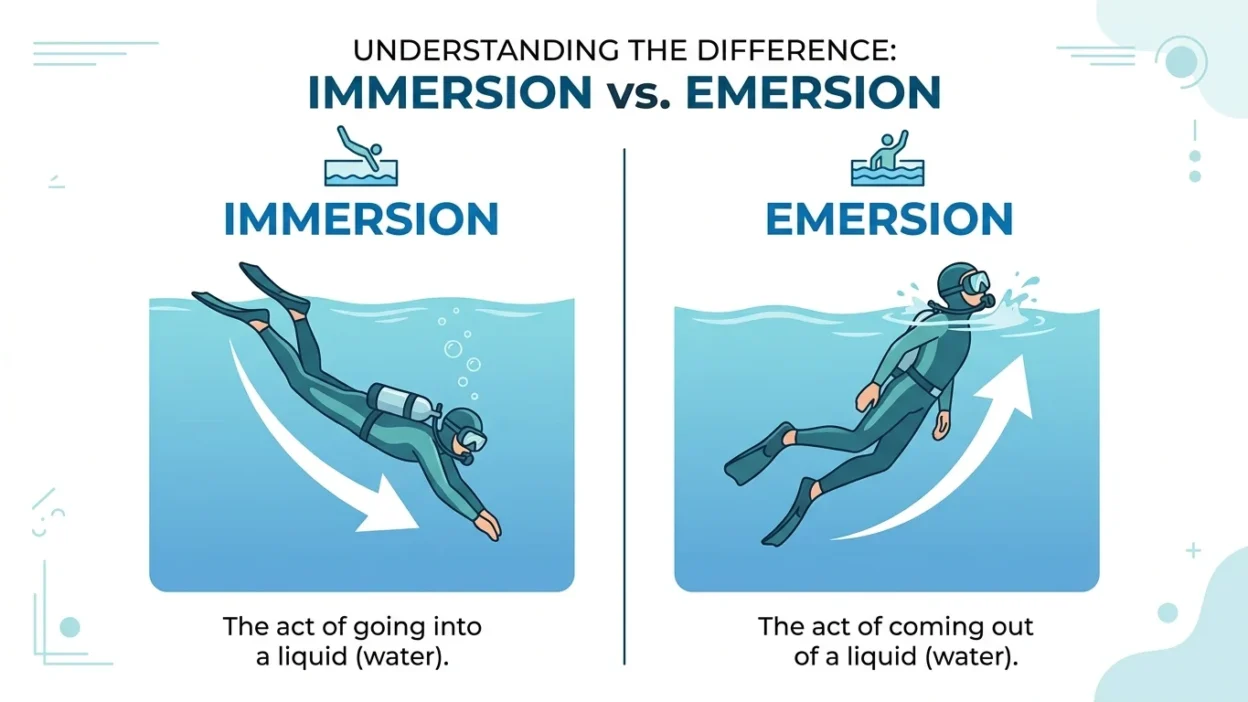
The main difference between emersion vs immersion is simple:
- Immersion means going into something, especially being completely surrounded or deeply involved.
- Emersion means coming out of something, especially emerging from water or another covering.
Think of it this way:
- Immersion = Going in
- Emersion = Coming out
Although immersion is very common in everyday English, emersion is mostly used in scientific, biological, medical, and technical contexts.
What Does Emersion vs Immersion Mean?
Understanding each word separately makes the difference much clearer.
What Is Immersion?
Immersion refers to placing something completely under a liquid or becoming fully involved in an activity, environment, or experience.
It can describe physical situations, learning methods, technology, culture, or emotional involvement.
Examples:
- She practiced Spanish through language immersion.
- The phone stopped working after complete water immersion.
- Virtual reality creates total immersion in digital environments.
- Living abroad provided cultural immersion.
The idea behind immersion is complete involvement or being surrounded.
What Is Emersion?
Emersion means emerging from a liquid or becoming exposed after being submerged. It is commonly used in biology, astronomy, medicine, and environmental sciences.
Examples:
- The turtle reached the surface after emersion.
- Scientists observed the plant during seasonal emersion.
- The diver’s emersion was carefully monitored.
- The island appeared after the tide, marking its emersion.
Unlike immersion, emersion usually focuses on the process of coming out or becoming visible.
Emersion vs Immersion Comparison Table
| Feature | Emersion | Immersion |
|---|---|---|
| Basic Meaning | Coming out | Going into |
| Direction | Upward or outward | Downward or inward |
| Everyday Usage | Rare | Very common |
| Common Fields | Biology, medicine, astronomy, ecology | Education, technology, culture, sports |
| Memory Trick | E = Exit | I = Into |
Examples of Immersion in Everyday Life
Immersion appears in many situations beyond simply entering water.
Examples include:
- Language immersion programs help students learn naturally.
- Reading a great novel creates complete immersion.
- Gamers enjoy total immersion through realistic graphics.
- Meditation encourages mental immersion in the present moment.
- Museums sometimes offer immersive experiences using sound and visuals.
Because the word has many figurative meanings, it appears frequently in conversations, articles, and educational materials.
Examples of Emersion in Real Life
Although less common, emersion remains important in specialized subjects.
Examples include:
- Marine animals experience emersion when tides recede.
- Certain plants survive both immersion and emersion.
- Doctors recorded the patient’s gradual emersion from therapeutic water.
- Astronomers use the term when a celestial object reappears after being hidden.
In scientific writing, precision matters, making emersion the correct choice whenever something emerges rather than submerges.
Common Mistakes People Make
Many English learners mix these words because they look and sound similar.
Here are the most common mistakes:
- Using immersion when describing something coming out of water.
- Using emersion to describe language learning.
- Assuming both words are interchangeable.
- Thinking emersion is simply the opposite spelling of immersion.
- Replacing immersion with emergence, even though they have different meanings.
Remember that context determines which word fits best.
Simple Memory Trick
A quick memory trick can help you remember forever.
- Immersion = Into
- Emersion = Exit
Notice how both Immersion and Into start with I.
Similarly, Emersion begins with E, just like Exit and Emerging.
This simple association makes choosing the correct word much easier.
When Should You Use Immersion?
Use immersion whenever someone or something becomes completely surrounded or deeply involved.
Common situations include:
- Language learning
- Cultural experiences
- Virtual reality
- Water submersion
- Scientific experiments
- Reading and storytelling
- Gaming
- Meditation
- Education
- Training programs
Immersion often carries both literal and figurative meanings.
When Should You Use Emersion?
Use emersion whenever something comes out of water or another covering.
Typical situations include:
- Marine biology
- Ecology
- Astronomy
- Diving
- Medical research
- Environmental science
- Tide studies
- Aquatic plants
- Geological observations
Outside scientific writing, most people rarely need this word.
American vs British English
The meanings of emersion and immersion are the same in both American English and British English.
However, there are small differences in frequency.
- Immersion is widely used in both American and British English, especially in education, technology, entertainment, and language learning.
- Emersion remains uncommon in everyday speech in both varieties and mostly appears in academic or scientific writing.
Therefore, regardless of whether you write for American or British audiences, the definitions stay the same.
Related Words and LSI Keywords
Using related vocabulary helps improve understanding while strengthening SEO naturally.
Related terms include:
- submersion
- emergence
- emerging
- exposure
- language immersion
- cultural immersion
- immersive learning
- immersive experience
- underwater
- surface
- aquatic environment
- marine biology
- scientific terminology
- vocabulary differences
- English usage
- word comparison
- grammar guide
- English vocabulary
- academic writing
- language learning
Tips for Remembering the Difference
Here are a few practical tips:
- Think Into = Immersion.
- Think Exit = Emersion.
- If someone is learning through total involvement, use immersion.
- If something is appearing after being underwater, use emersion.
- Ask yourself whether the movement is inward or outward before choosing the word.
These habits make correct usage almost automatic.
Frequently Asked Questions
What is the difference between emersion and immersion?
Immersion means going into or becoming completely surrounded, while emersion means coming out or emerging from a covering, especially water.
Is emersion the opposite of immersion?
In many physical situations, yes. Immersion describes entering, while emersion describes leaving or emerging.
Which word is more common?
Immersion is far more common in everyday English, education, technology, and culture. Emersion mainly appears in scientific and technical writing.
Can I use emersion for language learning?
No. Language learning always uses immersion, not emersion.
Is emersion a real English word?
Yes. Although uncommon, emersion is an accepted English word with established scientific and technical uses.
Do American and British English use these words differently?
No. Both varieties use the same meanings. The only difference is that emersion remains relatively rare in everyday communication.
What is cultural immersion?
Cultural immersion means fully experiencing another culture by participating in its language, traditions, customs, and daily life.
How can I remember the difference easily?
Remember this phrase:
Immersion goes In. Emersion Exits.
This simple trick works in nearly every situation.
Summary
Understanding emersion vs immersion becomes simple once you focus on direction. Immersion describes going into something or becoming completely involved, making it the preferred word for language learning, education, virtual reality, reading, and many everyday experiences. In contrast, emersion refers to coming out or emerging, especially in scientific, biological, medical, and environmental contexts.
Whenever you are unsure which word to choose, ask yourself one question: Is something going in or coming out? If it goes in, use immersion. If it comes out, use emersion. Keeping this straightforward rule in mind will help you write more accurately, communicate more confidently, and avoid one of the most common vocabulary mix-ups in English.

Cedric Halewood is known for his intricate historical narratives.
His work reflects a deep fascination with lost civilizations.
He lives near the coast, where he finds inspiration in the sea.