
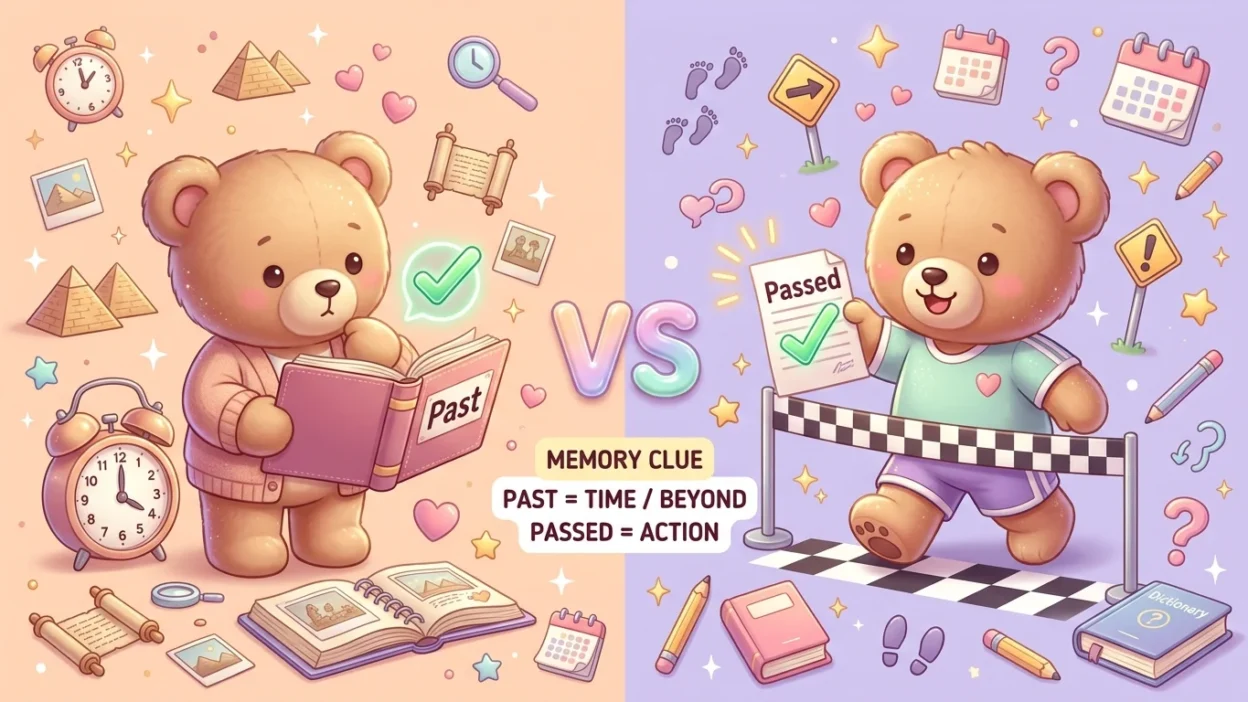
Have you ever confused past vs passed? These two words sound very similar, but they have different meanings and grammatical roles. Past can refer to time, position, or something that has already happened, while passed is usually the past tense or past participle of the verb pass.
In this guide, you’ll learn the difference between past and passed, their meanings, examples, common mistakes, grammar rules, American and British English usage, FAQs, and an easy memory trick.
Quick Answer
- Past ✅ = refers to time, something that has already happened, or movement beyond a point.
- Passed ✅ = the past tense or past participle of pass.
Examples:
- We talked about the past. ✅
- She passed the exam. ✅
- He walked past the store. ✅
- He passed the store. ✅
The easiest rule is:
Past = time, position, or beyond
Passed = an action
What Does Past Mean?
Past can function as a noun, adjective, preposition, or adverb.
It generally refers to something that happened before now.
Examples:
- I don’t like talking about the past.
- She learned from her past mistakes.
- In the past, people traveled differently.
- We walked past the house.
- It’s half past five.
Past as a Noun
As a noun, past refers to a time that has already happened.
Examples:
- We cannot change the past.
- His past is complicated.
- She learned from her past.
- Let’s leave the past behind.
Past as an Adjective
Past can describe something that happened previously.
Examples:
- Past experiences can teach valuable lessons.
- Several past presidents attended the event.
- I remember our past conversations.
Past as a Preposition
Past can indicate movement beyond something.
Examples:
- She walked past the store.
- We drove past the school.
- He ran past me.
- The car went past the house.
Past as an Adverb
Past can describe movement beyond a particular point.
Example:
- The car drove past quickly.
What Does Passed Mean?
Passed is the past tense and past participle of the verb pass.
It describes an action that has already happened.
Examples:
- She passed the exam.
- He passed the ball.
- They passed the building.
- The car passed us.
- Time passed quickly.
Think of:
Pass → Passed
Past vs Passed Comparison Table
| Word | Part of Speech | Main Meaning | Example |
|---|---|---|---|
| Past | Noun, adjective, preposition, adverb | Earlier time or beyond a point | We walked past the house. |
| Passed | Verb | Completed the action of passing | She passed the house. |
Why Are Past and Passed Confused?
The main reason is pronunciation.
In most varieties of English, past and passed sound very similar or identical.
However, their grammatical roles are different.
Compare:
- Past = a time, position, or direction
- Passed = an action
This distinction helps you choose the correct spelling.
Past vs Passed for Time
When talking about time that has already happened, use past.
Examples:
- The past few days have been busy.
- We discussed the past.
- She lives in the past.
- In the past, things were different.
- He has learned from his past.
Do not use passed when you simply mean previous time.
Incorrect:
- ❌ In the passed, people used candles.
Correct:
- ✅ In the past, people used candles.
Passed as an Action
Use passed when someone or something performs the action of passing.
Examples:
- She passed the exam.
- He passed the ball.
- The car passed me.
- They passed the finish line.
- The teacher passed out the papers.
Here, passed describes something that happened.
Past vs Passed a Place
This is one of the most confusing situations.
Both can appear with places, but they work differently.
Walked Past
Past can be a preposition meaning beyond.
- We walked past the school.
Here, past describes where we walked.
Passed
Passed is the verb.
- We passed the school.
Here, passed means we went beyond the school.
Both sentences can describe a similar event.
The grammatical structure is different:
- We walked past the school.
- We passed the school.
Past vs Passed an Exam
When talking about successfully completing an exam, use passed.
Correct:
- ✅ She passed the exam.
- ✅ He passed his driving test.
Incorrect:
- ❌ She past the exam.
Why?
Because passed is the verb pass in the past tense.
Past vs Passed Time
Both words can appear when talking about time, but they have different functions.
Time Passed
Use passed as a verb.
- Time passed quickly.
- Several hours passed.
- The years passed.
Here, something is performing the action of passing.
The Past
Use past as a noun or adjective.
- We remember the past.
- Past events can teach us lessons.
Compare:
- Time passed quickly.
- We cannot change the past.
Past vs Passed Away
The correct expression is:
passed away ✅
Example:
- Her grandfather passed away peacefully.
Do not write:
- ❌ Her grandfather past away.
Passed away is a euphemistic expression meaning died.
Past vs Passed By
Both forms can be correct depending on the sentence.
Passed By
Passed by is a verb phrase.
- She passed by my house.
- Time passed by quickly.
- He passed by without saying anything.
Past
Past can be used as a preposition.
- She walked past my house.
- He drove past the restaurant.
Compare:
- She passed by my house.
- She walked past my house.
Both can be correct.
Past vs Passed in Common Phrases
Common phrases with Past
- the past
- in the past
- the past few days
- past experiences
- past mistakes
- half past three
- walk past something
- go past something
Common phrases with Passed
- passed the exam
- passed the test
- passed the ball
- passed the car
- passed away
- passed by
- time passed
- passed the finish line
Common Mistakes People Make
Mistake 1: Writing Past Instead of Passed
Incorrect:
- ❌ She past the exam.
Correct:
- ✅ She passed the exam.
Mistake 2: Writing Passed Instead of Past
Incorrect:
- ❌ In the passed, we used to live there.
Correct:
- ✅ In the past, we used to live there.
Mistake 3: Writing Past Away
Incorrect:
- ❌ He past away last year.
Correct:
- ✅ He passed away last year.
Mistake 4: Confusing Past and Passed With Movement
Incorrect:
- ❌ We walked passed the store.
Correct:
- ✅ We walked past the store.
But:
- ✅ We passed the store.
The key is that past follows the verb walked, while passed itself is the verb.
Simple Memory Trick
💡 Memory Trick
Spelling Box
PAST = TIME OR BEYOND ⏰
PASSED = ACTION 🚶
Think:
The past is time.
Passed is something you did.
Examples:
In the past → time
She passed the test → action
He walked past the house → beyond
Past vs Passed in Questions
Past
- What happened in the past?
- Have you learned from your past?
- Did you walk past the store?
Passed
- Did you pass the exam?
- She passed the test, didn’t she?
- Has he passed the car?
Notice that past can refer to time or position, while passed describes an action.
Past vs Passed in Formal Writing
Both words are standard English and are used in formal writing.
The important thing is to choose the form based on meaning.
Examples:
- The company has learned from its past mistakes.
- The proposal passed the committee.
- Several years have passed since the event.
- The researchers walked past the building.
American vs British English
There is no significant spelling difference between American and British English for past and passed.
Both varieties use:
- past = earlier time, previous, or beyond
- passed = past tense of pass
The same grammar rules apply.
When Should You Use Past?
Use past when referring to:
- Previous time
- Earlier events
- History
- Something beyond a point
- Time on a clock
Examples:
- The past is behind us.
- I learned from my past.
- We walked past the library.
- It’s ten past four.
Ask yourself:
“Am I talking about time, history, or something beyond a point?”
If yes, past may be correct.
When Should You Use Passed?
Use passed when you need the past tense or past participle of pass.
Examples:
- She passed the exam.
- He passed the ball.
- The car passed us.
- Time passed quickly.
- They passed the finish line.
Ask yourself:
“Is someone or something performing the action of passing?”
If yes, use passed.
Related Words and LSI Keywords
- past meaning
- passed meaning
- past vs passed
- passed vs past
- past definition
- passed definition
- past tense of pass
- past time
- passed the exam
- past away vs passed away
- passed away
- walked past
- passed by
- time passed
- in the past
- English grammar
- English spelling
- commonly confused words
- common spelling mistakes
- correct English usage
- vocabulary
- grammar guide
Tips for Remembering the Difference
- Past relates to time or something beyond a point.
- Passed is the past tense of pass.
- You passed an exam.
- You walked past a building.
- Time passed quickly.
- The past cannot be changed.
- Passed away is correct.
- Past away is incorrect.
- Past can be a noun, adjective, preposition, or adverb.
- Passed functions as a verb form.
Frequently Asked Questions
What is the difference between past and passed?
Past refers to earlier time, previous events, or something beyond a point. Passed is the past tense and past participle of the verb pass.
Is it past or passed the test?
The correct phrase is passed the test.
Example:
- She passed the test.
Is it past or passed away?
The correct expression is passed away.
Example:
- His grandfather passed away last year.
Is it walked past or walked passed?
The correct phrase is walked past.
Example:
- We walked past the store.
Is it time past or time passed?
Usually, time passed is correct when describing the action.
Example:
- Time passed quickly.
Is “in the passed” correct?
No. The correct expression is in the past.
Example:
- In the past, people communicated differently.
Is “past” a verb?
Usually, past is a noun, adjective, preposition, or adverb. Passed is the verb form of pass.
Is passed a verb?
Yes. Passed is the past tense and past participle of pass.
Can past and passed be used in the same sentence?
Yes.
Example:
- We passed the old building we had visited in the past.
What is an easy way to remember past vs passed?
Remember: PAST = TIME OR BEYOND, while PASSED = ACTION. You passed the exam, but you walked past the school.
Is there an American and British difference?
No. American and British English use past and passed with the same meanings and spellings.
Summary
The difference between past vs passed becomes simple when you focus on their grammatical roles. Past refers to earlier time, previous events, or something beyond a particular point. Passed is the past tense or past participle of pass and describes an action.
Remember the easy rule: past = time or beyond; passed = action. You can talk about the past, walk past a building, or say that time passed quickly. If someone successfully completes an exam, they passed it. Once you understand this distinction, choosing between past and passed becomes much easier.

Rowan Blythecroft crafts atmospheric fiction filled with mystery and folklore.
Her stories often blur the line between reality and imagination.
She spends most of her days wandering forests and writing by candlelight.