
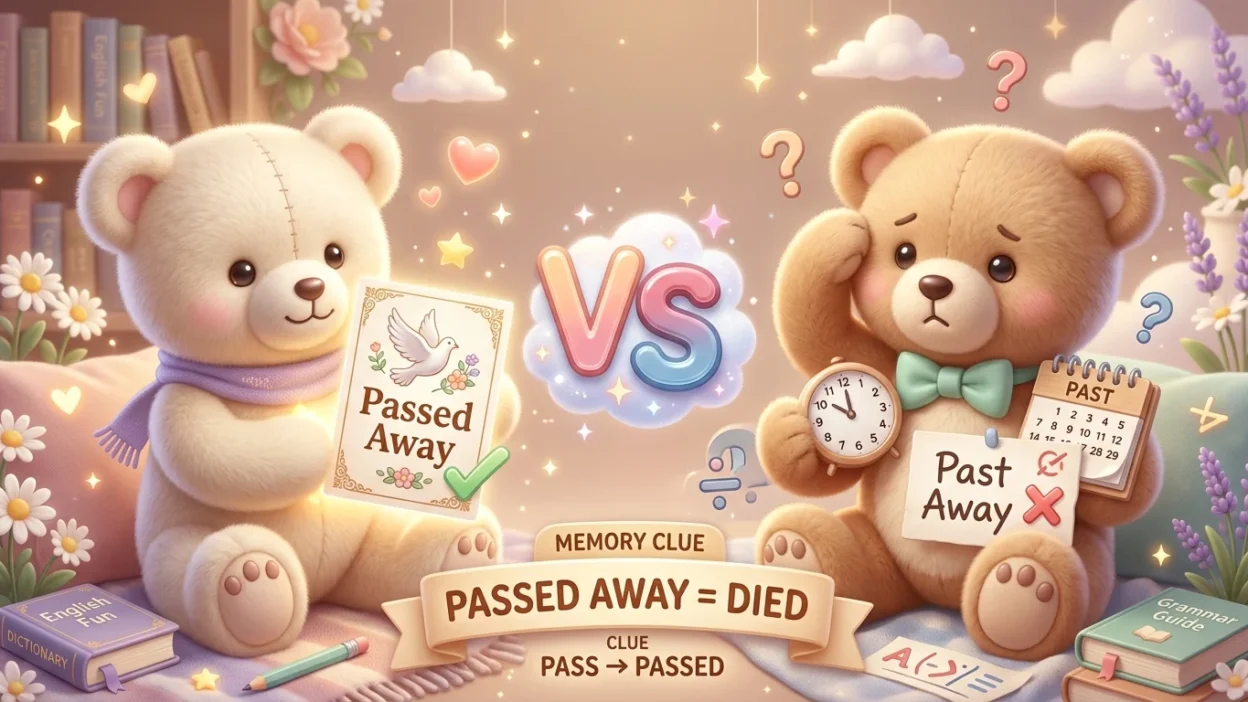
Have you ever wondered whether passed away vs past away is correct? This is a very common spelling mistake because passed and past sound alike in many contexts. However, when you’re talking about someone who has died, the correct expression is passed away.
In this guide, you’ll learn the difference between passed away and past away, their meanings, examples, common mistakes, grammar rules, American and British English usage, FAQs, and an easy memory trick.
Quick Answer
- Passed away ✅ = a polite expression meaning died.
- Past away ❌ = incorrect when you mean that someone died.
Examples:
- Her grandfather passed away last year. ✅
- Her grandfather past away last year. ❌
The easiest rule is:
Passed away = died
Past away = incorrect
What Does Passed Away Mean?
Passed away is a common and polite expression meaning that someone died.
It is often used when people want to discuss death in a softer or more respectful way.
Examples:
- My uncle passed away last year.
- Her grandmother passed away peacefully.
- His father passed away at the age of 80.
- Their beloved dog passed away recently.
- We were saddened to hear that she passed away.
The expression is known as a euphemism, which means it uses a gentler expression instead of a more direct one.
For example:
- He died. → direct
- He passed away. → softer and more respectful
What Does Past Away Mean?
Past away is not the standard English expression for death.
When you mean that someone died, writing past away is a spelling mistake.
Incorrect:
- ❌ My grandfather past away yesterday.
Correct:
- ✅ My grandfather passed away yesterday.
The confusion happens because past and passed can sound very similar.
Passed Away vs Past Away Comparison Table
| Phrase | Correct? | Meaning | Example |
|---|---|---|---|
| Passed away | ✅ Yes | Died | Her father passed away peacefully. |
| Past away | ❌ No | Incorrect expression | ❌ Her father past away peacefully. |
Why Is Passed Away Correct?
The phrase comes from the verb pass.
Passed is the past tense and past participle of pass.
The expression pass away developed as a polite way of referring to death, suggesting that a person has moved from life to death.
Therefore:
- Present: pass away
- Past: passed away
Examples:
- Sadly, he may pass away soon.
- Sadly, he passed away last night.
- She has passed away.
The spelling remains passed with -ed.
Why Do People Write Past Away?
The mistake happens because past and passed sound similar.
People may also associate past with the idea of something being over or finished.
However, the expression itself is:
pass away → passed away
Not:
past away
Think of passed away as a verb phrase rather than a phrase involving the word past.
Passed Away Examples in Sentences
Here are some correct examples:
- My grandfather passed away peacefully.
- Her mother passed away last winter.
- His uncle passed away after a long illness.
- We were heartbroken when our dog passed away.
- She passed away surrounded by her family.
- His friend passed away unexpectedly.
- The actor passed away at the age of 75.
- They announced that the former leader had passed away.
- I still remember my grandmother, who passed away several years ago.
- We were sorry to hear that your father passed away.
Passed Away vs Died
Both expressions communicate the same basic event, but their tone differs.
Died
Died is direct and neutral.
Example:
- His father died in 2024.
Passed Away
Passed away is softer and often more compassionate.
Example:
- His father passed away in 2024.
The choice depends on context, audience, and tone.
In condolences and sensitive conversations, passed away is often preferred.
Passed Away in Condolences
Passed away is frequently used in sympathy messages.
Examples:
- I’m sorry to hear that your mother passed away.
- My condolences for the loss of your father.
- I’m deeply sorry that your grandmother passed away.
- We were saddened to hear that he passed away.
- May you find comfort during this difficult time.
The phrase can sound more gentle than simply saying died.
Passed Away vs Passed On
Passed on can sometimes be used as another euphemism for death, although passed away is more common and widely understood.
Examples:
- She passed away peacefully.
- He passed on many years ago.
However, passed on can have other meanings, such as transferring information or declining an opportunity, so passed away is clearer when referring to death.
Passed Away vs Past
It’s helpful to understand the difference between past and passed.
Past
Past can refer to:
- Earlier time
- Previous events
- Something beyond a point
- A position or direction
Examples:
- We talked about the past.
- He walked past the house.
- In the past, things were different.
Passed
Passed is the past tense of pass.
Examples:
- She passed the exam.
- He passed the store.
- Time passed quickly.
- His grandfather passed away.
So remember:
Past = time or beyond
Passed = an action
Common Mistakes People Make
Mistake 1: Writing Past Away
Incorrect:
- ❌ My aunt past away last year.
Correct:
- ✅ My aunt passed away last year.
Mistake 2: Writing Past Away in Condolences
Incorrect:
- ❌ I’m sorry to hear that your father past away.
Correct:
- ✅ I’m sorry to hear that your father passed away.
Mistake 3: Using Past as the Verb
Past is not the past-tense form of pass.
Incorrect:
- ❌ She past the exam.
Correct:
- ✅ She passed the exam.
The same rule applies to passed away.
Mistake 4: Thinking “Past” Means Something Is Over
Although past can refer to something that has already happened, it does not replace passed in the expression passed away.
Simple Memory Trick
💡 Memory Trick
Spelling Box
PASSED AWAY = DIED 🕊️
Think:
PASS → PASSED
So:
PASS AWAY → PASSED AWAY
Never write past away when referring to death.
Remember:
Passed = action
Past = time or beyond
Passed Away in Formal Writing
Passed away is acceptable in many forms of writing, including:
- Sympathy messages
- Obituaries
- Personal letters
- News reports
- Social media announcements
- Conversations
- Memorial writing
However, some professional or medical contexts may use more direct language such as died or death for precision.
For example:
- The patient died at 8:30 p.m.
is more direct and clinical than:
- The patient passed away at 8:30 p.m.
The choice depends on the tone and purpose of the writing.
American vs British English
There is no significant difference between American and British English in the spelling of this expression.
Both use:
- passed away ✅
- past away ❌
The expression is widely understood in both varieties of English.
When Should You Use Passed Away?
Use passed away when you want to politely or gently say that someone or an animal has died.
Examples:
- She passed away peacefully.
- His father passed away last year.
- My beloved dog passed away recently.
- We were saddened to learn that he passed away.
It is especially common in sensitive conversations about death and condolences.
When Should You Use Past Away?
You should not use past away when referring to death.
Instead, use:
passed away
Incorrect:
- ❌ He past away yesterday.
Correct:
- ✅ He passed away yesterday.
Related Words and LSI Keywords
- passed away meaning
- past away meaning
- passed away vs past away
- past away vs passed away
- passed away spelling
- past away spelling
- passed away definition
- passed away correctly
- passed away meaning in English
- died vs passed away
- pass away
- passed on
- death euphemism
- condolences
- sympathy message
- common spelling mistakes
- commonly confused words
- English grammar
- English spelling
- correct English usage
- vocabulary
- grammar guide
Tips for Remembering the Difference
- Passed away is the correct expression for death.
- Past away is incorrect.
- Passed comes from the verb pass.
- The expression is pass away → passed away.
- Use passed away in many sensitive or compassionate conversations.
- Past usually refers to earlier time or something beyond a point.
- Remember: PASSED AWAY = DIED.
- If you’re talking about death, choose passed away, not past away.
Frequently Asked Questions
Is it passed away or past away?
The correct expression is passed away.
Example:
- Her grandfather passed away last year.
Is past away correct?
No. Past away is a common spelling mistake. When you mean that someone died, use passed away.
What does passed away mean?
Passed away is a polite expression meaning died.
Why do people say past away?
People often confuse past and passed because they sound very similar. However, the correct verb form in pass away is passed.
Is “he past away” correct?
No. The correct sentence is:
- He passed away.
Is “she passed away” grammatically correct?
Yes. She passed away is grammatically correct and means she died.
Is passed away formal English?
Yes. Passed away is standard English and is widely used in respectful or sensitive contexts. In clinical or highly precise contexts, died may be preferred.
Is passed away a euphemism?
Yes. Passed away is commonly described as a euphemism for died. It provides a softer and more gentle way to refer to death.
Can I say passed away for a pet?
Yes. Many people use passed away when referring to a beloved pet that has died.
Example:
- Our dog passed away peacefully last night.
Is passed away used in American English?
Yes. Passed away is commonly used in American English.
Is passed away used in British English?
Yes. Passed away is also commonly used in British English.
What is the difference between past and passed?
Past usually refers to earlier time or something beyond a point. Passed is the past tense of pass and describes an action.
What is an easy way to remember passed away vs past away?
Remember PASS → PASSED, so PASS AWAY → PASSED AWAY. If you mean someone died, always use passed away.
Summary
The difference between passed away vs past away is simple: passed away is the correct standard expression meaning died, while past away is a common spelling mistake. The word passed comes from the verb pass, so the correct phrase follows the pattern pass away → passed away.
Whenever you’re talking about someone’s death, remember PASSED AWAY = DIED. Although past and passed can sound alike, past relates to earlier time or something beyond a point, while passed describes an action. So write “He passed away,” not “He past away.”

Cedric Halewood is known for his intricate historical narratives.
His work reflects a deep fascination with lost civilizations.
He lives near the coast, where he finds inspiration in the sea.